30 Cents vs $27: Open-Source Models Face Off in Coding, With DeepSeek Leading at 100x Cost-Efficiency

Building the same CRM cost $27.69 with Fable 5 but just 30 cents with DeepSeek V4 Flash—a 100x gap.
A hands-on test pit top model Fable 5 against DeepSeek V4 Flash, GLM 5.2, Qwen 3.6, and more on building a sales CRM from scratch. Costs ranged from $27.69 to just 30 cents. The article breaks down each model's coding capability and cost-efficiency to help you pick the right AI coding tool.
A Stark Battle Between Price and Performance
As the capabilities of open-source large language models improve at breakneck speed, an increasingly practical question confronts developers: How much can you actually save by using the cheapest open-source models for coding tasks, and how good will the results be?
An overseas blogger recently conducted a highly instructive hands-on test, pitting Fable 5—widely regarded as the most powerful model available—against DeepSeek V4 Flash, arguably the "cheapest frontier" model, on the same task. They also brought in Opus 4.8, GPT 5.5 (Codex), Sonnet 5, GLM 5.2, and Qwen 3.6 as points of comparison.
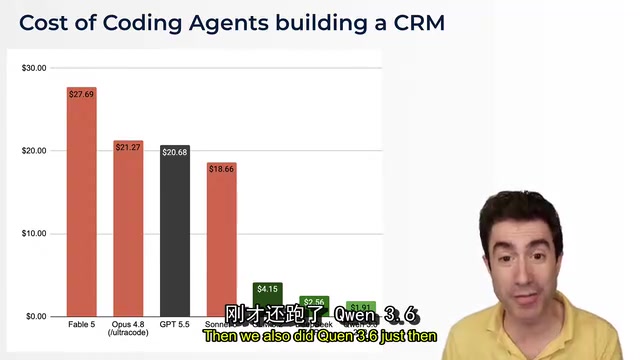
The results were stunning—to complete the same project, Fable 5 cost $27.69, while DeepSeek V4 Flash required just 30 cents, a price gap of nearly 100x. Behind that number lies a profound transformation unfolding in the open-source model ecosystem.
The Open-Source vs. Closed-Source Backdrop: Open-source large language models refer to models whose weights (model parameters) are publicly released, allowing developers to freely download and deploy them. Unlike the closed-source approach of companies like OpenAI and Anthropic, which package their models as API services, the open-source route was ignited by Meta's LLaMA series. It was subsequently joined by Chinese teams' DeepSeek, Alibaba's Qwen, Zhipu's GLM, and others, forming a complete ecosystem that can be deployed locally or accessed cheaply through third-party inference platforms. The cost advantage of open-source models comes from two levels: first, inference providers (such as OpenRouter and Together AI) drive down the per-token price through large-scale GPU clusters; second, some models can be quantized and run locally on consumer-grade hardware, bringing the marginal cost close to zero.
A Unified Real-World Task: Building a Sales CRM from Scratch
To ensure fairness, the blogger gave every model an identical task: based on a single agents.md business requirements document, build a fully functional sales CRM system, akin to a simplified version of Salesforce or Pipedrive.
The system needed to cover a dashboard, organization management, contacts, deal records, and a drag-and-drop sales pipeline. The blogger used the lightweight coding agent tool Pi to drive each open-source model, equipping it with browser skills so the models could test their own results during the coding process. The closed-source models Fable 5 and GPT 5.5 ran in Claude Code and Codex, respectively.
Why choose a CRM as the evaluation task? A sales CRM system covers nearly all the core technical challenges of a typical web application: relational data modeling (the many-to-many relationships among organizations, contacts, and deals), state management (real-time updates of pipeline stages), drag-and-drop interaction (involving the correct integration of the browser's native Drag and Drop API or third-party libraries), data visualization (dashboard charts), and the complete CRUD operation loop. This kind of "end-to-end application construction" task is gradually becoming the new industry standard for evaluating coding agent capabilities. It is far closer to real engineering scenarios than traditional code-generation benchmarks like HumanEval, and more genuinely tests a model's system design capability and cross-file code organization ability.
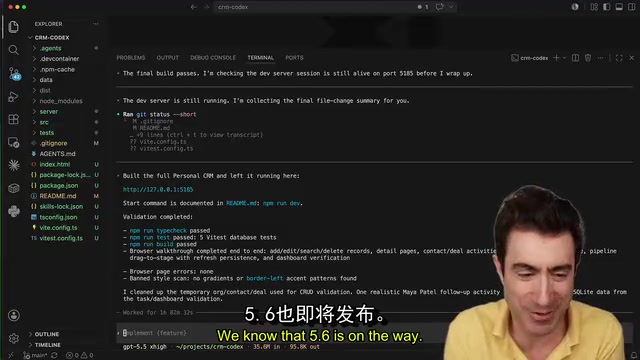
The time each model took also varied significantly: Fable 5 ran for 36 minutes, GPT 5.5 took as long as 1 hour and 2 minutes, while DeepSeek V4 Flash completed the entire task in just about 15 minutes.
Closed-Source Model Performance: The Flagship Tier Pulls Ahead
Fable 5: The Quality Ceiling
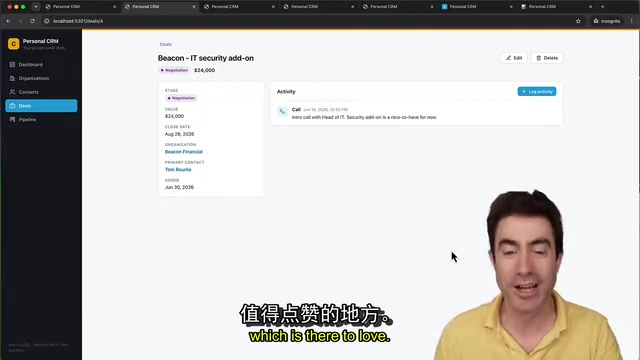
As the model with the strongest overall capability currently available, Fable 5's output truly lives up to its reputation. The dashboard clearly displays the core data of the sales pipeline, the organization and contact pages feature refined badges and tags, the drag-and-drop pipeline operations are smooth, and the total amount at the top updates in real time. The whole thing exudes a highly professional product quality.
Opus 4.8 and GPT 5.5: Each With Its Own Strengths
With Ultra Code mode enabled, Opus 4.8 produced results extremely close to Fable 5's, and some details—like the dashed-line connection effects—were even more impressive. The interface generated by GPT 5.5 via Codex had a distinctly different style, adorned with small icons, and its feature completeness was solid, but the blogger felt the overall look was a bit "amateurish."
What are Ultra Code mode and multi-agent collaboration workflows? Ultra Code mode introduces a Multi-Agent Workflow: one "main agent" is responsible for generating code, while an "Adversarial Agent" plays the role of a picky reviewer, critiquing and testing the output. This architecture borrows from the ideas of Code Review and Red Teaming in software engineering, and can significantly improve the final code quality within a single task. Unlike directly calling a chat interface, coding agent tools (such as Pi, Claude Code, and Codex) automatically break a large task into multiple sub-steps, generating code, executing it, reading error messages, and feeding them back to the model for correction at each step, forming a closed-loop iteration. The trade-off of Ultra Code mode is that it consumes more tokens, raising costs accordingly, but for delivery scenarios that demand ultimate quality, this extra expense is usually worthwhile.
Open-Source Model Testing: A Cliff-Edge Leap in Cost-Efficiency
The real highlight lies on the open-source side.
GLM 5.2: The Best Overall Value
GLM 5.2 from z.ai delivered an eye-catching performance: beautifully designed charts with clear labels, complete features including lists, organizations, contacts, and deals, and a drag-and-drop pipeline that—while lacking highlight effects—was fully usable. The cost was just $4.15—a cliff-edge drop compared to Fable 5, yet it still delivered a remarkably professional result. This also explains why the open-source community holds it in such high regard.
Qwen 3.6: The Potential and Limitations of Local Deployment
The 27B version of Qwen 3.6 was the only model in this test that could potentially run locally on a personal computer (with 32GB of RAM or more). The blogger accessed it via OpenRouter at a cost of just $1.91. Its icon design was a notable highlight, but during drag-and-drop testing it encountered a serious bug—the data couldn't update, and the server subsequently crashed.
Model Quantization: The Technical Key to Local Execution: Qwen 3.6 27B's ability to run on consumer-grade devices is thanks to model Quantization technology. Quantization refers to compressing model parameters from high-precision floating-point numbers (such as FP16, 2 bytes per parameter) into low-precision integers (such as INT4, about 0.5 bytes per parameter), thereby reducing VRAM/RAM usage to a quarter or even less, at the cost of a slight loss in precision. A 27B-parameter model at FP16 precision requires about 54GB of VRAM; quantized to INT4, it drops to about 14GB, and with runtime overhead, 32GB of unified memory (such as Apple's M-series chips) can basically handle it. The core appeal of local deployment is that once the model download is complete, the cost of each subsequent inference is merely electricity. For high-frequency usage scenarios, the long-term total cost of ownership (TCO) may be far lower than the pay-per-use API model.
This shows that local small models still need multiple rounds of iterative refinement, but for developers willing to accept repeated debugging, local execution with nearly zero marginal cost (just electricity) remains highly appealing.
DeepSeek V4 Flash: The Genuine Shock of 30 Cents
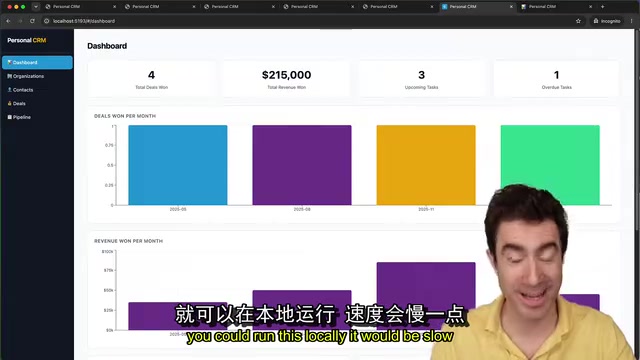
Saved for last, DeepSeek V4 Flash completed the entire project at a cost of just 30 cents, nearly 100 times cheaper than Fable 5. More importantly, the result was fully usable: the dashboard featured activity and task cards, the organization, contact, and deal pages had complete functionality, the tag styling was attractive, and the most critical drag-and-drop sales pipeline not only operated normally but also updated the total in real time.
The edit and delete buttons were somewhat crude, and the dashboard wasn't exactly fancy, but for a project generated in 15 minutes at a cost of just 30 cents to reach this level of completeness is nothing short of astonishing. This is also strong evidence for why DeepSeek V4 Flash currently sits firmly atop OpenRouter's coding model rankings.
OpenRouter and the Rise of the Inference Marketplace: OpenRouter is a model inference aggregation platform where developers need only a single API Key to call hundreds of different open-source and closed-source models on demand, with the platform automatically routing requests to the optimal inference provider in the background. This model is similar to a "compute supermarket" of the cloud computing era, allowing developers to flexibly switch between models and pay by actual usage without building their own GPU infrastructure. OpenRouter also provides real-time model leaderboards (ranked by dimensions such as usage and performance), and DeepSeek V4 Flash's long-standing dominance atop the coding task rankings is validated by real user data from the platform, giving it high reference value. For small and medium-sized teams and independent developers, OpenRouter dramatically lowers the barrier to evaluating and switching between multiple models.
Selection Guide: Three Clear Paths
Drawing on this hands-on test, the blogger offered three clear selection recommendations:
- For ultimate quality: Choose Fable 5. It produces the most professional results, at the cost of roughly $27 per run—suitable for external delivery or high-demand scenarios.
- For extremely low cost: Choose DeepSeek V4 Flash. It's fast, extremely cheap, and its product completeness is surprisingly good—making it the top choice for rapid prototyping.
- For a balance of cost and quality: GLM 5.2 is the best compromise between the two, with an affordable price and excellent result quality, suitable for most medium-sized projects.
Open Source Is Reshaping the Economics of AI Coding
The most profound takeaway from this test may not be which model is the strongest, but rather that the relationship between performance and cost is being completely rewritten. From $27 to 30 cents, this isn't just a price difference—it's a paradigm shift.
For the vast majority of small and medium-sized development tasks, DeepSeek V4 Flash and GLM 5.2 can already deliver "good enough" results. As locally deployable models like Qwen continue to iterate, "zero marginal cost" AI coding may accelerate toward becoming reality. The rise of open-source large language models is making high-quality AI-assisted coding more accessible than ever—when the cost of generating a complete, usable CRM system is less than a cup of coffee, the barrier to AI-assisted development is no longer cost, but the developer's own engineering judgment and task-decomposition skills.
Key Takeaways
Related articles

The Truth Behind Codex 'Build a Website in 5 Minutes': AI Isn't Creating Sites—It's Helping You Copy Them
Exposing the truth behind viral Codex 5-minute website videos: creators aren't building original sites with AI—they're copying shared prompts or scraping others' work. Learn AI coding tools' real limits.

Getting Started with AI Agent Development: A Complete Guide from Concept to Practice
A comprehensive guide to AI Agent architecture and development, covering automated marketing, intelligent customer service, and investment analysis scenarios with single and multi-agent collaboration.

The Truth Behind Codex 'Build a Website in 5 Minutes': AI Isn't Creating Sites — It's Helping You Copy Them
Exposing the truth behind viral Codex 5-minute website videos: creators aren't building original sites with AI — they're copying shared prompts or scraping others' work.