4 Core Competencies Every High-Value LLM Application Engineer Must Have
The 4 must-have skills that separate high-value LLM engineers from the crowd.
Despite a surge of AI learners, companies still struggle to hire qualified engineers. This article breaks down the four core competencies that define truly valuable LLM application developers: task decomposition, tool calling design, evaluation and observability, and production environment readiness — and shows how to build a complete, job-ready skill set.
The AI Industry Paradox: Flooded with Learners, Yet Starved for Talent
The AI field is playing out a fascinating contradiction: on one side, a massive wave of learners diving deep into hot topics like Agents, RAG, and MCP; on the other, companies sitting on hundreds of thousands in budget with no suitable candidates in sight.
Technical Background: An Agent refers to an AI system capable of autonomously perceiving its environment, planning, and executing multi-step tasks. RAG (Retrieval-Augmented Generation) combines external knowledge base retrieval with LLM generation capabilities — an architecture that effectively reduces model hallucination. MCP (Model Context Protocol) is an open protocol introduced by Anthropic in late 2024 to standardize how LLMs interact with external tools and data sources. Together, these three form the core technical stack of modern LLM application development and dominate the current learning community discourse.
This supply-demand mismatch is no accident. It exposes a truth most people overlook — the market doesn't need people who can recite concepts; it needs engineers who can turn messy business problems into real products. Many people spend six months learning AI, watch countless tutorials, and bookmark stacks of resources, yet still can't land projects or jobs. The root cause: they never built a complete, cohesive skill set.
This article draws on the experience of a Bilibili content creator with two years of hands-on AI product and application development, breaking down the four core competencies that define a truly high-value LLM application engineer.
Competency 1: Task Decomposition — From Business Problem to Technical Solution
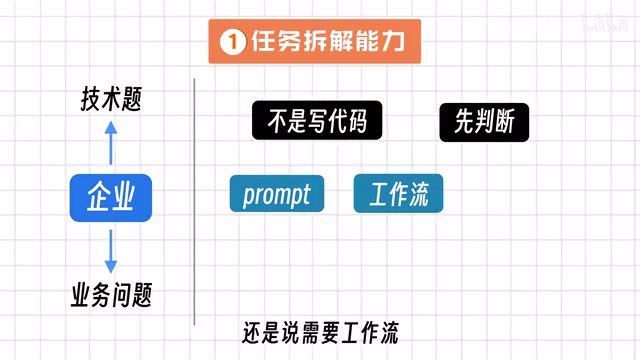
What companies hand you is never a clean, well-defined technical problem. It's a pile of messy, ambiguous business challenges. When a real expert receives a requirement, the first instinct isn't to open an editor and start coding — it's to assess and decompose.
Evaluating Problem Complexity
When facing a requirement, you need to quickly gauge which tier it falls into:
- Can a single Prompt solve it directly?
- Does it require a fully designed workflow?
- Or does it need multi-Agent coordination to complete?
These three tiers represent fundamentally different engineering approaches: Prompt engineering is the lightest-weight solution, suited for single-turn, high-certainty tasks; Workflow breaks complex tasks into ordered steps and automates the flow using orchestration frameworks like LangChain or Dify — ideal for medium-complexity business scenarios; Multi-Agent coordination organizes agents with distinct roles (e.g., a planning agent, execution agent, and validation agent) into a collaborative network, suited for high-complexity scenarios requiring parallel processing, cross-validation, or cross-domain decision-making. Choosing the wrong tier leads to either over-engineering or under-powering — both are costly mistakes in real projects.
Beyond identifying the right technical path, you also need to pinpoint critical checkpoints in the process: which steps can be handed off to automated execution, and which must retain human review. No amount of framework knowledge can compensate for an inability to decompose business requirements. This is the foundation for everything that follows — and the first dividing line between a "technical executor" and a "solution designer."
Competency 2: Tool Calling — The Make-or-Break of Agent Deployment
Many people blame poor agent performance on "the model not being strong enough." But in reality, most project failures trace back not to the model, but to poorly designed tools.
Tool calling (Function Calling / Tool Use) is the core mechanism for deploying LLM applications in production. When a model determines it needs an external capability for the current task — such as querying a database, calling an API, or executing code — it generates a structured tool call request. The host system executes the call and returns the result for the model to continue processing. The quality of tool design directly impacts agent reliability: vague tool descriptions lead to model misuse; tools lacking error handling cause cascading failures across the entire pipeline; improper permission boundaries create security risks that can be exploited to trigger actions beyond the model's authorized scope.
Four Key Dimensions of Tool Design
An agent that truly works in production must handle the following dimensions at the tool layer:
- Permission Control: Which resources can the tool access, and where are the boundaries?
- Error Handling: How does the system respond to call failures, timeouts, or error returns?
- Context Management: How is information kept coherent and accurate across multi-turn interactions?
- Tool Orchestration: How do multiple tools collaborate in an orderly, on-demand fashion?
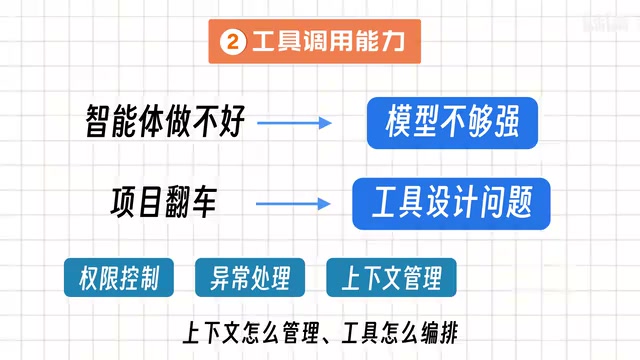
These seemingly tedious engineering details are precisely what determines whether your agent is a system that runs reliably in production — or a "toy" that dazzles in demos but crashes on launch day. Tool calling ability is fundamentally the bridge that converts AI capability into dependable service.
Competency 3: Evaluation and Observability — Ignored by 90% of Learners
This is the competency most easily overlooked by learners, yet the one that creates the widest professional gap.
Moving Beyond "Feels Pretty Good" Testing
Many people evaluate their agent's effectiveness with a single sentence: "Feels pretty good." But that subjective "feeling" is exactly what companies fear most — quality assessments without quantitative metrics or trace-level visibility are meaningless in production environments.
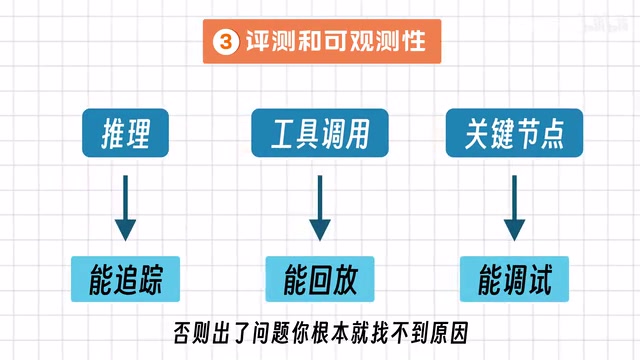
Observability is a concept rooted in distributed systems engineering, built on three pillars: Logs, Metrics, and Traces. In LLM applications, observability means being able to record and replay every model inference's inputs and outputs, the parameters and return values of each tool call, and token consumption and latency data. Tools like LangSmith, LangFuse, and Arize Phoenix are purpose-built for this use case, giving developers a clear view of every step in the agent's "reasoning" process. Systems without observability become black boxes when quality degrades — impossible to improve systematically.
A professional approach requires full observability across the system:
- Every inference process must be traceable
- Every tool call must be replayable
- Every critical checkpoint must be debuggable
Without this, tracking down the root cause of a production issue becomes nearly impossible. Observability isn't a nice-to-have feature — it's a prerequisite for transforming an agent from a "black box" into a "maintainable system," and a direct reflection of engineering rigor.
Competency 4: Production Readiness — The Line Between Toy and Product
If the first three competencies determine whether you can build it, this final competency determines whether what you build is a toy or a product.
The Complexity of Real Production Systems
An agent running live in the real world faces a landscape full of uncertainty: it will throw errors, get interrupted, wait for human review, and need to resume execution. Navigating this complexity requires a full suite of engineering capabilities:
- State Management: Accurately recording and restoring system state across long-running workflows
- Checkpoint Recovery: Resuming from the correct position after an interruption, not from scratch
- Log Monitoring: Real-time visibility into system health
- Risk Defense: Effective protection against malformed inputs and adversarial behavior
- Cost Optimization: Thoughtfully managing token consumption and API call overhead
In long-running agent tasks — such as automated research report generation or multi-step approval workflows — a task may run for minutes or even hours, facing uncertainties like network interruptions, API rate limiting, and human-in-the-loop waiting. State management requires persisting task progress to a database or message queue (e.g., Redis, PostgreSQL). Checkpoint recovery ensures that after a failure, execution resumes from the most recent checkpoint rather than the beginning — frameworks like LangGraph natively support this kind of stateful graph execution. On the cost optimization front, caching intermediate results, selectively using premium models, and batching requests can reduce API call costs by 30–70% — a critical engineering consideration for enterprise-grade projects.
These capabilities are all essential, collectively bridging the gap between an AI application that "runs" and one that "reliably serves users."
Building a Complete Skill Set: Direction Matters More Than Effort
Connecting these four competencies reveals a clear progression path: Task decomposition is the starting point; tool calling determines real-world deployment; evaluation and observability ensure quality; production readiness completes the leap from product to service.
A complete LLM application development skill set should cover:
- Core principles of large language models
- Agent and AI application development
- RAG knowledge base architecture
- MCP and tool calling
- AI product design and requirements analysis
- Enterprise-grade project deployment frameworks
Using this framework, learners can clearly identify their current stage and pinpoint exactly which gaps to fill next.
Closing Thoughts
In the AI era, hard work matters — but direction matters more. Rather than blindly churning through courses in a sea of concepts, bookmarking resources you never act on, build your skill set around what enterprises actually need. When you can decompose ambiguous business requirements into clear technical solutions, design stable and reliable tool chains, establish traceable evaluation mechanisms, and keep systems running reliably in production — that's when you truly become the LLM application engineer that companies are willing to pay a premium to hire.
Related articles

Older Google Home Gets Gemini Live Upgrade: Conditions and Experience Fully Explained
Google is rolling out Gemini Live conversational AI to older Google Home speakers, but subscription or plan requirements may apply. Here's what you need to know.

Older Google Home Gets Gemini Live Upgrade: Complete Breakdown of Requirements and Experience
Google is rolling out Gemini Live conversational AI to older Google Home speakers, but subscription or plan restrictions may apply. Full breakdown of the upgrade details and impact.

GPT-5.6 Hands-On Review: Analyzing the Agent Capabilities Behind Its #1 Ranking on the Frontend Development Leaderboard
GPT-5.6 SoulX High tops the frontend dev leaderboard at 1636 points with Agent Arena rank #2. Hands-on tests of portfolio pages and mystery games reveal its task decomposition and self-correction capabilities.