433 Fitness Exercises Open-Source Dataset: Structured Fields + Animation Demos Fully Explained

Open-source dataset of 433 structured fitness exercises with animations gains massive GitHub traction.
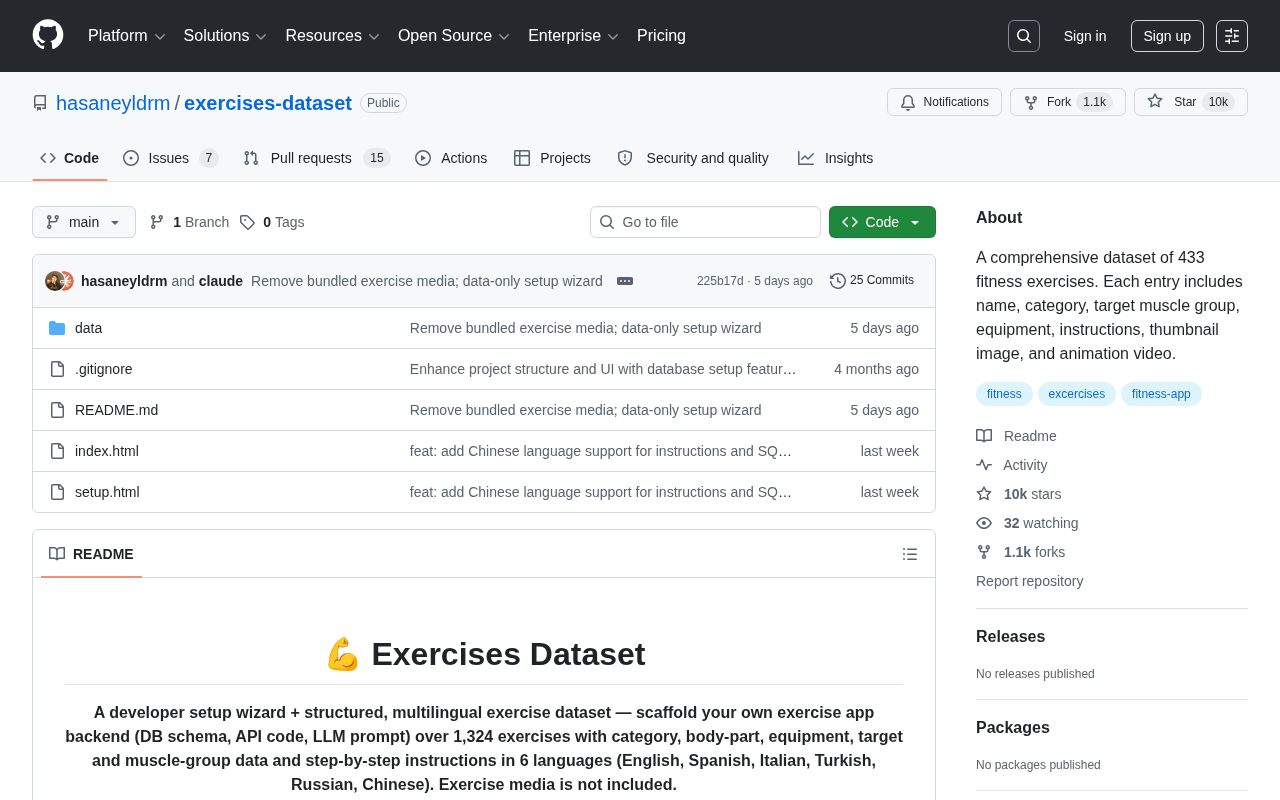
The GitHub repository exercises-dataset has rapidly gained over 9,300 stars by offering a structured dataset of 433 fitness exercises complete with target muscle groups, equipment types, instructions, thumbnails, and animation demos. Its multimodal design serves fitness app developers, AI coaching systems, RAG knowledge bases, and exercise science research, addressing the long-standing scarcity of high-quality vertical domain data.
Why an Open-Source Fitness Dataset Gained Nearly a Thousand Stars in a Single Day
Among GitHub's many trending projects, a repository called hasaneyldrm/exercises-dataset quietly climbed the daily hot list—gaining 938 new stars in a single day, with total Stars now exceeding 9,300 and Forks surpassing 1,040. Unlike complex large model frameworks or cutting-edge algorithm projects, its core is remarkably straightforward: a structured dataset covering 433 fitness exercises.
The rapid rise of such a seemingly simple dataset is backed by clear market logic. The global digital fitness market surpassed $30 billion in 2023 and is projected to exceed $80 billion by 2030. The explosion of smart wearables, workout tracking apps, AI personal trainers, and similar products has driven strong demand for underlying exercise data. However, fitness datasets have long remained fragmented—either locked behind paid databases (like ExRx.net) or consisting of non-standardized data scraped individually by developers, lacking unified field definitions and matching visual assets. This reflects a long-overlooked pain point: across AI applications, fitness tech, and web development, high-quality, structured, ready-to-use vertical domain data remains a scarce resource.
"Structured data" refers to data organized in a predefined format where each field has a clear type and meaning, enabling programs to directly parse, query, and filter it—fundamentally different from scattered text scraped from web pages. Compared to scraping, cleaning, and organizing data from scratch, directly reusing a ready-made open-source fitness dataset is obviously far more efficient.
The fundamental reason high-quality vertical domain datasets are scarce is that their production costs far exceed what's apparent on the surface. Taking this fitness exercise dataset as an example, 433 exercise entries represent: knowledge input from professional fitness trainers or exercise science experts, the development of standardized naming conventions, filming and editing of exercise demonstrations, manual annotation across multiple dimensions, and ongoing quality review processes. The total cost of these steps often reaches tens or even hundreds of thousands of dollars, yet the final dataset is provided for free in open-source form—creating a massive value gap that explains why such projects gain rapid community recognition the moment they appear.
Full Field Analysis: Far More Than Just Exercise Names
The biggest highlight of this fitness exercise dataset is its field completeness. Each record is not an isolated name but a complete entry containing multi-dimensional information.
Structured Field Design
Each exercise entry contains the following core fields:
- Name: Standardized naming for easy search and matching
- Category: Classification into strength training, cardio, stretching, etc.
- Target Muscle Group: Clearly identifies the primary muscles worked by the exercise
- Equipment: Dumbbells, barbells, bodyweight, machines, etc.
- Instructions: Written standard execution steps
- Thumbnail Image: Static illustration
- Animation Video: Dynamic demonstration of the full movement
This design addresses both machine-readability and human-readability. Text fields can be directly parsed and filtered by programs, while images and animations provide ready-made visual assets for user interfaces. Notably, this "multimodal" field combination—simultaneously containing text, images, and animation—is itself quite forward-thinking in dataset design.
Multimodal datasets can simultaneously support Natural Language Processing (NLP), Computer Vision (CV), and other AI tasks, with application potential far exceeding single-format datasets. The core challenge of multimodal AI lies in aligning and fusing data across different modalities—for example, OpenAI's CLIP model uses contrastive learning to map images and text into a shared vector space, while Google's Gemini attempts to encode multimodal information in a unified way during pre-training. A dataset that naturally binds text descriptions with visual movement assets provides an excellent starting point for cross-modal learning: researchers can directly use text-animation pairs to fine-tune multimodal embedding models without building data alignment pipelines from scratch.
Why "Animation Demos" Are the Key Differentiator
In fitness applications, pure text descriptions often fail to help users accurately understand movement fundamentals. This dataset provides thumbnail images and animation demos for each exercise, meaning developers can build visually complete fitness products without additional filming or purchasing assets. Animation assets are typically stored in GIF or lightweight video formats, ensuring continuous movement demonstration while controlling file size—ideal for mobile applications with bandwidth constraints.
On the technical implementation level, modern web applications typically host such assets on CDNs (Content Delivery Networks), combined with Lazy Loading strategies that only trigger resource requests when users scroll to the corresponding entry, achieving a balance between visual completeness and loading performance. This is the key reason it's more competitive compared to similar text-only datasets.
Who Would Use This Open-Source Fitness Dataset
Notably, the project's primary language tag is HTML, suggesting it contains not just raw JSON data but likely also a visual presentation page that lets users intuitively browse all exercises. JSON (JavaScript Object Notation), as a data exchange format, has become the de facto standard for transmitting structured data in web applications and API development due to its lightweight, readable, and cross-platform nature—virtually all mainstream programming languages natively support JSON parsing and generation. Compared to XML's verbose tags, JSON's key-value pair structure is more concise; compared to CSV's flat design, JSON supports nesting and arrays, naturally expressing hierarchical relationships—for example, the "target muscle group" in an exercise entry can be a nested object containing primary and secondary muscles, and this expressiveness is particularly important in fitness data scenarios.
Typical Use Cases
Fitness App Developers are the most direct beneficiaries. When building workout planning applications, an exercise library is an unavoidable foundational module, and building a database of 433 exercises from scratch requires enormous effort. Directly reusing this dataset can significantly shorten development cycles.
AI Application Developers also benefit greatly. In AI fitness coaching and intelligent training recommendation scenarios, structured exercise data can serve as a knowledge base for large models or as a data source for Retrieval-Augmented Generation (RAG). RAG is one of the mainstream architectures for current LLM applications—its core idea is: when a user asks a question, first retrieve relevant content from an external knowledge base, then inject the retrieved results as context for the large language model to generate an answer. This approach effectively addresses the LLM "hallucination" problem, making model responses verifiable.
From a technical implementation perspective, RAG typically uses vector databases to convert text fields from the dataset into high-dimensional vectors and build indexes. Vector databases work by converting text through an Embedding Model into high-dimensional floating-point vectors; the underlying layer typically employs HNSW (Hierarchical Navigable Small World) or IVF (Inverted File Index) approximate nearest neighbor algorithms, achieving engineering balance between retrieval accuracy and speed—retrieval latency is usually under 10 milliseconds, far superior to traditional full-text search. When a user initiates a query, the query text is likewise converted into a vector, and the system quickly locates the semantically closest entries by computing metrics like cosine similarity—this process is called Approximate Nearest Neighbor (ANN) search. Popular choices include cloud-native solutions like Pinecone, Weaviate, Qdrant, and Milvus, as well as Meta's open-source Faiss library (suitable for local deployment).
For this fitness dataset, "squat" and "leg training" would naturally cluster in vector space, so even when users' query phrasing doesn't exactly match the database field descriptions, the system can still accurately retrieve relevant exercises—this is precisely the core advantage of semantic search over traditional keyword matching. When a user asks "what exercises work the chest," the AI can provide accurate answers with demonstrations based on this data, rather than fabricating information.
Exercise Science Research and Education: For researchers and students in human-computer interaction and exercise science, a ready-made standardized dataset significantly lowers the barrier to experimentation and prototype validation. Particularly noteworthy is the Pose Estimation direction—a computer vision technology that understands human posture by detecting key points at joints like shoulders, elbows, and knees.
From a technical evolution perspective, Carnegie Mellon University's OpenPose (2017) first achieved real-time multi-person skeleton detection, Google's MediaPipe BlazePose (2020) brought real-time detection of 33 full-body key points to mobile devices (with inference latency as low as tens of milliseconds), and ViTPose based on the Vision Transformer architecture achieved higher accuracy on the standard benchmark dataset COCO. In terms of technical approaches, RGB camera-based 2D pose estimation has the lowest cost and is suitable for phones; depth camera-based (e.g., Intel RealSense) 3D pose estimation offers higher accuracy and is suitable for professional fitness equipment—Apple Watch paired with iPhone for exercise counting, Mirror smart fitness mirrors, and Tempo fitness devices have all commercialized this technology.
However, a gap remains between academic accuracy and real-world fitness scenarios: loose clothing, dim lighting, and camera angles can all significantly affect key point detection reliability. Researchers can combine this dataset's exercise classification labels with pose estimation models to build a complete feedback loop of "movement recognition → standard comparison → real-time correction," training AI systems that can judge in real-time whether a user's form is correct—for example, automatically detecting whether knees extend past toes during squats or whether the back maintains a neutral position, thereby achieving true AI personal trainer functionality.
The Value of Open-Source Datasets: An Underestimated "Hard Currency"
This project's popularity reveals a clear trend: In the era of large models, high-quality vertical domain datasets are themselves a form of hard currency.
As model capabilities grow increasingly powerful and homogeneous, true differentiation often depends on the quality of data fed to models. This phenomenon is known in the industry as the "data flywheel" effect—high-quality data trains better models, better models attract more users, more users generate more data, forming a positive cycle. This concept was first validated in practice by tech giants like Amazon in recommendation systems, and later reinforced by AI companies like OpenAI and Google: their true moat lies not purely in model architecture innovation, but in the massive high-quality annotated data accumulated over time.
For vertical domain AI applications, general-purpose large models often lack precise coverage of professional fitness knowledge—muscle anatomy terminology, exercise variation naming, equipment specifications, and other details are prone to errors. This limitation stems from the training data distribution of large models: the proportion of professional fitness content in general corpora is extremely low, and it lacks systematic classification and verification, causing models to give vague or incorrect answers when handling professional questions like "the difference between Romanian Deadlift and Stiff-Leg Deadlift" or "the effect of grip width variation in cable pulldowns on lat activation." Domain-specific structured data curated by humans, like this dataset, is precisely the key to filling knowledge gaps in general-purpose models. A domain dataset with standardized fields and complete supporting assets may have far greater practical production value than a piece of flashy code.
Three Points to Note Before Use
Although this fitness dataset is highly valuable, developers should pay attention to the following before adoption:
- License Agreement: Be sure to confirm the repository's open-source license. Images and animation assets may involve copyright, so exercise extra caution before commercial use. Common open-source licenses include MIT (allows almost any use), Apache 2.0 (requires preserving copyright notice), CC BY (Creative Commons, requires attribution), while CC BY-NC (prohibits commercial use), commonly used for datasets, explicitly restricts commercial products. Notably, code licenses (like MIT, Apache) and content licenses (like the Creative Commons series) belong to different legal frameworks—a repository's code and dataset may be governed by different licenses, and developers need to verify each item separately to avoid legal risks from confusing the two types.
- Data Accuracy: Fitness exercise instructions directly affect users' workout safety. It's recommended to have professionals conduct secondary verification of movement fundamentals before use in production products. Especially for exercises involving the spine, joints, and other sensitive areas, incorrect guidance may cause exercise injuries—this is the bottom line of responsibility for fitness tech products.
- Long-term Maintainability: The update frequency of open-source datasets deserves ongoing attention. While 433 exercises provide broad coverage, there's still room for expansion. An actively maintained repository typically has continuous commit records, issue discussions, and PR merges—all important indicators for judging a project's vitality.
Summary
The success of exercises-dataset is no accident. It precisely addresses developers' need for "ready-to-use" resources, solving a real problem in the most direct way. In an era where everyone chases cutting-edge models, this fitness exercise dataset reminds us: solid data infrastructure equally deserves to be seen and valued. The value of a dataset lies not only in its content itself but in how it lowers the entry barrier for the entire ecosystem—when more developers can rapidly build fitness applications and AI features, the ultimate beneficiaries are ordinary users who hope to improve their health through technology. Whether you're developing a fitness app, building an AI fitness coach, or constructing a RAG knowledge base, this is a quality open-source resource worth bookmarking.
Related articles

Fable 5 vs GPT-5.6: An In-Depth Head-to-Head Comparison of Two Top-Tier Coding Models
In-depth comparison of Fable 5 vs GPT-5.6 (Sol) for AI coding. Covering token efficiency, code quality, design, cost, and safety based on $10K+ real usage data.

Fable 5 vs GPT-5.6: An In-Depth Head-to-Head Comparison of Two Top-Tier Coding Models
In-depth comparison of Fable 5 vs GPT-5.6 (Sol) for AI coding. Real-world data on token efficiency, code quality, design capability, and cost from $10K+ testing.

The New Coding Paradigm in the AI Era: Why You Should Generate More Code Instead of Reading Every Line
Explore the new code review mindset for the AI programming era: now that code is cheap, engineers should generate massive amounts of code to verify critical code rather than obsessing over reading every line.