5 Techniques to Push AI to Its True Limits: An Anthropic Engineer's Collaboration Methodology

5 practical techniques from an Anthropic engineer to systematically push AI past its apparent limits.
Anthropic engineer Talik argues that poor AI performance stems not from weak prompts, but from users' cognitive blind spots. Using a four-quadrant awareness framework, he offers five actionable techniques—blindspot passes, low-fidelity mockups, Socratic interviews, pre-implementation plan audits, and midpoint process notes—to help users clarify needs, reduce AI guesswork, and maintain control throughout complex tasks.
Many people assume poor AI performance comes from poorly written prompts. That used to be my assumption too — until I read a lengthy post by Talik, an engineer at Anthropic, who completely dismantles that idea. The real problem isn't how you word your prompts; it's the blind spots in your own understanding of what you actually need. This article breaks down his methodology to help everyday users systematically unlock AI's full potential.
The Map Is Not the Territory: The Core Dilemma of AI Collaboration
Talik invokes an ancient metaphor: the map is not the territory. This phrase originates from Polish-American philosopher Alfred Korzybski, who introduced this epistemological principle in 1931. Its core meaning: our descriptions and models of reality can never fully capture reality's complexity. Applied to AI writing or coding, prompts, skill definitions, and context are all "maps" — but the real "territory" is all the unexpected complications that emerge during execution.
The problem is that when the map has gaps, AI doesn't pause and wait for you. It guesses: "The user probably wants this." Large language models (LLMs) are fundamentally systems that generate text based on probability distributions. When input is ambiguous, the model performs "maximum likelihood inference" based on statistical patterns in its training data. In short tasks, this produces manageable errors — but the longer the task, the more guesses pile up, and errors don't just take you one step off course. They compound across every step.
So Talik identifies the biggest challenge in AI collaboration as that uncomfortable old saying: "I don't know what I don't know." To unpack this, he organizes the cognitive positions people occupy when working with AI into four categories.
The Four Quadrants of Awareness
This four-quadrant framework isn't Talik's invention. Its best-known version comes from a 2002 improvised remark by former U.S. Secretary of Defense Donald Rumsfeld, though it had already circulated for years in project risk management and organizational behavior. Its value when applied to human-AI collaboration is this: it transforms "communication failure" from a vague feeling into something locatable and addressable.
- Known Knowns: Your goals, constraints, and input/output formats — what you explicitly tell the AI, the regions already marked on the map.
- Known Unknowns: Things like whether you'll go with option A or option B, still undecided. If you don't flag that "this isn't settled yet," AI will quietly make a default choice for you.
- Unknown Knowns: The subtlest category. You have a standard in mind but can't articulate it — you can't explain what "natural tone" means, but you immediately know when a sentence sounds "AI-ish."
- Unknown Unknowns: True blind spots. These are especially dangerous because AI's autocomplete behavior quietly "fills them in," leaving you under the impression your needs have been met — until things break after launch. When modifying a login module in an unfamiliar codebase, the real danger isn't forgetting a button. It's not knowing which questions to ask in the first place.
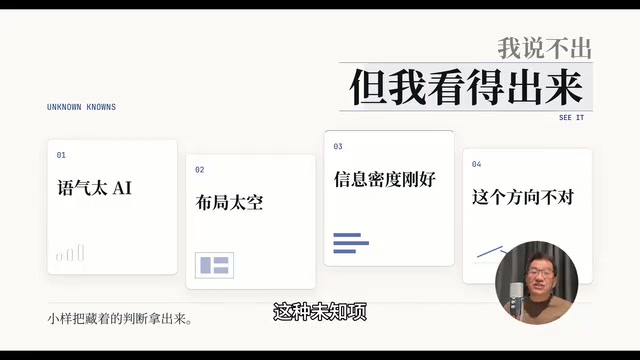
The biggest takeaway from this framework: collaborating with AI is not a talent. It's a skill that can be deliberately practiced.
Before You Start: Help AI Understand Where You Are
The truly effective approach isn't giving AI a stronger command — it's telling it: "Here's where I am, here's what I know, here's where I'm uncertain, and here's where I'd like your judgment." Talik offers five practical methods for the project kickoff phase.
Method 1: Blindspot Pass
When entering an unfamiliar codebase or domain, don't pretend you know it. Tell the AI directly: "I have blind spots here. Help me identify what I don't know I don't know." This step directly targets the fourth quadrant, asking AI to mark the blank spaces on your map.
Method 2: Brainstorm with Mockups
This approach is especially well-suited to third-quadrant situations — "I can't describe it, but I'll know it when I see it." Say you want to build a data dashboard but can't articulate the layout, spacing, or chart density. Once AI produces four HTML directions, you can immediately react: "This one's too busy, that one's too sparse, this one's just right."
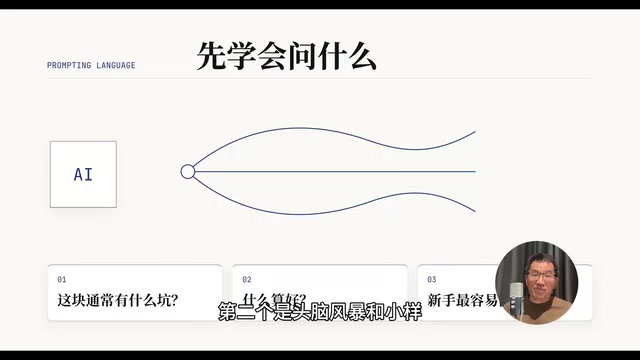
The value of mockups isn't better aesthetics — it's low cost of failure. If you wait until the backend is connected, the frontend is built, and complex interactions are fully wired before discovering that a button shouldn't be there at all, the cost of rework is enormous. Talik also provides 14 visualization template tools to help AI quickly surface what you "don't know you know."
Method 3: Socratic Interview
When you have a rough plan but something feels fuzzy, ask AI to play "Socrates." The Socratic Method traces back to ancient Greece; its core is using continuous questioning to expose the hidden assumptions and contradictions in a person's thinking. In modern prompt engineering, this is called a "Requirement Elicitation" technique — asking the model to clarify needs one question at a time before delivering a final answer, rather than immediately producing a solution full of default assumptions. Research shows this approach significantly reduces LLM "hallucination-style completions." You can say something like: "Keep asking me questions, but only one at a time, until you're 95% confident you understand what I need — then give me the complete answer." These questions often end up changing your entire direction.
Method 4: Provide Reference Material
Some things are genuinely hard to put into words — the feel of a UI component, the camera movement in a specific shot. The best reference is often a complete screenshot or code snippet. A screenshot tells AI what something looks like; code also tells it why it looks that way.
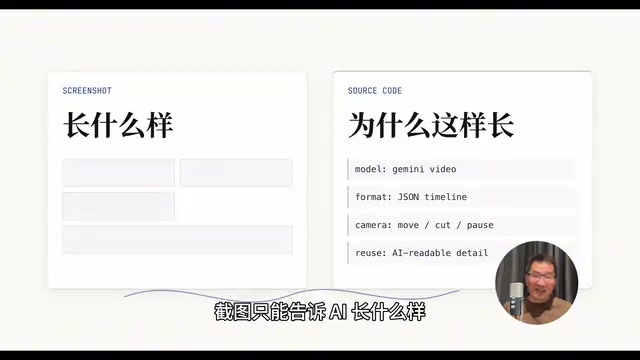
For example, to recreate a specific film shot, you can use a multimodal model like Gemini. Multimodal LLMs can simultaneously process images, video frames, and text, building semantic connections across modalities. Converting visual content into JSON format reflects an "information dimensionality reduction" engineering philosophy: raw video frames contain pixel data that AI can't directly reuse, but once a multimodal model extracts structured fields like "focal length, motion trajectory, timestamp, color tone," that data becomes a directly callable interface for downstream tasks — these structured details are what AI can actually work with.
Method 5: Pre-Implementation Plan Audit
This isn't the kind of checklist that looks thorough but nobody reads. The key is getting AI to surface the decisions most likely to need your approval first. For example: "Please write a real-time HTML solution, but first list the three decisions I'm most likely to want to adjust. Put the mechanical details after that — I trust your judgment on those." This step is about pushing back against AI's "over-autonomy" and protecting your own decision-making bandwidth.
Midway Through: Don't Let AI Swallow the Process
Talik makes a sharp observation: AI projects don't usually die at the start — they die halfway through.
Casually saying "go ahead and finish it" actually carries hidden risk. AI will adjust course while quietly "digesting" the reasons for those adjustments, ultimately delivering something that looks finished — but you no longer know what happened in between. The technical root of this problem lies in LLMs' context window limits and memory mechanisms: mainstream models have no persistent memory across sessions, and early decision records and path selections are easily "diluted" by new information or pushed out of the context window in long conversations.
His solution: have AI maintain a process notes file, recording the original plan, key decisions, and especially any deviations from the plan — why the original path couldn't be continued, and why a more conservative option was chosen. This closely mirrors the "Architecture Decision Record" (ADR) practice in software engineering, whose core value is the same: not just recording what was decided, but preserving the reasoning chain for why the other path wasn't taken. Injecting these notes into the context at the start of the next session patches the model's systemic memory gap.
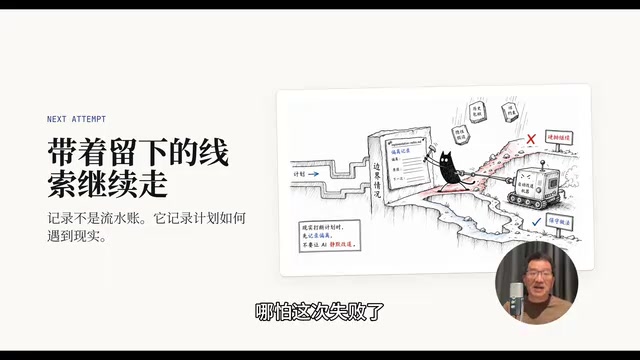
This record isn't for appearances. It makes the AI's next attempt smarter. Even when something fails, the next try doesn't start from scratch — it starts with clues.
After You're Done: Help Others Understand It Too
Many AI projects don't actually get stuck on "can't build it" — they get stuck on "how do I get my colleagues, manager, or client to actually understand what was built."
Deliverables for others can't just say "it's done." Have AI organize the prototype, requirements, and implementation notes into a ready-to-send document: open with a demo, then explain why it was built this way, what was built, and what risks remain.
Personal retrospectives can't just read the code diff. A diff is only part of the map — it tells you what changed in the files, but not necessarily what will happen when things run. So Talik asks AI to generate a change report with context, and attaches a short quiz at the bottom. If you can't answer it correctly, you don't truly understand what changed — and you shouldn't be comfortable merging the code.
Conclusion: Treat AI as a Source of Thinking Power
Putting this whole process together: find your blind spots before starting, keep notes in the middle, and use a quiz to debrief at the end. It sounds like a lot of steps, but the real value of this approach is that it forces you to confront your own cognitive blind spots — instead of handing over decision-making to AI's best guesses.
One final mindset note: don't treat AI as a "problem-solving tool." Treat it as an amplifier for both your thinking and your capacity to act. Some people use AI to save time. But the more worthwhile goal is using AI to do things that simply weren't possible before.
Key Takeaways
Related articles

The Truth Behind Codex 'Build a Website in 5 Minutes': AI Isn't Creating Sites—It's Helping You Copy Them
Exposing the truth behind viral Codex 5-minute website videos: creators aren't building original sites with AI—they're copying shared prompts or scraping others' work. Learn AI coding tools' real limits.

Getting Started with AI Agent Development: A Complete Guide from Concept to Practice
A comprehensive guide to AI Agent architecture and development, covering automated marketing, intelligent customer service, and investment analysis scenarios with single and multi-agent collaboration.

The Truth Behind Codex 'Build a Website in 5 Minutes': AI Isn't Creating Sites — It's Helping You Copy Them
Exposing the truth behind viral Codex 5-minute website videos: creators aren't building original sites with AI — they're copying shared prompts or scraping others' work.