6-Week Agent Engineering Roadmap: From Beginner to Enterprise Deployment

A 6-week hands-on roadmap for mastering Agent engineering from core architecture to enterprise production deployment.
This article outlines a structured 6-week learning path for Agent development, covering the three core pillars — planning (ReAct/CoT), memory (vector databases), and tool use (MCP). It progresses through LangGraph multi-agent orchestration, RAG integration, lightweight deployment techniques, and ends with real-world multi-scenario project practice, forming a complete enterprise-grade engineering pipeline.
Why Agent Development Is Becoming a Core Developer Competency
As large model capabilities continue to advance, the center of gravity in AI applications is shifting from "conversation" to "action." At its core, an Agent (intelligent agent) equips a large model with the ability to plan, remember, and call tools — enabling it to autonomously complete complex tasks. Today, intelligent agents have moved well beyond tech circles into mainstream awareness. Their appearances on major public stages and in humanoid robot demonstrations signal that this trend has firmly arrived.
For developers, the message is clear: mastering Agent development frameworks like LangChain, LangGraph, and MCP, and being able to deploy them in real-world business scenarios, is becoming a high-value engineering skill. This article is based on a structured Agent hands-on curriculum, mapping out a complete learning path from beginner to production deployment — helping you understand the core threads of Agent engineering.
The Core Architecture of Agents: Three Pillars
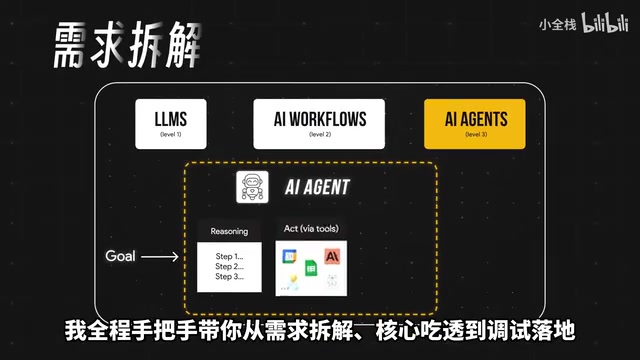
To understand Agents, you first need to understand what sets them apart from ordinary large model API calls. A complete Agent typically consists of three core modules.
Planning
The planning module is responsible for breaking down complex goals into executable subtasks — and it's the source of an Agent's "autonomy." Common implementation paradigms include Chain-of-Thought (CoT) and ReAct (Reasoning + Acting).
The ReAct paradigm was formally introduced by Yao et al. in their 2022 paper "ReAct: Synergizing Reasoning and Acting in Language Models." Its core innovation lies in combining chain-of-thought reasoning with external tool interactions, forming a closed-loop cycle of "think → act → observe." Unlike pure CoT, ReAct allows the model to call external tools at any point during reasoning to retrieve information, compensating for the model's internal knowledge limitations — the model first reasons about what to do next, then executes the action, observes the result, and continues reasoning based on that feedback.
It's worth noting that CoT (Chain-of-Thought) itself originated from Google Brain research in 2022, and the initial discovery was somewhat accidental: adding a simple phrase like "Let's think step by step" to a prompt dramatically improved large model accuracy on math reasoning and logic problems. The underlying mechanism is that step-by-step reasoning allows the model to decompose complex problems into a series of intermediate steps, reducing the probability of error at any single step. ReAct builds on CoT by introducing an "action" dimension — when the reasoning chain reaches a point the model cannot resolve from internal knowledge alone, it can proactively invoke external tools like search engines, calculators, or code interpreters, rather than being forced to guess. This paradigm shows significant advantages in complex Q&A, web navigation, and code debugging tasks, and serves as the theoretical foundation for mainstream Agent frameworks like LangChain's AgentExecutor, greatly enhancing an Agent's ability to handle open-ended tasks.
Memory
Large models are inherently stateless — each call is independent. The memory module addresses this limitation, and is divided into short-term memory (current conversation context) and long-term memory (typically using vector databases to store historical information).
A vector database is the core infrastructure of an Agent's long-term memory system. It works by converting unstructured data like text and images into high-dimensional vectors via an Embedding model, storing them in specialized index structures, and supporting fast semantic similarity retrieval (typically using ANN — Approximate Nearest Neighbor — algorithms). Popular implementations include Pinecone, Weaviate, Chroma, and FAISS.
To understand vector databases, you first need to understand the essence of Embedding: it's a technique that encodes semantic information into a continuous vector space, so that semantically similar content ends up closer together in that space. For example, the vector distance between "Apple smartphone" and "iPhone" will be far smaller than the distance between "Apple smartphone" and "climate change" — this is the fundamental reason semantic retrieval outperforms traditional keyword matching. ANN algorithms are the key that makes vector retrieval practically usable at scale: finding the exact most-similar vector in a database of tens of millions of entries is computationally expensive, but algorithms like HNSW and IVF introduce a small, acceptable margin of error to achieve retrieval speeds orders of magnitude faster. In Agent contexts, long-term memory design requires balancing storage granularity (sentence vs. paragraph), retrieval strategy (similarity threshold, TopK count), and memory update mechanisms — all of which directly affect Agent performance in multi-turn conversations. Well-designed memory allows an Agent to remain coherent across interactions and learn from past experience.
Tool Use
Tool use is the key to Agents truly "working in the real world." By calling external APIs, databases, search engines, and even code execution environments, Agents can break through the knowledge boundaries of large models and interact with the real world.
MCP (Model Context Protocol), which has attracted significant attention recently, was released by Anthropic in late 2024. It is an open, standardized protocol designed to solve the "interface fragmentation" problem between AI models and external tools and data sources. Before MCP, every Agent framework and every model provider had its own tool-calling specification, making it difficult to reuse tools across different systems. MCP draws inspiration from LSP (Language Server Protocol), defining a unified server/client communication specification so that tool developers only need to implement the MCP interface once to be callable by all models and frameworks that support the protocol.
LSP was launched by Microsoft in 2016 for VS Code — it decoupled language features like code completion, syntax checking, and jump-to-definition from the editor itself, allowing any editor to support hundreds of programming languages by implementing a single LSP client. This design fundamentally transformed the developer tooling ecosystem. MCP's ambition is similar: to standardize how AI connects with tools. In the MCP architecture, an MCP Server encapsulates specific tool capabilities (such as reading files, querying databases, or calling third-party APIs), while the MCP Client (typically an AI application or Agent framework) communicates with the server via a standardized JSON-RPC protocol, with neither side needing to care about the other's internal implementation. Claude, Cursor, and other mainstream products have already added MCP support, signaling that the AI tooling ecosystem is moving toward interoperability — providing a unified protocol standard for Agents to connect with external tools.
The 6-Week Learning Path: A Progressive Hands-On Framework
The core value of this curriculum lies in its structured, progressive design — breaking Agent learning into six stages, with each week focused on a distinct capability layer, forming a complete path from laying the foundation to achieving project closure.
Weeks 1–2: Build the Foundation, Master the Principles
The first two weeks focus on "foundation" and "core." Week 1 systematically covers Agent's core architecture and components, building an understanding of how the three modules — planning, memory, and tool use — work together. Week 2 dives deeper into how Agents actually work and where the hard problems are, with a focus on the ReAct and CoT paradigms and the key logic for real-world deployment. This phase emphasizes conceptual understanding and serves as the foundation for all subsequent hands-on work.

Week 3: Multi-Agent Collaboration and Tuning
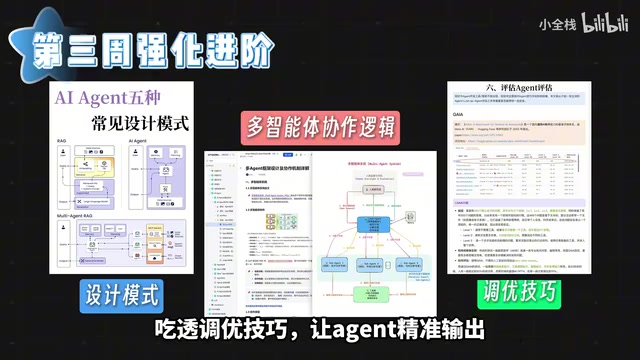
A single Agent's capabilities have inherent limits. For sufficiently complex tasks, Multi-Agent collaboration is often the better solution — different Agents handle different responsibilities and work together toward a larger goal.
LangGraph is an important tool for this scenario. Released by the LangChain team as a framework extension for orchestrating complex Agent workflows, LangGraph's core abstraction is a Stateful Directed Graph. Unlike traditional linear chains, LangGraph explicitly models each processing node and the conditional transitions between nodes as a graph structure, supporting loops, conditional branching, and concurrent execution.
To understand LangGraph's design motivation, you first need to understand the limitations of traditional LangChain Chains. Early LangChain used the "pipeline" as its core metaphor — data flows linearly through a series of processing steps. This works well for simple "query → retrieve → generate" scenarios, but falls short when facing tasks that require repeated iteration, conditional logic, or multi-agent collaboration. For example, after an Agent executes a tool call, it may need to decide — based on the result — whether to call another tool, retry, or return an answer directly. Graph structures naturally support this kind of non-linear control flow. At the implementation level, LangGraph passes information between nodes through a shared State object, and developers can precisely define which state fields each node reads and writes — preventing information chaos between Agents. Thanks to this explicit state management, LangGraph's execution can be paused, inspected, and resumed at any node, which is its core advantage over frameworks like AutoGen when it comes to debuggability. This week also covers tuning techniques to help Agents achieve precise, stable output.
Week 4: Integrating RAG with Agents
RAG (Retrieval-Augmented Generation) was introduced by Meta AI Research in 2020. Its basic architecture has two phases — offline indexing and online retrieval: in the offline phase, enterprise documents are chunked, vectorized, and stored in a vector database; in the online phase, before the model generates a response, the most relevant text fragments are retrieved from the vector database and injected into the prompt as context. RAG's value lies in replacing "memorization" with "retrieval" — avoiding the knowledge staleness problem caused by a model's training data cutoff date, while also mitigating model "hallucination" (the tendency of models to fabricate facts).
From an engineering evolution perspective, RAG has gone through three generations: "Naive RAG" → "Advanced RAG" → "Modular RAG." Naive RAG simply retrieves and concatenates text fragments, which works reasonably well when document quality is high and questions are clear-cut, but fails on ambiguous questions or tasks requiring multi-document synthesis. Advanced RAG introduced optimizations like Query Rewriting, Reranking, and Hybrid Search (combining vector retrieval with keyword retrieval). When RAG is fused with Agents, the system gains a higher-level "meta-cognitive" capability: the Agent can actively decide when retrieval is needed, what to retrieve, whether retrieved results are trustworthy, and can even perform Multi-hop Retrieval — breaking complex questions into sub-questions, retrieving answers in sequence, and progressively deriving the final answer. This combination significantly improves accuracy in complex knowledge Q&A scenarios and is one of the most widely adopted enterprise AI deployment patterns today. Week 4 focuses on connecting the architectural logic of both systems and exploring how to adapt lightweight tools for real business scenarios.
From Deployment to Closure: The Last Mile of Engineering
Technology selection and prototype development are just the starting point. The real challenge lies in engineering-grade production deployment.
Week 5: Lightweight Deployment and Business Customization
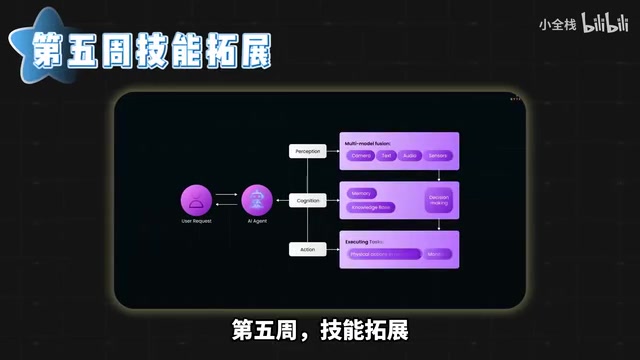
Enterprise applications typically have stringent requirements around cost, performance, and compatibility. Week 5 focuses on lightweight Agent deployment, exploring how to run Agents stably in resource-constrained environments and how to customize and adapt them for specific business scenarios.
Lightweight deployment typically involves several core engineering considerations. Model quantization is the most commonly used compression technique: INT8 quantization compresses model weights from 32-bit floating point to 8-bit integers, reducing memory usage by approximately 75% and noticeably improving inference speed, with precision loss generally within acceptable limits. More aggressive INT4 quantization (using algorithms like GPTQ and AWQ) can further compress a 7B-parameter model's memory footprint to under 4GB, enabling it to run on consumer-grade GPUs or even CPUs. Inference framework selection is equally important: llama.cpp is known for minimal dependencies and strong CPU inference performance, making it ideal for edge deployment; vLLM, using its PagedAttention technology, achieves high-throughput GPU inference and is better suited for production environments requiring concurrent request handling. Wrapping inference as a service typically involves packaging inference capabilities into an OpenAI-compatible REST API, enabling reuse of existing Agent frameworks and toolchains. These decisions directly determine whether an Agent can graduate from demo to production.
Week 6: Multi-Scenario End-to-End Practice
The final week is the integrative hands-on phase — synthesizing knowledge from all five previous weeks to complete real business integrations across multiple Agent scenarios. The "knowledge → skills → project" closed-loop design is the core advantage that distinguishes this curriculum from fragmented tutorials.
Learning Recommendations: Enter Rationally, Land Solidly
This curriculum markets itself as beginner-friendly — and its accessible positioning is genuinely commendable. It does provide a clear learning map for newcomers. That said, it's important to have realistic expectations: Agent development is fundamentally an engineering discipline. Behind the planning, memory, and tool use modules lie countless detail trade-offs, and real skill development requires hands-on practice and project work.
The recommendation is to use this six-week roadmap as your skeleton, while going deep into the official documentation (LangChain, LangGraph, MCP) to understand the design philosophy behind each component, and getting hands-on with real scenarios as early as possible. The opportunities in the Agent era are real — but they belong to those willing to put in the work to truly master both the principles and the engineering.
Related articles

Disaster and Glory of the Apollo Program: The History We Must Revisit Before Returning to the Moon
From the fatal Apollo 1 fire to Apollo 8's daring lunar orbit to Apollo 11's successful landing—revisiting the disasters, fears, and compromises of the Apollo program and their lessons for today's return to the Moon.
Netflix Trust Exercise Turns Into Firing Trap: Where Are the Boundaries of Corporate Trust?
A Netflix employee was fired after sharing private info in a trust exercise. We analyze the risks of corporate trust exercises and how employees can protect themselves.

AMD CDNA5 Architecture Deep Dive: Technical Evolution and the AI Computing Competition Landscape
Deep analysis of AMD's CDNA5 architecture covering Chiplet packaging upgrades, HBM memory evolution, and low-precision compute optimization, examining how AMD challenges NVIDIA's AI chip dominance.