7 AI Agent Money-Making Projects: A Hands-On Guide from Domain Flipping to Competitor Monitoring

7 AI Agent automated side business ideas with hands-on guides for earning $1,000+/day
Greg Eisenberg shares 7 immediately actionable AI Agent business ideas using tools like GenSpark Claw for automated income. Projects cover dead domain flipping, local liquidation arbitrage, hiring signal cold emails, business acquisition analysis, and zombie SaaS acquisition. The core logic leverages AI's continuous monitoring, data aggregation, and automated execution capabilities to find arbitrage opportunities in information-asymmetric markets, generating $1,000-$3,000 per day in cash flow.
Introduction: From Ideas to Earning $1,000/Day with AI Side Businesses
Many people are asking: stop giving me billion-dollar startup ideas — give me practical, small-but-profitable AI projects that can earn me $1,000 to $3,000 per day. In his latest video, Greg Eisenberg shared 7 AI Agent business ideas you can start immediately, complete with a full creative framework and hands-on toolchain.
This article breaks down the core logic, implementation path, and monetization model for each of these 7 projects, helping you understand how to build cash-flow businesses with AI Agents.
Core Tool: Key Capabilities of GenSpark Claw
Before diving into the projects, let's understand Greg's core tool — GenSpark Claw.
What is an AI Agent? An AI Agent is an AI system capable of autonomously perceiving its environment, formulating plans, and executing multi-step tasks — unlike traditional single-query AI. Its core capability lies in "Tool Use" — it can operate browsers, read/write files, send emails, call APIs, and form complete automated workflows. This makes it particularly suited for business scenarios requiring continuous monitoring, data aggregation, and repetitive execution.
GenSpark Claw is essentially a cloud-based version of OpenAI Computer Use (Open Claw). Computer Use is a technology that lets AI models directly control computer interfaces — it can view screenshots, move the mouse, click buttons, and type text just like a human, no longer relying on structured APIs but able to operate any software with a graphical interface, vastly expanding the boundaries of automation. GenSpark Claw brings this capability to the cloud with several key advantages:
- More secure: Runs in the cloud, accessible to everyday users
- Easier setup: No complex local configuration needed
- Built-in skills: Audio transcription, email management, data analysis, and more out of the box
- Multi-model support: Runs mainstream models like Sonnet 4.6
- Integrated communication: Connects to Slack, WhatsApp, Telegram, etc.
Key setup tips: Enable "Prevent Sleep" to keep the AI continuously active, and enable "Heartbeat" to check for pending events every 30 minutes (this consumes tokens, so it's recommended to enable only after the business generates revenue).
Project 1: Dead Domain Flipping — Automated Arbitrage Through Low-Buy, High-Sell
Core Logic
A large number of .com domains expire and are released because owners forget about them or abandon them — many of which are high-quality. Use AI to monitor domain auction platforms, filter by scoring criteria, buy low, and sell high.
Domain market background: Tens of thousands of .com domains expire globally every day, forming a secondary market worth hundreds of millions of dollars. DR (Domain Rating) is a domain authority metric created by Ahrefs that reflects backlink quality — domains with DR 20+ have significant SEO value because search engines index new content on these domains faster and give them higher ranking weight. GoDaddy Auctions and DropCatch are mainstream expired domain auction platforms where professional domain investors (Domainers) are highly active. AI's involvement allows individual investors to participate in this market at lower costs, bridging the gap in information processing capabilities.
Hands-On Method
Greg set up the following filtering criteria in GenSpark Claw:
- Monitor expired domains, GoDaddy Auctions, DropCatch
- Filtering criteria: DR 20+, clean backlink profile, no adult/gambling history
- Push 10 domains worth bidding on every morning (budget $200-$2,500)
- Monetization targets: Newsletter operators, SEO agencies, or rebuild as content sites
Monetization Model
Greg revealed he previously ran a premium domain marketplace: buying domains for $8, designing a logo, and selling for $3,000-$5,000. Now this entire process can be automated with AI, yielding extremely high profit margins.

Project 2: Local Liquidation Arbitrage — Earning 15-30% Commission with Zero Inventory
Core Logic
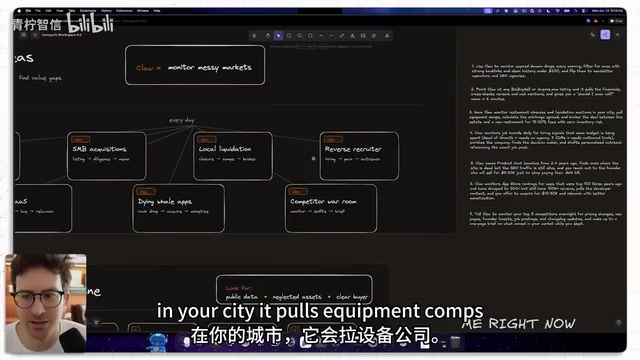
When restaurants close, their equipment is often sold at extremely low prices. Use AI to monitor restaurant closures and liquidation auction information, calculate arbitrage margins, and earn 15-30% commission as a middleman with zero inventory.
Results in Practice
The AI scanned 1,600 different liquidation listings and ultimately flagged 10 deal opportunities. For example, a restaurant exhaust hood was listed at a very low price, but its market value was $1,500 — a 300% price gap.
Why Does This Model Work?
- Restaurant owners are too busy handling liquidation to optimize their sales
- Listings on Craigslist and similar platforms have unoptimized titles and descriptions
- Information asymmetry between buyers and sellers is severe
- AI can automatically push deal opportunities to Slack daily
Project 3: Hiring Signal Cold Emails — Precisely Reaching Clients with Budget
Core Logic
Company hiring means budgets are flowing. Monitor job boards, identify signals (e.g., hiring a Head of Growth = needs an agency), find decision-makers, and send personalized outreach emails.
The logic of signal-driven sales: Job postings are among the most valuable "buying intent signals" in B2B sales. When a company posts a Head of Growth or Marketing Director position, it means the company is in an expansion phase with approved budgets — the perfect time for external service providers to engage. This strategy of precise outreach based on public data is known as "Signal-Based Selling" in the sales intelligence field. Hacker News's "Who's Hiring" posts are a premium data source due to their high density of tech startups and timely updates, while Greenhouse is an enterprise-grade applicant tracking system whose public job pages have well-structured data that's easy for AI to scrape and analyze at scale.
Live Demo
Greg demonstrated building this project live. The AI scraped 222 positions from Hacker News's "Who's Hiring" and Greenhouse, filtered down to 14 companies actively hiring marketing leaders, and drafted personalized cold emails for each.

Email example: "Hey, saw that Quest DB is expanding their marketing team, specifically a technical content writer. This kind of hiring usually happens when a company has real momentum. I specifically help companies at this stage with marketing strategy and execution..." — referencing the specific job post with a high degree of personalization.
Project 4: Business Acquisition Analysis — Investment Memo in 6 Minutes
Use Claw to monitor business transaction platforms like BizBuySell or Acquire.com, automatically pull financial data, cross-reference reviews and web mentions, and generate a "worth contacting or not" memo in 6 minutes. You can use it to buy businesses yourself, or sell it as a service to people looking to acquire companies.
Digital asset M&A market background: Platforms like Acquire.com, MicroAcquire, and Flippa specialize in brokering transactions for small SaaS products, content sites, and apps — a market that has matured rapidly in recent years. These assets are typically priced at 2-4x annual net profit (i.e., 2-4x ARR multiples), but because sellers often lack professional financial presentation skills, buyers typically need to spend significant time on due diligence. AI compresses this process to the minute level, enabling individual investors to screen deal opportunities with institutional-grade efficiency.
Project 5: Zombie SaaS Acquisition — Picking Up Abandoned Digital Assets
Scan Product Hunt launches from 2-4 years ago, find products whose websites are dead but still have SEO traffic, and contact founders to acquire them for $5K-$25K — many founders just want to stop paying their AWS bills.
Why do zombie SaaS products have value? Product Hunt as a product launch platform has accumulated extensive historical data on early-stage projects, many of which have entered "zombie state" as founders shifted their attention elsewhere.
Related articles
 Tutorials
ChatGPT Plus Subscription Guide: Are GPT-5.5, image-2, and Codex Worth the Upgrade?
A detailed look at ChatGPT Plus features — GPT-5.5, image-2, and Codex — with a Plus vs Pro comparison and a complete step-by-step subscription guide for users outside the US.
 Tutorials
Harness AI Engineering in Practice: Using Claude Code to Master Enterprise-Level E-Commerce Development
Deep dive into Harness AI Engineering: master enterprise e-commerce development with Claude Code using the Rules, Skills, Wiki, and Changes framework.
 Tutorials
Cursor + Codex Dual-IDE Collaboration: A Practical Methodology for Open-Source Project Customization
A complete methodology for open-source project customization based on real-world experience, detailing the Cursor+Codex dual-IDE workflow, seven-stage process, MVP validation, and AI source code reading techniques.