7-Step Framework for Deploying Commercial AI Agents: From Requirements to Production

A systematic 7-step framework for taking commercial AI Agents from requirements gathering to production deployment.
This article breaks down the complete process of building commercial AI Agents into seven actionable steps: requirements gathering, platform/model/tool selection, prompt engineering, database configuration, UI development, evaluation and testing, and deployment. It provides practical comparisons of platforms like Coze, Dify, FastGPT, and LangGraph, along with role-specific recommendations for non-technical users, developers, and enterprise decision-makers.
Why Your AI Agent Never Makes It to Production
Many people hit roadblocks when building AI Agents: indecision over platform selection, uncertainty about where to store business data, frequent web scraping failures, inconsistent LLM outputs, and cascading errors after deployment. The root cause of these problems often isn't any single technical detail—it's the lack of a systematic methodology designed for commercial deployment.
An AI Agent is an artificial intelligence system capable of perceiving its environment, making autonomous decisions, and executing actions. Unlike traditional single-turn Q&A AI, Agents possess task planning, tool invocation, memory management, and multi-step reasoning capabilities. Since 2023, with the leap in capabilities of large language models like GPT-4, AI Agents have rapidly transitioned from academic concepts to engineering reality, becoming a new paradigm for enterprise automation. However, there's an enormous gap between a demo and a commercial product—and that's exactly where most people get stuck.
A Chinese tech content creator recently shared a comprehensive tutorial on building commercial AI Agents, breaking down the entire process from requirements gathering to final deployment into seven major steps. This article dissects each stage based on that framework, highlighting key decision points and practical essentials to help readers of different backgrounds find their own path to deploying AI Agents.
Step 1: Requirements Gathering — The True Starting Point for AI Agent Deployment
The first step in building an AI Agent isn't writing code or choosing a platform—it's clearly defining what specific business problem you're trying to solve.
The core value of an AI Agent lies in replacing repetitive, mechanical tasks that don't require deep thinking, freeing up human effort for higher-value work. Here are some typical scenarios:
- Content creators: Having AI automatically find benchmark accounts, track trending topics, analyze performance data, and draft copy
- Trade/e-commerce professionals: Having an AI Agent automatically aggregate orders across platforms, compare prices, and compile business data reports
The more detailed your requirements gathering, the better your Agent will fit your business and the more commercial value it will deliver. It's recommended to use AI to assist in the process, gradually refining vague ideas into a complete requirements checklist. A good requirements checklist should include: who the target users are, what the core task workflow looks like, what the inputs and outputs are, how success is measured, and how exceptions are handled.
Step 2: Platform, Model, and Tool Selection — The Key to Stability
Selection is where many people get stuck the longest. The tutorial provides a clear horizontal comparison of mainstream AI Agent building platforms:
No-Code/Low-Code Platform Comparison
| Platform | Strengths | Weaknesses | Best For |
|---|---|---|---|
| Coze | Rich ecosystem, one-click publishing | Cloud-only, no private deployment | Rapid prototyping, lightweight apps |
| Dify | Fully open-source, extremely flexible | Native knowledge base Q&A is relatively weak | Developers needing deep customization |
| FastGPT | Excellent knowledge Q&A performance | Has certain usage limitations | Knowledge base-driven Q&A scenarios |
| LangGraph | Supports autonomous AI planning, step-by-step execution | Requires coding ability | Deep customization of complex tasks |
LangGraph is a framework within the LangChain ecosystem specifically designed for building stateful, multi-step AI Agents. Based on the concept of directed acyclic graphs (DAGs), it models an Agent's decision-making process as combinations of nodes and edges, supporting conditional branching, loops, parallel execution, and human-in-the-loop collaboration. Compared to simple chain-based calls, LangGraph is better suited for Agent scenarios requiring dynamic planning, multi-round iteration, and complex state management—but correspondingly demands stronger programming skills from developers.
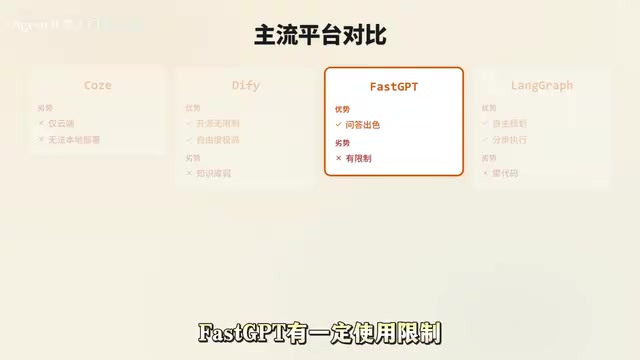
The core conclusion: There's no universally best platform—only the best fit for your scenario. In practice, you can absolutely mix and match multiple platforms to maximize their respective strengths.
LLM Selection Logic
Model selection can follow a simple decision tree:
- No sensitive data + need for peak reasoning accuracy: Go with top-tier models like OpenAI or Gemini
- Everyday translation, summarization, basic copywriting: Domestic Chinese models are more than sufficient, with DeepSeek offering particularly outstanding cost-effectiveness
- Sensitive/private data involved: Consider locally deployed open-source models (e.g., Llama series)
It's worth noting that model selection also needs to account for context window length (determining how much information can be processed at once), multimodal capabilities (whether image/audio understanding is supported), and API call stability and latency. In commercial scenarios, model stability is often more important than peak performance.
Tool Selection: The Bridge to the External World
Platforms alone can only leverage an LLM's language capabilities. To enable web search, image generation, cross-system integration, and data collection, you must rely on external tools. Tools fall into two categories:
- Tools with API interfaces: Can be directly integrated and configured in platforms like Coze and Dify—simple and efficient
- Websites and systems without API interfaces: Require RPA browser automation technology to simulate human operations
RPA (Robotic Process Automation) is a technology that uses software robots to simulate human computer operations. In AI Agent scenarios, when target systems don't offer open APIs, RPA tools (such as Selenium, Playwright, browser extensions, etc.) can simulate clicks, inputs, scrolling, and other actions to complete data collection and system integration. These technologies need to handle dynamically rendered pages, CAPTCHAs, session maintenance, and other challenges. In actual deployment, you also need to consider target websites' anti-scraping policies and compliance issues.
This also explains why many people encounter "unable to scrape webpage" problems—most scraping failures occur because dynamic pages don't have open interfaces or websites have anti-scraping mechanisms in place, requiring automated browser tools to resolve.
Step 3: Prompt Engineering — The Core Soul of an AI Agent
High-quality prompts can directly improve LLM output accuracy, ensure conversational context coherence, and significantly reduce token consumption and commercial operating costs.
A token is the basic unit of measurement for how large language models process text—in Chinese, approximately every 1-2 characters corresponds to one token. In commercial scenarios, each API call is billed based on the number of input and output tokens. Taking GPT-4 as an example, the cost per million tokens is in the tens of dollars range. Therefore, reducing token consumption through concise prompts, controlled output length, and proper caching is a cost optimization aspect that cannot be ignored in commercial AI Agent operations. A well-designed prompt system can reduce token consumption by 30%-50% while maintaining output quality.

Mastering prompt engineering requires understanding these key elements:
- Professional prompt frameworks: CRISPE, BROKE, ICIO, and other proven commercial prompt frameworks
- Advanced interaction techniques: Splitting long content across multiple outputs, using special delimiters to separate information, adding reference examples, breaking complex tasks into steps
- Strict output specifications: Explicitly constrain word count, format, style, and language difficulty
The CRISPE framework encompasses six dimensions: Capacity (role capabilities), Request (request content), Insight (background insights), Statement (output declaration), Personality (persona style), and Experiment (iterative experimentation). The BROKE framework constructs prompts across five layers: Background, Role, Objectives, Key Results, and Evolve. The core value of these frameworks lies in structuring vague natural language instructions, significantly reducing LLM hallucination rates and output instability.
These methods address the common problems of AI "giving irrelevant answers, producing chaotic output, and generating non-standard content" at their root. Prompt engineering isn't as simple as writing a single sentence—it's a systematic engineering methodology that requires repeated refinement. In actual commercial use, a mature prompt set often requires dozens or even hundreds of iterative tests before achieving stable, reliable results.
Step 4: Database Configuration — The Foundation of Commercial Data Storage
Chat records generated during AI Agent operation, collected business data, and knowledge base materials all require dedicated databases for storage and management. The tutorial provides differentiated recommendations for different audiences:
- Non-technical beginners: Feishu (Lark) Multidimensional Tables are the top choice. Highly visual, easy to operate, and convenient to integrate—perfectly suited for lightweight commercial scenarios. The downside is that read speeds slow down with large data volumes, and complex business logic cannot be handled.
- Technical practitioners/enterprise use: Professional databases like MySQL and NoSQL are recommended, capable of handling large data volumes, high concurrency, and complex business scenarios with better stability and security guarantees.
A supplementary note on database type differences: MySQL is a representative relational database, suited for structured data storage and complex queries where data has clear relationships. NoSQL databases (like MongoDB, Redis) excel at handling unstructured or semi-structured data with better horizontal scalability. In AI Agent scenarios, conversation records and user profiles are often well-suited for NoSQL storage, while orders, financial data, and other structured business data are better suited for relational databases. Vector databases (like Pinecone, Milvus) are core components for knowledge base retrieval, storing semantic vectors of text and enabling similarity search.

This tiered recommendation is highly pragmatic—don't choose a solution beyond your capabilities just for the "tech factor." Whatever solves the problem is a good solution.
Step 5: UI Development — The Leap from Tool to Product
A professional UI is the critical step that elevates an AI Agent from a "personal tool" to a "commercial product."
UI capabilities vary significantly across platforms:
- Coze: Supports custom DIY interfaces
- Dify: Comes with a ready-made interface, but customization options are limited
- Both platforms support API service publishing, allowing you to develop a dedicated frontend independent of the official interface
The core advantage of building a custom UI: unified management of multiple AI Agents with different functions, with all operations consolidated on a single page, making commercial delivery and presentation far more professional. Even zero-experience users can quickly develop custom interfaces using AI coding assistants like Cursor.
Cursor is an IDE (Integrated Development Environment) with integrated AI code generation capabilities that can automatically generate frontend page code from natural language descriptions. Similar tools include V0 (Vercel's AI frontend generation tool), Bolt.new, and others. These tools have dramatically lowered the barrier to UI development, enabling non-professional developers to build usable product interfaces within hours. However, it's important to note that AI-generated code still requires human review and debugging, particularly in areas involving user data security and interaction logic.
Step 6: Evaluation and Testing — Essential Safeguards Before Commercial Launch
Just because an Agent runs normally doesn't mean it's ready for commercial deployment. Testing and evaluation are two different dimensions of work:
- Testing: Identifying program errors, model failures to recognize tasks, request anomalies, and other technical issues
- Evaluation: Optimizing output quality to ensure answers are accurate, logically rigorous, and properly formatted
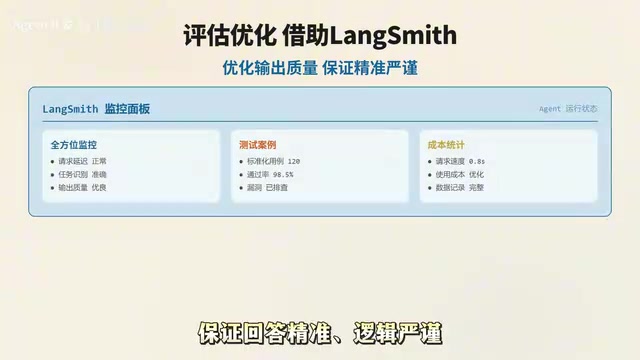
The tutorial recommends using LangSmith for comprehensive monitoring, specifically:
- Monitoring Agent runtime status and identifying program vulnerabilities
- Building standardized test case sets
- Tracking request speed and token usage costs
- Completely recording every Q&A interaction and its parameters
- Continuously iterating and optimizing to reduce commercial operating costs
LangSmith is an LLM application observability and evaluation platform developed by the LangChain team, offering full-chain tracing, automated evaluation, dataset management, and A/B testing capabilities. It records the complete execution chain of every Agent call, including inputs/outputs at each node, latency times, and token consumption, helping developers quickly identify performance bottlenecks and quality issues. Similar observability tools include LangFuse (an open-source alternative), Weights & Biases, and others—enterprises can choose the appropriate solution based on budget and deployment requirements.
This step is often overlooked by beginners, but it directly determines the reliability and user experience of an AI Agent in real business scenarios. It's recommended to prepare at least 50-100 test cases covering various edge cases, including normal inputs, abnormal inputs, extreme-length inputs, multilingual mixed inputs, and other scenarios.
Step 7: Deployment and Release — Final Launch and Delivery
Deployment approaches vary significantly across platforms:
- Coze: One-click publishing to ecosystem platforms like Doubao and WeChat Mini Programs—streamlined launch process
- Dify: Can be directly packaged and published as an independent external application
- Deep customization: Purchase dedicated servers for independent private deployment, meeting enterprise-grade security and performance requirements
Private deployment typically involves cloud server procurement (e.g., Alibaba Cloud, Tencent Cloud, AWS), Docker containerization, Nginx reverse proxy configuration, SSL certificate deployment, domain registration, and more. For enterprise-grade applications, you also need to consider load balancing, auto-scaling, data backup, disaster recovery, and other high-availability architecture designs. While this sounds complex, modern cloud services have simplified most infrastructure operations into visual configurations, and combined with AI coding tools, developers with intermediate technical skills can complete deployment independently.
Summary: Deployment Recommendations by Role
The core value of this seven-step framework lies in providing a complete mental model that helps people of different backgrounds find their entry point:
- Zero-experience non-technical users: Focus on requirements gathering, no-code platform selection, prompt engineering, and Feishu database solutions for rapid lightweight deployment
- Developers with some technical background: Explore platform mixing and matching, professional database configuration, custom UI development, and private deployment in depth
- Enterprise decision-makers: Focus on overall architecture design, security compliance, cost control, and continuous iteration mechanisms
It's important to note that technology in the AI Agent space evolves extremely fast—specific platforms and tools may continuously update and change. However, this methodology framework from requirements to deployment has strong universality. Once you've mastered the methodology, switching tools is merely an execution-level adjustment.
From an industry trend perspective, in 2024 AI Agents are evolving from single-task types toward multi-Agent collaboration, and the emergence of standard protocols like MCP (Model Context Protocol) is driving interoperability across the Agent ecosystem. In the future, the barrier to building AI Agents will continue to decrease, but requirements for business understanding depth and system architecture capabilities will only increase. The earlier you establish a systematic building methodology, the better positioned you'll be to gain first-mover advantage in this technology wave.
Key Takeaways
Related articles

The Truth Behind Codex 'Build a Website in 5 Minutes': AI Isn't Creating Sites—It's Helping You Copy Them
Exposing the truth behind viral Codex 5-minute website videos: creators aren't building original sites with AI—they're copying shared prompts or scraping others' work. Learn AI coding tools' real limits.

Getting Started with AI Agent Development: A Complete Guide from Concept to Practice
A comprehensive guide to AI Agent architecture and development, covering automated marketing, intelligent customer service, and investment analysis scenarios with single and multi-agent collaboration.

The Truth Behind Codex 'Build a Website in 5 Minutes': AI Isn't Creating Sites — It's Helping You Copy Them
Exposing the truth behind viral Codex 5-minute website videos: creators aren't building original sites with AI — they're copying shared prompts or scraping others' work.