A Complete Breakdown of the Engineering Challenges Behind RAG and Agent Interview Questions

A systematic breakdown of the real engineering challenges behind RAG and Agent interview questions.
Filling your resume with RAG, Agent, and multimodal buzzwords isn't enough—interviewers care whether you can build production-grade systems. This article covers data cleaning, chunking strategy, hybrid retrieval, reranking, hallucination protection, agent safety boundaries, loop circuit breakers, and multimodal cross-validation.
Many candidates fill their resumes with buzzwords like RAG, Agent, and multimodal, yet after sending out dozens of applications, they keep failing the technical interviews. The problem isn't that you can't use the tools—it's that you only know how to "get a demo running" and can't clearly articulate the truly tricky engineering challenges in production environments. Based on frontline project experience, this article systematically organizes the "hidden test points" that interviewers care about, helping you make the cognitive leap from library-caller to architect.
What Are Interviewers Actually Testing?
When many people build projects at home, the input data is always perfect and user queries are always well-formed. This "smooth sailing" scenario is called the Happy Path in engineering. For example, you get a PDF, read it in without a second thought, dump it straight into a vector database without any denoising or cleaning, and rely solely on the most basic vector matching during retrieval.
But real business is a "muddy road in a rainstorm." Interviewers evaluate you with the strict standards of a production environment:
- You dumped the file in directly? They'll follow up: Did you clean the data? How did you design your chunking strategy? What happens when headers, footers, and ad noise get retrieved as knowledge?
- You only used vector retrieval? They'll ask: How do you use hybrid retrieval and reranking to improve recall?
- What happens when the system throws an error? How do you detect when the LLM starts fabricating data? How do you break out when an agent gets stuck in an infinite loop?
Put simply, interviewers don't care whether you can "stack blocks with tools"—they care whether you can turn vague requirements into a production-grade product that runs stably online, in complex real-world scenarios.
Solution Selection: The Gold Standard of ROI
When a business team throws you a vague requirement, a qualified architect has three problem-solving approaches with vastly different costs at their disposal:
- Prompt Engineering—the lightest and cheapest. If the task is just formatted output or simple logical reasoning (e.g., classifying colloquial feedback into complaints/suggestions/inquiries), writing a prompt is enough—fast response, low cost.
- RAG (Retrieval-Augmented Generation)—moderate cost. RAG was formally proposed by the Meta AI research team in 2020. Its core idea is to combine the parametric knowledge of large language models with external non-parametric knowledge bases, dynamically retrieving relevant document fragments as context to inject during inference. This both breaks through the limitation of the model's training data cutoff date and dramatically reduces hallucination rates. When a task heavily depends on a company's private documents or frequently changing domain knowledge (like expense reimbursement rules), RAG is the best choice for supplementing accurate external knowledge.
- Agent—the most capable but costly and high-latency. The theoretical foundation of LLM Agents comes from the ReAct (Reasoning + Acting) framework that spread widely in 2023, centered on the iterative loop of "perceive → think → act → observe." Industrial-grade Agents are typically built on stateful graph frameworks like LangGraph and LlamaIndex Workflows, supporting complex control flows such as conditional branching, parallel execution, and human-in-the-loop interrupts. Only when a task requires the LLM to plan multiple steps on its own and frequently call external interfaces to perform operations (like automatically checking schedules, calculating attendance, or sending approvals) should an Agent be deployed.
The core principle is: ROI must always exceed technical complexity. If a simple solution can get the job done, never force a complex architecture—the best decision is the one that fits the business.
RAG Engineering Deep Dive: From Dirty Data to the Battle for Recall
"Garbage in, garbage out." If you don't preprocess raw data and filter out noise—if you feed the model a mess of garbled text and HTML tags directly—even the strongest recall algorithm can't save you. So before chunking, you must perform a "precision surgery": thorough cleaning and denoising.
The Art of Chunking Strategy
Chunk too large, and the model gets drowsy reading it and loses details; chunk too small, and information becomes fragmented, with semantics that can't be pieced together. There's a key point to make in interviews: never say your chunk size and overlap use default parameters. You need to explain the business-informed reasoning behind them—how you set chunk sizes based on the natural structure of paragraphs and sections, and how overlap prevents semantic breaks across context. Explaining these details lets the interviewer immediately sense that this is a project you personally polished.
The Battle for Recall: Two Core Strategies
User queries are often colloquial, which can lead to serious recall failures. There are two commonly used engineering strategies:
- Semantic Alignment: A user asks, "How do I do that reimbursement thing, it's stuck in the process," while the document title is "Travel Expense Standards and Subsidy Disbursement Rules"—they don't match at all on the surface. You need to use an LLM to rewrite and expand the query, translating it into multiple expressions that conform to the document's terminology.
- Hybrid Retrieval + Reranking: Dense Retrieval encodes text into high-dimensional dense vectors via neural networks and computes semantic similarity through cosine similarity, excelling at synonyms and semantic leaps; traditional BM25 keyword retrieval is based on word frequency statistics and is superior at exact entity name matching. Each has its blind spots. Hybrid retrieval merges the two scores through algorithms like RRF (Reciprocal Rank Fusion), balancing semantic understanding and literal precision to coarsely rank a large batch of candidate fragments. Then introduce a Rerank model—these cross-encoders jointly model the query and candidate documents after concatenation, capturing finer-grained interaction information, re-scoring the candidate set precisely to pick the best few from dozens of candidate chunks.
Practice shows that just a few hundred milliseconds of extra latency can buy you over 90% precise recall from your knowledge base. This is exactly where architects with real engineering deployment experience pull ahead of ordinary library-callers.
Hallucination Protection: Better to Say "I Don't Know"
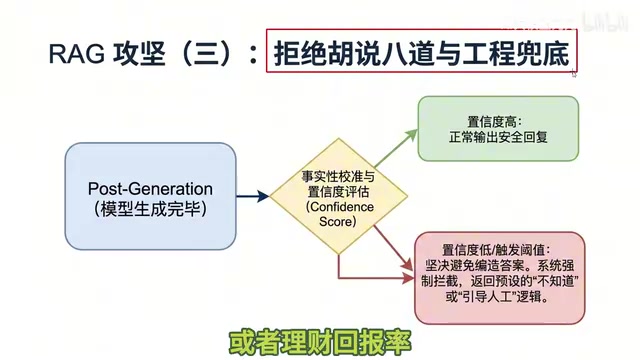
In serious scenarios like healthcare, finance, and customer service, if an LLM fabricates a fake prescription or investment return rate, it creates enormous legal risk for the company. LLM hallucinations fall into two categories: factual hallucinations (fabricating facts that don't exist) and faithfulness hallucinations (generating content inconsistent with the provided context). In RAG scenarios, faithfulness hallucinations are more harmful and more insidious—the model clearly has the retrieved documents, yet quietly "improvises" content beyond the document's scope in its answer. So in these scenarios, it's better to let the model honestly answer "I don't know" than to let it fabricate an answer.
The engineering approach is to add a step of factual calibration and confidence assessment after generation: use evaluation frameworks like RAGAS and TruLens to automatically score Answer Faithfulness. The underlying principle is to use a judge LLM to verify whether each sentence of the generated answer can find explicit support in the retrieved documents. High scores get output normally; but once confidence is too low or a preset threshold is triggered, the system forcibly intercepts and triggers fallback logic—returning a polite "no relevant content found" or guiding the user to a human agent. With this safety net, the system truly achieves production-ready safety.
Agent Deep Dive: Safety Boundaries and Infinite Loop Circuit Breakers
Many people think an agent is just letting an LLM call a couple of APIs, but real business is far from that simple. When you let a model call tools, you must draw clear decision boundaries, treating them by risk level:
- Safe operations (like petting a kitten): general information queries, reading databases—the agent can be allowed to plan autonomously and run fully automatically.
- Sensitive operations (like using a microwave): modifying configurations, automatically sending emails—the system must pause and trigger a confirmation mechanism, executing only after a human clicks to confirm.
- High-risk operations (like landmines): modifying core databases, transferring funds—the system must absolutely block and forcibly hand off to a human.
The Human-Machine Collaboration Switching Mechanism
The system is normally in automatic mode, but once specific conditions are triggered (confidence too low, hitting sensitive words, out-of-scope questions, logical conflicts), it initiates the switching pipeline: the agent proactively requests human intervention and immediately freezes the current session state, preserving the context intact.
It's like hitting a level in a single-player game you can't beat—you save your progress, get an expert to carry you, then load the save and continue after clearing it. Once the human finishes, they can selectively re-inject the result and context back into the system, letting the LLM seamlessly take over. This "Human-in-the-Loop" mechanism is natively supported through interrupt nodes in frameworks like LangGraph. It both safeguards business operations and is one of the highest-scoring items that proves project maturity in interviews.
Three Safeguards Against Reflection Infinite Loops
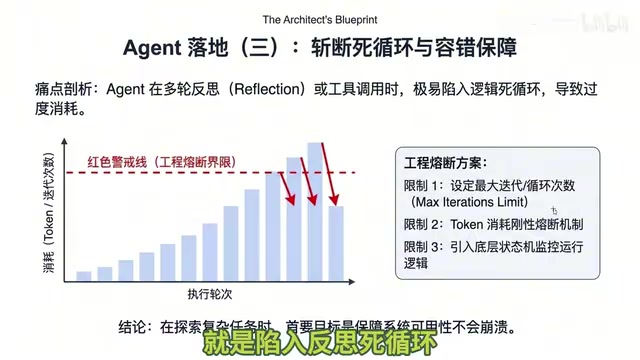
Sometimes an LLM is "too responsible"—during multi-turn tool calls or self-reflection, it gets stuck in some error and keeps trying: tool errors → change a parameter → error again → reflect again... Not only does it fail to solve the task, it burns tokens like crazy. You wake up to find hundreds of dollars gone and the task still incomplete. This problem is especially common in ReAct-based Agents, because the framework encourages the model to keep generating new action plans after observing errors, lacking native termination protection.
In engineering, you must add three hard safeguards:
- Maximum iteration/loop count limit: force a stop when the count is reached.
- Rigid token consumption circuit breaker: intercept immediately when spending exceeds the threshold.
- Low-level state machine monitoring: compare the hashes of the model's recent output actions—once abnormal repetition is detected (the brain freezing), immediately alert and forcibly terminate.
Ensuring system availability and preventing crashes is always the top priority.
Multimodal in Practice: Dual-Model Cross-Validation
Real enterprise documents are far more than plain text—quarterly financial reports contain stamped scanned images, tables with complex merged cells, and large blocks of unstructured text. If you only use a traditional text parser, the key trend charts and table data in images are completely lost.
The core goal is to cross the semantic gap between modalities through multimodal data parsing and hybrid feature representation, accurately linking visual information with textual context during retrieval and generation.
Automatic Error Correction: The Detail-Obsessed Specialist + The Big-Picture Generalist
Whether it's OCR or a vision LLM, both have inherent recognition errors. Traditional OCR engines (like PaddleOCR, Tesseract) have high accuracy for printed text recognition but limited ability to understand complex layouts and mixed text-image content; multimodal LLMs represented by GPT-4V and mPLUG-DocOwl can simultaneously understand text, position, and visual features, but occasionally make mistakes on numerical precision. If you blindly trust an OCR result and miss a zero in an invoice amount, financial auditing could suffer a major incident. The core principle is: never blindly trust a single model's output.
The engineering approach is to feed the raw image into two models simultaneously: one is a dedicated OCR model (the "detail-obsessed specialist" responsible for extracting textual details), and the other is a general multimodal LLM (the "comprehensive generalist" responsible for capturing the overall big picture). The two results enter a cross-validation stage: if they agree, output directly; if they disagree, trigger multi-stage cross-checking combined with a business rule base for secondary verification. This approach of hedging single-model random errors with system-level redundancy has become the industry standard practice in critical scenarios like finance and law, and truly brings multimodal applications into production environments.
The Golden Project Narrative Formula: Make the Interviewer Remember You
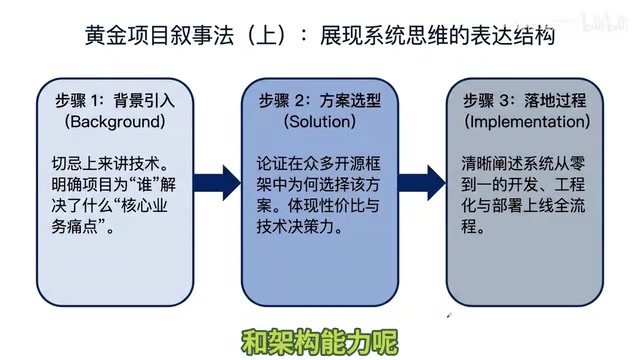
With the hardcore tech explained thoroughly, how do you express it in an interview to demonstrate systems thinking? Interviewers hear candidates say "I used the top open-source framework" every day—their ears have gone numb. You need a structured narrative formula:
- Set the context: Don't start by dryly reciting your tech stack. First clearly explain what core business pain point the project solved and for whom in the company, proving your deep insight into the business.
- Explain solution selection: Deeply argue why you chose this approach among many technical paths rather than a more complex one, showing your cost-benefit consideration and technical decision-making ability.
- Explain the delivery process: Logically articulate the full pipeline from zero-to-one development, engineering buildout, to deployment and launch.
- Post-mortem on pitfalls (the key to standing out): Proactively share the hardcore bottlenecks—like extremely low recall or agent infinite loops—detailing your troubleshooting approach, the solutions you tried, and how you ultimately solved it with engineering defenses. Only those who have truly stepped on these pitfalls can describe these details.
- Results comparison (the value anchor): Don't use vague phrases like "it worked well." Bring quantified metrics directly—response time reduced by 1.2 seconds, recall improved by 25%, withstood concurrency pressure—and clearly show the business value before and after optimization.
Conclusion: Foundational Competitiveness Never Goes Out of Date
The underlying core of competition in the LLM industry has never been about who masters more frameworks or can recite more technical jargon—those are all superficial, and frameworks get refactored every three months. But foundational systems thinking and business insight never go out of date.
What enterprises truly need is your ability to polish vague, chaotic business requirements into stable, usable, deployment-ready products with strong exception-handling capabilities that continuously create business value. Stop the meaningless piling up of jargon, and re-examine every seemingly simple API call with the mindset of a true systems architect—be the tech helmsman who understands the business, not the replaceable cog.
Related articles

The Truth Behind Codex 'Build a Website in 5 Minutes': AI Isn't Creating Sites—It's Helping You Copy Them
Exposing the truth behind viral Codex 5-minute website videos: creators aren't building original sites with AI—they're copying shared prompts or scraping others' work. Learn AI coding tools' real limits.

Getting Started with AI Agent Development: A Complete Guide from Concept to Practice
A comprehensive guide to AI Agent architecture and development, covering automated marketing, intelligent customer service, and investment analysis scenarios with single and multi-agent collaboration.

The Truth Behind Codex 'Build a Website in 5 Minutes': AI Isn't Creating Sites — It's Helping You Copy Them
Exposing the truth behind viral Codex 5-minute website videos: creators aren't building original sites with AI — they're copying shared prompts or scraping others' work.