A Complete Guide to Nuxt: Core Features and Best Practices of the Vue Full-Stack Framework

A deep dive into Nuxt, the Vue.js full-stack meta-framework, and its core features.
Nuxt is a full-stack web framework built on Vue.js. This article explores its core features—convention over configuration, flexible rendering modes (SSR/SSG/Hybrid), the Nitro engine, file-system routing, and Vite-powered developer experience—along with use cases and selection advice.
What Is Nuxt
Nuxt is a full-stack web framework built on Vue.js. It has already accumulated over 60,727 Stars and 5,842 Forks on GitHub, and maintains steady daily growth in its star count. As one of the most important meta-frameworks in the Vue ecosystem, Nuxt is written in TypeScript and provides developers with a complete solution spanning server-side rendering (SSR), static site generation (SSG), and full-stack application development.
What is a meta-framework? A meta-framework is a higher-level framework built on top of a foundational UI framework. It does not replace the underlying framework, but rather provides a complete engineering solution around it. In addition to Nuxt (based on Vue), Next.js (based on React), SvelteKit (based on Svelte), and Analog (based on Angular) all fall into this category. The core value of a meta-framework lies in solving the "last mile" problem: when developers build real applications with Vue or React, they still need to solve issues like routing, SSR, code splitting, and data prefetching on their own. Meta-frameworks codify these decisions into conventions, dramatically lowering the barrier to building production-grade applications from scratch.
If Vue solves the problem of the "view layer," then Nuxt extends its scope to the entire application architecture level—it handles a series of tedious configurations such as routing, data fetching, state management, build optimization, and deployment on the developer's behalf, allowing teams to focus their energy on the business logic itself.
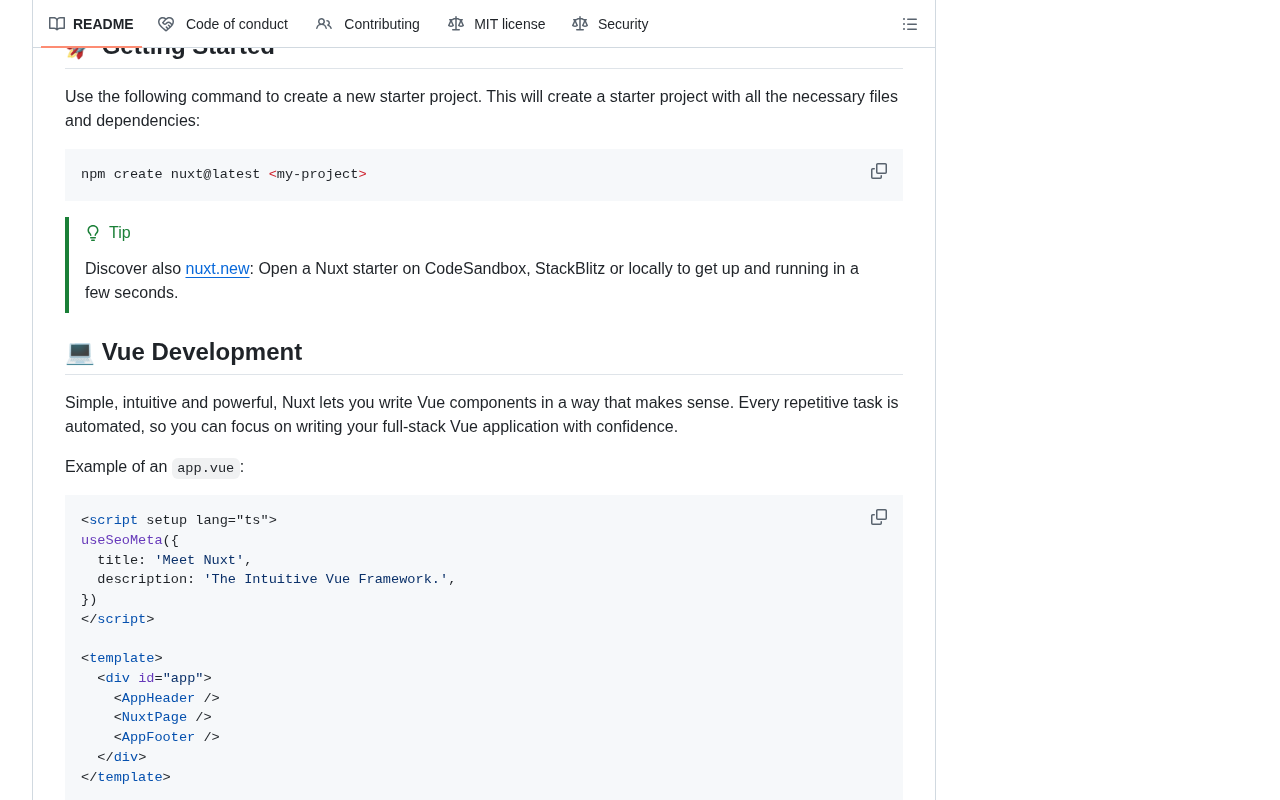
Analysis of Nuxt's Core Features
Convention over Configuration: Say Goodbye to Boilerplate
The most central design philosophy of Nuxt is "Convention over Configuration" (CoC)—a paradigm first popularized by the Ruby on Rails framework: the framework presets a set of sensible default rules, and developers only need to configure explicitly when they want to deviate from the default behavior, rather than writing configuration code for every detail.
In Nuxt, this philosophy is embodied especially thoroughly. Developers simply place Vue components in the pages/ directory, and Nuxt automatically generates the corresponding routes; place layouts in layouts/ and components in components/, and the framework automatically handles registration and imports. This file-system-based convention greatly reduces the amount of boilerplate code in a project—place a component file at pages/about.vue, and the framework automatically maps it to the /about route, with no need to maintain a separate routing configuration file. This not only unifies the team's understanding of project structure and lowers the onboarding cost for new members, but also provides a predictable structural foundation for toolchains such as IDE plugins and code generators.
Flexible Multiple Rendering Modes
One of Nuxt's major highlights is its flexible rendering strategies, which can be freely switched based on actual needs:
- Server-Side Rendering (SSR): The server dynamically generates the complete HTML on each request before returning it to the client, significantly improving the first-screen blank-page problem and allowing search engine crawlers to directly capture the full content—crucial for SEO;
- Static Site Generation (SSG): Static HTML files for all pages are pre-generated during the build phase and returned directly on request, without any server-side runtime computation. This is ideal for blogs and documentation sites where content updates infrequently, and it can be deployed to CDN edge nodes for extremely low latency;
- Client-Side Rendering (CSR): Similar to a traditional SPA application, all rendering is done in the browser;
- Hybrid Rendering: Different routes within the same project adopt different strategies—for example, the homepage uses SSR to ensure real-time content, while documentation pages use SSG to boost performance, balancing flexibility and efficiency.
This "choose as needed" capability enables Nuxt to cover a wide range of scenarios, from marketing landing pages to complex backend systems.
Full-Stack Development Capabilities Powered by the Nitro Engine
With its built-in Nitro server engine, Nuxt is no longer confined to the scope of a frontend framework. Nitro is a next-generation server engine developed specifically by the Nuxt team. Its core innovation lies in the "universal deployment adapter" mechanism: at build time, Nitro compiles server-side code into the artifacts of the target platform, allowing the same codebase to run seamlessly on traditional Node.js servers, serverless functions such as AWS Lambda, and edge computing environments such as Cloudflare Workers—the latter runs code on CDN nodes closest to the user, rather than in centralized data centers, compressing response latency for users worldwide down to the millisecond level.
Nitro also has built-in capabilities such as H3 (a minimalist, high-performance HTTP framework), file-system routing, and automatic code splitting, positioning it far beyond traditional frameworks like Express/Koa. Developers can write API endpoints, middleware, and server-side logic directly in the server/ directory, achieving true full-stack development, and can deploy to mainstream platforms such as Vercel, Netlify, and Cloudflare with almost no code changes.
The Nuxt Technology Ecosystem and Development Experience
A Rich Modular Ecosystem
Nuxt has a thriving module ecosystem. Through modules provided by both the official team and the community, developers can integrate common features such as Tailwind CSS, PWA, image optimization, internationalization, and content management with a single line of configuration. This "plug-and-play" module mechanism significantly improves development efficiency while keeping the framework core lean.
An Exceptional Developer Experience
Nuxt deeply integrates Vite as its default build tool. Vite was developed by Evan You, the creator of Vue, and its revolutionary aspect lies in leveraging the browser's native ES Module support to enable "on-demand compilation" during development—there is no need to bundle the entire project at startup, so cold-start times can drop from minutes to under a second, and Hot Module Replacement (HMR) only needs to recompile the changed module rather than the entire bundle, delivering an extremely fast development feedback experience.
Combined with Nuxt's unique auto-import mechanism, the framework uses static analysis and virtual module techniques during the compilation phase to automatically identify Composables, components, and Vue APIs used in the code (such as ref and computed), and injects the corresponding import statements. Developers no longer need to manually write import { ref } from 'vue', which reduces repetitive code and avoids runtime errors caused by missing imports, while TypeScript type inference remains fully intact. Comprehensive TypeScript support and DevTools debugging tools also make type checking and troubleshooting smoother and more efficient.
Nuxt Use Cases and Selection Advice
For teams already familiar with Vue, Nuxt is almost the first choice for building production-grade applications. It is particularly well suited for the following scenarios:
- Content-driven websites or e-commerce applications that require strong SEO performance;
- Small-to-medium teams that pursue rapid iteration and wish to minimize infrastructure configuration;
- Projects that require integrated frontend-backend development to reduce overall tech-stack complexity.
Of course, if you only need to build a minimal static page, or if your team prefers the React ecosystem, Nuxt may not be the optimal solution—but within the Vue world, it is undoubtedly the most mature and complete full-stack framework option available today.
Conclusion
Judging by its community scale of over 60,000 Stars, Nuxt has become an indispensable piece of infrastructure in the Vue ecosystem. With its core philosophy of convention over configuration, its flexible and diverse rendering modes (SSR/SSG/Hybrid Rendering), and the cross-platform full-stack capabilities granted by Nitro, Nuxt has redefined how Vue applications are developed. For teams that want to maintain development efficiency while balancing performance and SEO, Nuxt is well worth in-depth learning and long-term practice.
Key Takeaways
Related articles

The Truth Behind Codex 'Build a Website in 5 Minutes': AI Isn't Creating Sites—It's Helping You Copy Them
Exposing the truth behind viral Codex 5-minute website videos: creators aren't building original sites with AI—they're copying shared prompts or scraping others' work. Learn AI coding tools' real limits.

Getting Started with AI Agent Development: A Complete Guide from Concept to Practice
A comprehensive guide to AI Agent architecture and development, covering automated marketing, intelligent customer service, and investment analysis scenarios with single and multi-agent collaboration.

The Truth Behind Codex 'Build a Website in 5 Minutes': AI Isn't Creating Sites — It's Helping You Copy Them
Exposing the truth behind viral Codex 5-minute website videos: creators aren't building original sites with AI — they're copying shared prompts or scraping others' work.