ag-kit: A Deep Dive into the TypeScript-Based AI Agent Development Toolkit

Deep dive into ag-kit, a TypeScript-native modular toolkit for building AI Agent applications.
This article provides a comprehensive analysis of ag-kit, a TypeScript-based AI Agent development toolkit on GitHub with 7,840 Stars. It explores the project's modular architecture, the advantages of using TypeScript for type-safe Agent development, its fit within the full-stack JavaScript ecosystem, and practical guidance on when to choose it over Python-based alternatives like LangChain.
Project Overview: What is ag-kit?
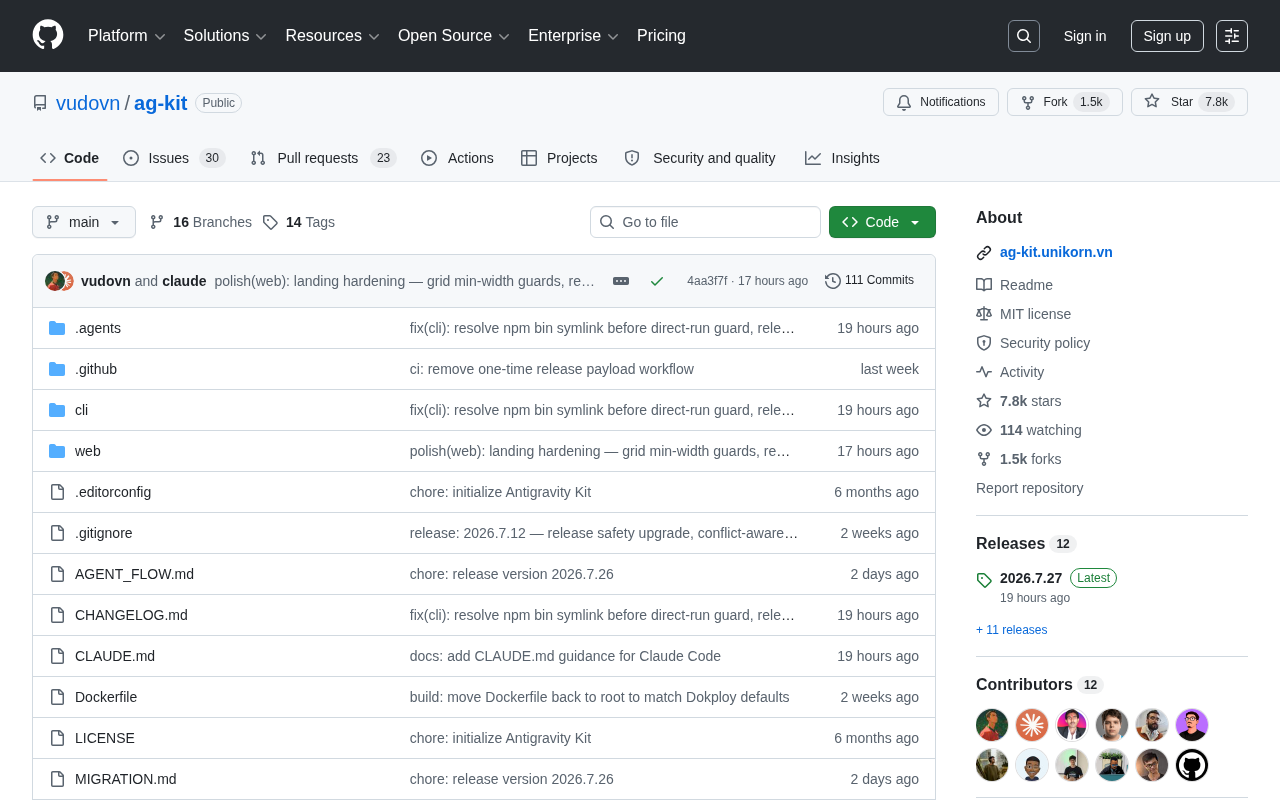
As the AI Agent wave sweeps across the entire software engineering landscape, a new generation of open-source tools focused on lowering the development barrier is emerging. vudovn/ag-kit on GitHub is a prime example. Built on TypeScript, this AI Agent development toolkit has quickly accumulated 7,840 Stars and 1,504 Forks thanks to its clean architectural design and developer-friendly API, maintaining a steady daily growth in Stars.
An AI Agent refers to an intelligent software system capable of perceiving its environment, making autonomous decisions, and executing actions to accomplish specific goals. Unlike traditional chatbots, Agents possess a closed-loop capability of "planning-execution-reflection" and can invoke external tools (such as search engines, databases, and APIs) to complete complex tasks. Since 2023, with the leaps in reasoning capabilities of large language models like GPT-4 and Claude, Agent development has transitioned from academic research to engineering practice. The explosion of projects like AutoGPT, LangChain, and CrewAI marks this field's official entry into a rapid growth phase.
For teams looking to quickly build AI Agent applications, ag-kit offers more than just a codebase—it provides an engineering mindset: how to abstract complex Agent logic into reusable, composable modules. The choice of TypeScript as the primary language also means it naturally fits into the modern Web and Node.js ecosystem, seamlessly integrating into full-stack frontend projects.
Why Build AI Agent Tools with TypeScript
Enhanced Developer Experience Through Type Safety
In Agent development, tool calling, state management, and message routing often involve extensive data structure definitions. Tool calling is one of the core mechanisms in modern AI Agent architecture—during reasoning, the large language model identifies that the current task requires external capabilities (such as querying weather, executing code, or accessing databases) and generates a structured function call request (typically in JSON format). The Agent runtime then parses and executes the corresponding tool function, feeding the results back to the model for continued reasoning. OpenAI pioneered this with its Function Calling API in June 2023, followed by similar mechanisms from Anthropic, Google, and other providers.
While JavaScript's dynamic nature offers flexibility during rapid prototyping, it can introduce hidden risks when building complex, maintainable Agent systems. ag-kit adopts TypeScript, shifting type checking to the coding stage so developers get complete type hints and error feedback when writing tool definitions and Agent configurations.
This is particularly critical for Agent systems that heavily depend on structured input and output. For example, when defining a tool that an Agent can call, parameter type constraints can map directly to the Schema used for interacting with the large language model, reducing failed calls caused by runtime parameter errors. Specifically, TypeScript interfaces and type definitions can automatically generate corresponding JSON Schemas through libraries like zod and typebox. This means developers only need to maintain a single TypeScript type definition to simultaneously gain IDE intellisense, compile-time type validation, and runtime parameter verification—dramatically reducing the common error of "type definitions inconsistent with actual data."
Embracing the Full-Stack Frontend Ecosystem
Unlike many Python-centric Agent frameworks, ag-kit stands firmly on the JavaScript/TypeScript ecosystem side. This means a vast number of Web developers can enter the Agent development field using their familiar language stack, without switching back and forth between Python and Node.js.
The advantages of this isomorphic development approach manifest at multiple levels: the frontend conversation interface and backend Agent logic can share type definitions and data models; tool functions can be reused on both browser and server sides; deployment to Serverless platforms like Vercel or Cloudflare Workers requires no additional language runtime. For scenarios that need to embed Agent capabilities into web pages, desktop applications, or Serverless functions, this isomorphic advantage greatly simplifies engineering complexity—forming a stark contrast with Python Agent frameworks that typically require independent backend services.
ag-kit's Core Value and Modular Architecture
From Building from Scratch to Modular Assembly
Agent application development typically involves several core components: integration with large models, tool registration and invocation, context and memory management, and multi-step reasoning orchestration.
Among these, context and memory management is a key technical challenge for implementing multi-turn conversations and long-running tasks. Short-term memory typically refers to the current conversation's context window, limited by the large language model's token cap (e.g., 128K tokens for GPT-4 Turbo); long-term memory requires external storage, with common solutions including vector databases (such as Pinecone and Weaviate) for storing semanticized historical information, and structured databases for recording user preferences and task states. A high-quality memory management system needs to address information retrieval accuracy, context compression, and cross-session state persistence.
The core value of toolkits like ag-kit lies in encapsulating these components as standardized modules, allowing developers to assemble their own Agents like building blocks rather than reinventing the wheel. This modular design lowers the entry barrier for beginners while preserving customization space for advanced users. Developers can use out-of-the-box default configurations to quickly validate ideas, or dive deep to replace or extend specific modules.
The Real Demand Behind Community Popularity
The 7,840 Stars and 1,504 Forks reflect a genuine demand in the developer community for lightweight, TypeScript-native Agent tools. In the GitHub ecosystem, Stars typically represent user attention and bookmarking, while Forks indicate users copying the repository to their own accounts for modification or secondary development. Generally, well-known open-source projects have a Fork/Star ratio between 5%-15%, while ag-kit's approximately 19% ratio is significantly above average. This indicates the project not only attracts passive observers but also inspires substantial active participation from developers. A high Fork rate typically also suggests clear code structure and good extensibility, lowering the barrier for secondary development.
Compared to feature-heavy frameworks with steep learning curves, ag-kit wins with "sufficient yet clear." The fact that Forks account for nearly one-fifth of Stars also suggests that a considerable number of users aren't just bookmarking—they're genuinely building upon it for secondary development and practice.
Use Cases and Technology Selection Recommendations
Who Should Use ag-kit
If your tech stack is primarily Node.js or frontend-focused, and you want to integrate AI Agent capabilities into existing Web projects, ag-kit is worth evaluating. It's particularly suited for the following types of needs:
- Rapid prototype validation: Need to quickly get an Agent Demo with tool-calling capabilities up and running
- Full-stack unified projects: Frontend and backend both use TypeScript, avoiding the need to introduce additional Python runtime environments
- Lightweight deployment: Targeting Serverless or edge computing scenarios with minimal dependency footprint
Regarding lightweight deployment, Serverless architecture is a cloud computing model that executes on demand and bills per invocation, freeing developers from managing underlying server infrastructure. AWS Lambda, Vercel Serverless Functions, and Cloudflare Workers are typical representatives. Edge computing deploys compute nodes closer to users at the network edge, reducing latency. For AI Agent applications, a lightweight TypeScript toolkit naturally suits these deployment models—Node.js cold start times are far shorter than Python's, dependency sizes are smaller, and platforms like Cloudflare Workers directly support JavaScript runtimes. This enables Agent capabilities to be embedded in globally distributed applications with minimal operational costs.
Trade-offs Compared to Python Agent Frameworks
Any technology selection must consider practical context. For projects that depend on a rich machine learning ecosystem (such as complex vector retrieval or fine-tuning workflows), the Python ecosystem currently still offers more comprehensive library support. Take LangChain as an example: its Python version has over 300 integration connectors, covering an extensive tool chain from various vector databases to document loaders. While the JavaScript/TypeScript version is also rapidly maturing, it still has notable gaps in deep learning framework integration and scientific computing library support.
ag-kit excels more at application-layer Agent orchestration and integration rather than underlying model training. Therefore, when making technology decisions, you should clarify whether your project's core need is "application integration" or "foundational R&D." If it's the former and your team's primary skills are in JavaScript/TypeScript, ag-kit can significantly reduce development and deployment friction. If it's the latter, the maturity of the Python ecosystem remains difficult to replace.
Conclusion: ag-kit's Position in the AI Agent Ecosystem
ag-kit's rise is a microcosm of the "democratization" trend in AI Agent development. As large model capabilities become increasingly accessible, enabling more developers to build reliable Agent applications at lower cost has become the focal point of the entire ecosystem. TypeScript-native, modular, close to the Web ecosystem—ag-kit captures these key elements.
From a broader perspective, Agent development tools are undergoing a "layered" evolution: the bottom layer is the continuous improvement of large model reasoning capabilities; the middle layer is the abstraction and orchestration capabilities provided by various Agent frameworks; and the top layer is application development for specific business scenarios. ag-kit positions itself in the middle layer and has chosen TypeScript—the language with the largest developer base in Web development—making its growth potential directly tied to the prosperity of the JavaScript/TypeScript ecosystem.
For technology teams following AI Agent development, continuously tracking the evolution of such open-source tools may provide a competitive edge in the next wave of intelligent applications.
Key Takeaways
Related articles

The Truth Behind Codex 'Build a Website in 5 Minutes': AI Isn't Creating Sites—It's Helping You Copy Them
Exposing the truth behind viral Codex 5-minute website videos: creators aren't building original sites with AI—they're copying shared prompts or scraping others' work. Learn AI coding tools' real limits.

Getting Started with AI Agent Development: A Complete Guide from Concept to Practice
A comprehensive guide to AI Agent architecture and development, covering automated marketing, intelligent customer service, and investment analysis scenarios with single and multi-agent collaboration.

The Truth Behind Codex 'Build a Website in 5 Minutes': AI Isn't Creating Sites — It's Helping You Copy Them
Exposing the truth behind viral Codex 5-minute website videos: creators aren't building original sites with AI — they're copying shared prompts or scraping others' work.