Agent Loop: A Design Guide for AI Autonomous Reasoning-Action-Verification Workflows

A practical guide to designing AI agent loops covering goals, validation, and stop conditions.
This guide explains the core principles of AI Agent Loops — the Reason-Act-Observe paradigm — and how to apply them effectively. It covers three loop architectures (Single Loop, Maker-Checker, Supervisor), real-world case studies, and the key elements that make loops work, including verifiable goals, stop conditions, and cost awareness. It also offers a grounded perspective on the "agent fleet" hype.
From "Manual Prompting" to "Designing Loops"
A concept is spreading fast in the AI development community: stop manually writing prompts for coding agents — design a loop that sends prompts to the agent for you.
Hardcore developers like Boris Turney and Peter Steinberger have publicly stated they no longer manually issue instructions to coding agents one by one. Instead, they write "Agent Loops." Some take it even further, arguing that if you're still hand-writing loops, you're already behind — you should build a "meta-agent" that infers your general intent and writes the loop itself.
This methodology, known as "Loop Engineering," has a simple core idea: replace yourself as the "prompter" by designing a system that handles the repetitive prompting and iteration on your behalf.
That said, there's a question worth taking seriously: is this a genuine productivity boost, or just an impressive demo? For most people, blindly spinning up an "agent fleet" running around the clock will likely only amplify problems, leaving behind a pile of errors that need manual fixing.
What an Agent Loop Actually Is
At its core, an agent loop puts the AI through a continuous process: first reason about what to do, then take action, then observe the result — and repeat until a goal is achieved or a stop condition is triggered.
This is the "Reason-Act-Observe" paradigm the industry commonly refers to. It didn't appear out of nowhere — it has solid academic roots in the 2022 paper "ReAct: Synergizing Reasoning and Acting in Language Models", published jointly by Google and Princeton University. ReAct's key breakthrough was combining large language models' chain-of-thought reasoning with external tool-calling, enabling models not just to reason but to genuinely interact with their environment. This is fundamentally different from early prompt engineering — traditional prompts are single-turn Q&A, while a ReAct loop is a continuously iterating state machine. Think of it like a reliable intern: you don't need to micromanage every step. Give them a clear goal, and they'll figure out the next move, check their own work, and keep going — only coming back to tell you "it's done."
Why do loops matter so much? Imagine a chart with "number of attempts" on the X-axis and "quality" on the Y-axis: the AI's first attempt might only reach 50% quality. A human reviews it, gives feedback, and the next attempt jumps 5–10 points. This continues until it reaches 90% or 95% satisfaction.
The key insight is: this feedback-iteration cycle happens regardless. So why not hand it off to an agent instead of doing it yourself? Once you introduce an agent loop, the first attempt can already land at a much higher quality baseline. With a little more feedback, by the third or fourth attempt, quality far exceeds what you'd get without a validation loop.
Two Pillars: Goals and Validation
Regardless of how a loop is designed, two pillars are essential.
Pillar One: A Clear Goal
What exactly is the task you need to accomplish? The ideal goal is objective rather than subjective. Humans are great at defining what they want — the hard part is defining what "done" looks like.
Pillar Two: A Verifiable Stop Condition
How does the agent know when to stop? A helpful analogy: insert a fork into a cake and pull it out — if no batter sticks, it's done. You need to give the agent an equally clear "completion signal."
The ideal loop instruction is: "Keep iterating until metric X equals result Y." But sometimes you can only rely on subjective standards, like "until you're satisfied" or "until you're 100% confident."

One important nuance: most tasks don't actually need a complex loop architecture. In many cases, a simple terminal session with a good prompt delivers a single loop — and that's often the most practical approach. The reason to build some form of loop for most tasks is simply that the "validation" step is too important to skip.
Three Typical Loop Architectures
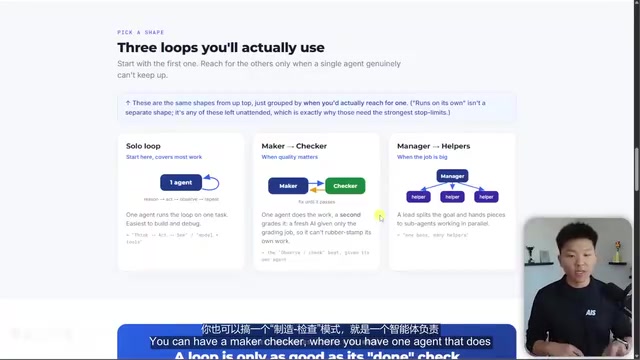
Based on how they're orchestrated, agent loops generally fall into three patterns:
- Single Loop: One agent independently handles reason-act-observe-repeat. The simplest and most common.
- Maker-Checker: One agent does the work; another agent scores and provides feedback.
- Supervisor: A master agent orchestrates a fleet of sub-agents, forming a layered collaborative structure.
The "Maker-Checker" pattern draws from the classic "Four-Eyes Principle" in software engineering and dual-control mechanisms in financial systems. In multi-agent AI systems, its strength lies in allowing the two agents to use different models, different temperature parameters, and even different system prompts — creating genuine "perspective differences" rather than the same model reviewing its own output. OpenAI research has shown that introducing an independent validator can increase code error detection rates by roughly 30%, which is why this pattern is widely adopted in code generation.
Real-World Cases: From Thumbnails to 3D Airplanes
Here are a few real examples that illustrate both the practical impact and the limitations of loop engineering.
Case 1: Designing Video Thumbnails
In Claude Code, an agent was tasked with designing 10 thumbnail concepts, scoring each against a MrBeast YouTube thumbnail rubric (clarity, curiosity, emotional impact, visual contrast), identifying weaknesses, improving, re-scoring, and iterating. The entire process took 27 minutes and produced the highest-scoring design.
But this exposed a classic problem: the definition of "done" was "until you're satisfied," and scoring was entirely subjective. The right fix would be to create a dedicated "scoring sub-agent" and use large-scale evaluation to make the scoring more objectively reliable.
Case 2: Building a 3D Airplane with Three.js
Another case involved building a rotatable 3D airplane purely in Three.js code, taking 37 minutes. The agent built it, then opened a browser to rotate and inspect the render, then iterated. The "open a browser to rotate and inspect" step relies on browser automation — typically via tools like Playwright or Puppeteer — which allow programs to control a real browser in headless or headed mode, take screenshots, detect elements, perform interactions, and feed visual results back to the agent, forming a truly closed perception-action loop. Compared to simply saying "build me a 3D airplane," the result was dramatically better — but the precision of the validation mechanism directly determines the quality ceiling.

Case 3: Recreating the Beatles Album Cover in Pure Code
The most interesting case was recreating the Abbey Road cover. The requirement: no image generation — pure HTML/CSS only — with a stop condition of "average score ≥ 9, maximum 8 iterations." The agent stopped at iteration 7, taking a browser screenshot of the HTML each time to validate it visually. The improvement from version to version was visible to the naked eye.
The final result, however, was nowhere close to the original — which reinforces the core point: the quality of a loop depends entirely on its validation mechanism and completion criteria. Subjective scoring plus the limitations of pure code meant that no amount of iteration could truly approximate the reference image.
What Makes a Loop Actually Work
A well-functioning agent loop requires the following:
- Verifiable goal: A clear understanding of what needs to be achieved
- Explicit stop condition: Knowing when to stop
- The right tools: Ability to perform visual inspection, code execution, process verification, etc.
- Memory: Retaining context across iterations
- Independent validator: Objective scoring that reduces subjective bias
- Plan before execution: Avoiding blind action
- Logging: Maintaining traceability
- Cost awareness: The longer a loop runs, the more it costs
On cost, here's a real cautionary note: loops running more than 12 hours often yield diminishing returns. There's a concrete economic logic here — in each iteration, the agent must carry the entire history in its context window, not just the current step. Using mainstream LLM pricing as a reference, a moderately complex coding loop might consume thousands to tens of thousands of tokens per iteration. Running for 12 hours means hundreds of iterations, and costs can easily exceed tens of dollars or more. If the goal is too hard or the completion standard too strict, the loop may never hit the stop condition and just keep spinning. Designing a reasonable stop condition is, at its core, also a cost control mechanism. Practical everyday loops typically run between 35 minutes and a few hours — you don't need a loop running continuously for four days and nights.
A Rational Take on the "Agent Fleet" Hype
Don't assume that because a well-known developer said something, it directly applies to your situation.
The people hyping around-the-clock agent clusters are often hardcore engineers at large tech companies handling large-scale codebase refactoring — for them, this approach may genuinely deliver a 10x productivity boost. But the beauty of AI is that it permeates every vertical, and not everyone uses it the same way.
For knowledge workers without a programming background, loop engineering can be applied to video processing (automatic transcription, removing filler pauses, beat-syncing, render validation) and content creation — not large-scale database refactoring. Starting a content-rich loop before bed and waking up to results that have been running for hours, then feeding those outputs back into more loops or iterating manually — this use case is more grounded and more sustainable.
Staying current with the frontier is great, but evaluate based on your real-world context whether these tools can genuinely move your work forward — rather than chasing cool demos.
Key Takeaways
Related articles

Disaster and Glory of the Apollo Program: The History We Must Revisit Before Returning to the Moon
From the fatal Apollo 1 fire to Apollo 8's daring lunar orbit to Apollo 11's successful landing—revisiting the disasters, fears, and compromises of the Apollo program and their lessons for today's return to the Moon.

Netflix Trust Exercise Turns Into Firing Trap: Where Are the Boundaries of Corporate Trust?
A Netflix employee was fired after sharing private info in a trust exercise. We analyze the risks of corporate trust exercises and how employees can protect themselves.

AMD CDNA5 Architecture Deep Dive: Technical Evolution and the AI Computing Competition Landscape
Deep analysis of AMD's CDNA5 architecture covering Chiplet packaging upgrades, HBM memory evolution, and low-precision compute optimization, examining how AMD challenges NVIDIA's AI chip dominance.