AgentScope 2.0 Deep Dive: Six Core Upgrades for Production-Grade Multi-Agent Development

AgentScope 2.0 upgrades from experimental to production-grade with six major multi-agent framework improvements.
Alibaba's Tongyi Lab has released AgentScope 2.0, a production-grade multi-agent framework featuring six core upgrades: a typed streaming event system, dangerous instruction interception, human-in-the-loop support, concurrent execution with context management, a cloud-portable workspace system, and built-in REST+SSE agent-as-a-service hosting. The release also includes a deep dive into the ReAct and Plan-and-Execute agent design paradigms.
AgentScope 2.0: A Major Leap Forward for Multi-Agent Frameworks
Alibaba's Tongyi Lab recently released AgentScope 2.0, a major update to its multi-agent development framework. Based on developer feedback and analysis, this is far from a minor patch — if AgentScope 1.0 was more of an "experimental" product, version 2.0 has reached "industrial-grade" maturity suitable for real production environments.
AgentScope is an open-source multi-agent framework developed by Alibaba's Tongyi Lab, purpose-built for constructing complex Multi-Agent applications. Multi-agent frameworks have become core infrastructure for AI engineering — since 2023, frameworks like LangChain, AutoGen, and CrewAI have emerged in rapid succession, marking a systemic shift in AI application development from single model calls toward multi-agent collaborative paradigms. Within this wave, Alibaba's Tongyi Lab has chosen to go deep into the infrastructure layer, and AgentScope 2.0 is the concentrated expression of that strategic bet. Its core objective is clear: improve the developer experience and make agents easier to build and run in production.
One important note for developers: 2.0 introduces breaking changes relative to 1.0. The framework has undergone a major refactor of its underlying APIs, meaning code written for 1.0 will not run in a 2.0 environment. Breaking changes are a double-edged sword in software engineering — they signal that the framework designers have reflected deeply on the underlying architecture and are willing to sacrifice short-term compatibility for long-term architectural health. This mirrors the Python 2-to-3 language migration and React Hooks' revolutionary replacement of class components — a necessary choice to pay down technical debt and achieve architectural advancement. For developers just starting out with multi-agent development, going straight to version 2.0 is the recommended path.
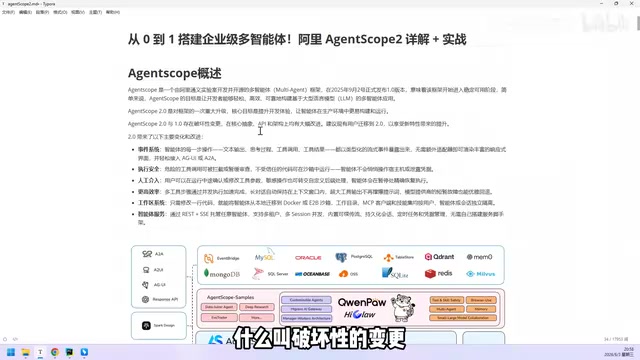
Six Core Upgrades: Built for Production
AgentScope 2.0 introduces systematic improvements across multiple critical dimensions, all pointing toward a single goal — making agent systems more robust, more efficient, and easier to deploy.
Event System: Typed Streaming Exposure
In 2.0, every operation — including text output, reasoning traces, tool calls, and tool results — is exposed externally as typed streaming events, dramatically improving system observability and security auditability. This design draws from the core principles of modern Observability Engineering: it's not enough for a system to just "run" — you also need to be able to "see" it. Through structured event streams, developers and operators can trace the full context behind every agent decision in real time, which is critical for diagnosing anomalous behavior caused by hallucinations.
Dangerous Instruction Interception: Handling LLM Uncertainty
Large language models are fundamentally probabilistic — they cannot guarantee 100% correct output. This inherent limitation stems from their training mechanism: models learn by performing next-token prediction over massive corpora, so their outputs are essentially samples drawn from a statistical distribution rather than deterministic reasoning. If a model hallucinates a dangerous instruction — such as deleting system files — and an agent executes it directly, the entire system could crash. AgentScope 2.0 has a built-in dangerous instruction interception mechanism that adds a safety validation layer before tool calls are actually executed, ensuring robust system operation. This is a critical step in the transition from "experimental framework" to "production tool."
Human-in-the-Loop
Users can confirm or modify tool parameters mid-execution, sensitive operations can be handed off to custom backends, and the system resumes precisely from the pause point to continue execution. Human-in-the-loop is not a concession due to inadequate technical capability — it is the design philosophy of industrial-grade AI systems. Preserving human judgment at high-risk decision points is the engineering implementation of the "human-AI collaboration" principle in AI safety. For high-risk scenarios like payments, fund transfers, and data deletion, human review is an indispensable safety guarantee and a foundational requirement for regulatory compliance.
Higher Execution Efficiency
Multiple tools or steps can execute concurrently to accelerate completion; long conversations are automatically trimmed to fit within the context window, preventing oversized tool outputs from overflowing the prompt; and the system gracefully degrades when model services experience brief outages. Context window management is a particularly critical engineering challenge — while leading LLMs have expanded their context lengths from early 4K tokens to 128K or beyond, the cumulative content generated by multi-turn tool calls can still easily exceed limits, and extremely long contexts significantly increase inference latency and API costs. AgentScope 2.0's automatic trimming strategy is a pragmatic engineering solution that balances information completeness with system efficiency.
Workspace System: Solving Environment Consistency
This is one of the most significant improvements in 2.0. Developers can seamlessly migrate from a local lightweight runtime environment to the cloud without modifying any code. The persistent problem of agents that "run fine locally but crash in the cloud" is fundamentally an environment dependency management challenge — subtle differences in local Python versions, system libraries, file paths, and more can all cause inconsistent behavior in production. The workspace system abstracts the runtime environment, encapsulating low-level details like dependency management, path resolution, and resource access into a unified interface. This transforms environment migration from "reconfiguration" into a "one-click switch" — and that is exactly the core pain point the workspace system is designed to solve.
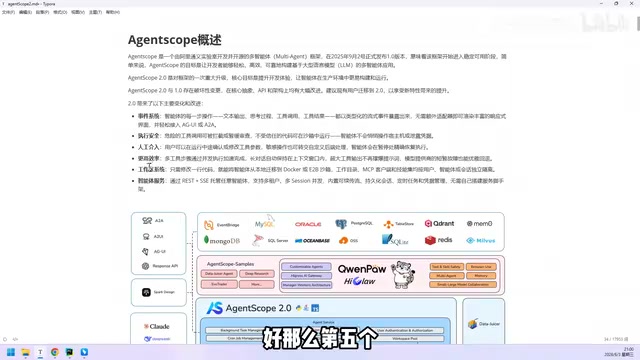
Agent-as-a-Service
The framework hosts arbitrary agents via REST + SSE, supports multi-tenant and multi-session concurrency, and includes built-in streaming, checkpoint resume, persistence, event task management, and queue management — all without developers needing to build their own service scaffolding. This significantly reduces production deployment costs. SSE (Server-Sent Events) here is a unidirectional real-time push protocol based on HTTP. Compared to WebSocket's bidirectional full-duplex communication, SSE is more lightweight, requires no complex connection state management, and naturally fits the scenario of continuously pushing an agent's "thought stream" from server to client. Combined with REST API's stateless design, this service-oriented architecture gives AgentScope 2.0 enterprise-grade service governance capabilities, with seamless integration into existing API gateways, load balancers, and monitoring systems.
A Complete Application Ecosystem Architecture
AgentScope 2.0 has built a relatively complete application ecosystem. The core framework sits at the center, with compatibility downward to multiple mainstream LLMs — including GPT, DeepSeek, Gemini, Zhipu AI, Qwen, and more. This multi-model compatibility strategy has clear engineering value: different models each have strengths and weaknesses across reasoning capability, context length, API cost, and response speed. Production environments often need to dynamically route tasks to the most appropriate model based on task type, avoiding strong dependency on any single vendor (i.e., the "model lock-in" risk).
You may not have noticed that what Alibaba's Tongyi Lab actually maintains is the core framework itself — surrounding applications, companion tools, runtime environments, and middleware are provided through ecosystem component combinations, together forming a complete development loop. This "core + ecosystem" architectural design ensures the framework stays focused while providing sufficient extensibility.
Agent Design Patterns: ReAct and Plan-and-Execute
Agents are relatively complex software systems, and making them run robustly requires following mature design paradigms.
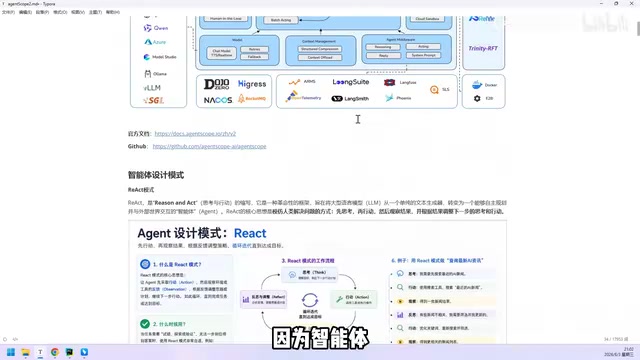
ReAct: Interleaved Reasoning and Acting
ReAct is currently the dominant paradigm widely adopted in industry and the core construction pattern used by AgentScope 2.0. To be clear, this ReAct has nothing to do with the front-end framework React — it's a combination of Reasoning and Acting, with the core idea being "thinking and acting alternately."
The ReAct paradigm originates from the 2022 paper "ReAct: Synergizing Reasoning and Acting in Language Models" co-authored by Princeton University and Google. This research systematically demonstrated for the first time the effectiveness of combining chain-of-thought prompting with external tool calls — experiments showed that having models output visible reasoning traces before acting not only significantly improved task completion rates but also substantially reduced the proportion of erroneous actions caused by hallucinations. This paper has become the theoretical cornerstone of current agent engineering design.
ReAct is a methodology, not a concrete technical framework. Its goal is to transform large language models from pure text generators into agents capable of autonomous planning and interaction with the external world. Its core approach mimics how humans solve problems: think first, then act, observe the result, and adjust accordingly.
Take "retrieve the latest AI news" as an example. The complete ReAct workflow looks like this:
- Think: I need to search for recent AI news
- Act: Call the search tool to execute a search
- Observe: Review the results returned by the search
- Reflect: Some news is irrelevant; I need to filter and find more recent content
- Loop: Refine the prompt, search again, filter, observe
- Output: Once satisfied, organize and deliver the latest AI news
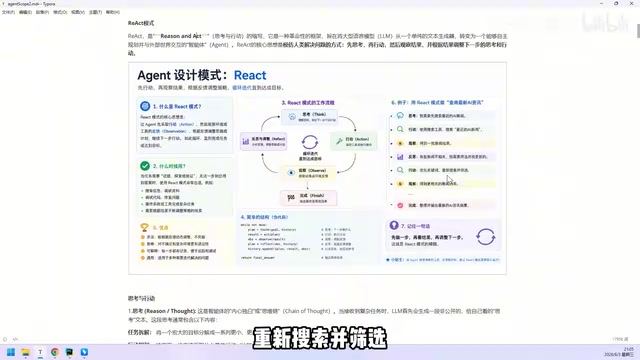
In short — "do one step, see the result, adjust the next step." This interleaved execution of thinking and acting gives agents the ability to dynamically handle complex tasks. Another key reason ReAct has spread so rapidly in industry is that its reasoning process is fully transparent and auditable for developers — every "thinking" step is exposed as text, making debugging and optimization intuitive. This forms a natural complement with AgentScope 2.0's typed event system.
Plan-and-Execute: Separating Planning from Execution
The counterpart to ReAct is the Plan-and-Execute (PE) paradigm. Unlike ReAct's dynamic interleaving, PE explicitly divides tasks into two phases:
Planning phase: Upon receiving a user instruction, a powerful LLM is first invoked to comprehensively analyze the task and produce a complete multi-step action plan. This plan is static — fully determined before execution begins.
Execution phase: The predetermined plan is followed step-by-step, with tools like search engines, code interpreters, and external APIs called to complete each step. Only when the plan is fully executed or a major obstacle is encountered does the system re-trigger the planning process.
The PE paradigm draws inspiration from the "compile-execute" separation concept in classical software engineering and the Work Breakdown Structure (WBS) task decomposition method from project management. Its core advantage: the planning phase can use larger, more capable models (such as the o1 or o3 series) to generate high-quality plans, while the execution phase uses faster, lower-cost models to complete specific steps — a division of labor where the "brain plans and the muscles execute," ensuring plan quality while keeping overall inference costs in check.
PE's strength lies in its clear global view, making it suitable for scenarios with well-defined task boundaries; ReAct's strength is its flexibility and adaptability, making it better suited for dynamic, uncertain, and complex environments. Production workloads today still predominantly use the ReAct pattern, but as the capabilities of reasoning models continue to advance, the PE paradigm is gaining increasing attention and adoption.
Conclusion
AgentScope 2.0 completes the critical leap from "experimental framework" to "production tool" through six major improvements: the event system, dangerous instruction interception, human-in-the-loop, concurrent execution, the workspace system, and agent-as-a-service. For developers looking to build enterprise-grade multi-agent applications, understanding the underlying ReAct paradigm and the complete ecosystem architecture is the first step to getting the most out of this framework. As multi-agent technology continues to mature, production-grade frameworks like AgentScope are steadily lowering the barrier to developing complex agent systems.
Related articles

Disaster and Glory of the Apollo Program: The History We Must Revisit Before Returning to the Moon
From the fatal Apollo 1 fire to Apollo 8's daring lunar orbit to Apollo 11's successful landing—revisiting the disasters, fears, and compromises of the Apollo program and their lessons for today's return to the Moon.
Netflix Trust Exercise Turns Into Firing Trap: Where Are the Boundaries of Corporate Trust?
A Netflix employee was fired after sharing private info in a trust exercise. We analyze the risks of corporate trust exercises and how employees can protect themselves.

AMD CDNA5 Architecture Deep Dive: Technical Evolution and the AI Computing Competition Landscape
Deep analysis of AMD's CDNA5 architecture covering Chiplet packaging upgrades, HBM memory evolution, and low-precision compute optimization, examining how AMD challenges NVIDIA's AI chip dominance.