AI Agent Architecture Decoded: An Engineering Guide from Conversations to Automation

A practical engineering breakdown of AI Agent architecture: from reactive models to full-stack automation.
This article deconstructs the four-layer engineering logic behind AI agents — covering the three core components (planning, memory, tool use), API cost optimization strategies, MCP protocol for standardized tool integration, and Skill-based modular encapsulation. Understanding this architecture lets you see through the mechanics of any AI product.
Most people's mental model of AI is still a chat window: type something in, get a response back. But what actually makes AI productive is the Agent architecture. This article systematically breaks down the four-layer engineering design of AI agents — from foundational runtime patterns to full-stack automation ecosystems — so you can instantly see through the mechanics of any AI product.
From Reactive Models to Closed-Loop Agents
The ChatGPT, DeepSeek, and similar tools we use daily are fundamentally reactive models: they respond to what you input, nothing more. They're passive by nature — you have to keep feeding them context to keep the conversation going. Agents operate on a completely different logic — they are closed-loop systems.
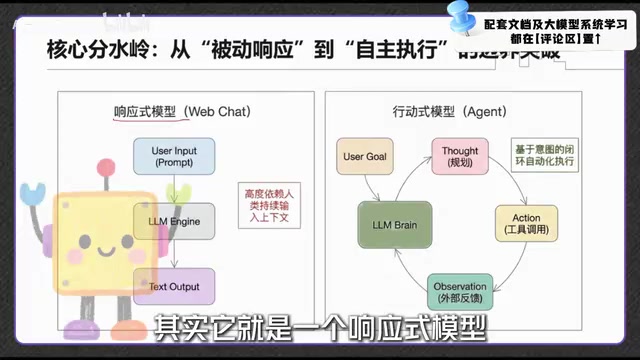
Give an agent a high-level goal (like "plan a trip for me"), and it will figure out step one on its own, choose the right tool for step two, check the results after execution, and iterate if something's off. It's like giving an assistant a single directive and letting them run with it until the job is done — not a back-and-forth Q&A.
The Three Core Components of an Agent
Think of the LLM as the system's CPU. To make it actually do work, three modules need to work in concert:
- Planning: The "reasoning circuit" that breaks down vague instructions into concrete actions
- Memory: Stores context and historical experience so you don't have to repeat yourself
- Tool Use: The agent's "hands and feet" — it can browse the web, call APIs, and query databases
Take "research competitors and write a report" as an example. In ReAct mode, the agent works in three phases: first as an explorer gathering data from the web, then as an analyst filtering and processing information, and finally as a writer compiling everything into a report. Each phase has different responsibilities and permissions — translating ambiguous instructions into concrete execution steps is precisely the core capability that modern AI engineering prioritizes.
Background on ReAct: ReAct (Reasoning + Acting) is an agent reasoning paradigm proposed by a Google Research team in 2022. The core idea is to interleave "chain-of-thought" reasoning with action execution — the model doesn't finish thinking before acting; instead, it thinks, acts, and observes results in an iterative loop, with each action's feedback influencing the next reasoning step. This design addresses both the "all thought, no action" failure of pure reasoning modes and the "all action, no reflection" failure of pure execution modes, giving agents the kind of iterative debugging capability humans use when solving complex problems. Mainstream agent frameworks like LangChain and AutoGen use ReAct or its variants as the default reasoning engine.
API Ecosystem and Cost Engineering
For the agent "brain" to call external capabilities, it relies on APIs. Think of APIs as the universal currency of the AI world: the agent sends a request with an API Key as its identity credential, the gateway layer validates the request and checks quota, then forwards it to the backend model, which returns results after processing.
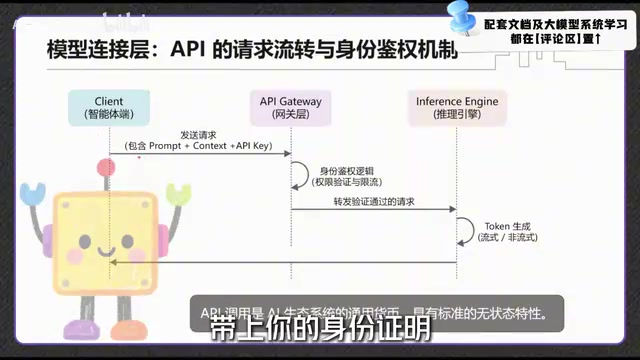
This is a standard stateless request-response process — the model has no memory of previous conversations; every call is a fresh handshake.
Stateless APIs and Session Management: HTTP is inherently stateless — servers retain no history of client requests. For LLM APIs, this means every request must include all relevant conversation history in the request body for the model to "remember" what was said earlier. This design greatly simplifies server-side architecture, but it also means token consumption grows linearly with conversation length. In practice, developers typically use a sliding window to retain the last N turns, apply summarization compression to historical content, or leverage vector databases for semantic retrieval-based "long-term memory" — balancing context completeness against cost control.
Bigger Models Aren't Always Better
The core of cost engineering is: dynamically route tasks to models based on complexity.
- Simple classification, routing → use 7B/8B small models: fast and extremely cheap
- Complex code generation, deep analysis → only then call mid-to-large models
A practical tip: don't fixate on expensive foreign models. Domestic options like DeepSeek and Qwen are already impressively capable and offer excellent cost-performance ratios. Route simple tasks to small models and complex tasks to large ones, and your monthly bill will look much healthier.
Aim for "Running Reliably," Not Just "Running"
In real engineering, network jitter, API timeouts, and token overflow are routine. A simple config.json port change can seamlessly switch code from calling Claude to DeepSeek — essentially "changing gas stations."
What really matters, though, is exception handling logic: auto-failover to backup models on handshake failure, auto-truncation or summarization on timeout or token overflow. Open-source middleware like CC Switch on GitHub already has these circuit-breaker and fallback patterns built in — no need to write all the boilerplate yourself.
MCP Protocol: Turning Agents from Specialists into Generalists
Even with a brain and power source, agents are still "one-trick ponies" — they're helpless with complex documents or web search because they lack standardized connection pathways. The solution is MCP (Model Context Protocol).

From Point-to-Point Chaos to Standardized Interfaces
Traditional point-to-point connections are expensive: every new tool requires a dedicated integration, the more tools you add the messier the codebase gets, and agents start suffering from "indigestion."
MCP works like a universal adapter. The agent doesn't need to understand database internals or web page structure — it just issues commands to MCP as the "middleman," achieving write once, call anywhere.
The Industry Significance of MCP: MCP was officially open-sourced by Anthropic in November 2024, with the design goal of becoming the "USB-C port" of AI tool integration — a unified standard that lets any AI model connect to any external tool or data source in the same way. Before MCP, the market had multiple incompatible integration specs: LangChain Tools, OpenAI Function Calling, and various proprietary plugin systems, creating severe ecosystem fragmentation. MCP uses JSON-RPC 2.0 as its communication foundation and defines three standard capability interfaces: Resources, Tools, and Prompts. Microsoft, Google, Block, and other major tech companies have since announced MCP support, and the protocol is rapidly becoming the de facto standard for agent tool integration — analogous in ecosystem value to REST API specs in the web world.
MCP's Three-Step Workflow
- Protocol Handshake: The agent queries the MCP server for available capabilities; MCP returns a complete skill manifest
- Format Translation: Like an interpreter, converts messy raw HTML into structured text the model can process
- Command Proxying: The agent issues simple commands; MCP handles external operations and returns results
Throughout the process, the agent never needs to care about implementation details — it stays focused on core business logic. GitHub already hosts a large collection of open-source MCP servers covering weather lookup, local file reading, and various API integrations. Plugging these into your agent instantly expands its capability boundaries.
Skill Modular Encapsulation: The Soul of the Architecture
Even with a functional agent, if every task requires writing out lengthy prompts to "onboard a new employee," efficiency suffers and the agent tends to get confused, producing lower-quality outputs.
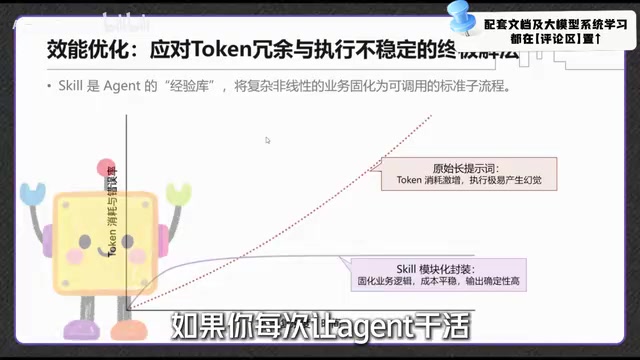
The data tells a clear story: with raw long-prompt approaches, the more complex the task, the higher the token consumption and the lower the accuracy. Introducing Skills — encapsulating high-frequency, high-complexity business logic into fixed "experience packages" — noticeably stabilizes the performance curve. It's like giving the agent an operations manual: when it encounters a familiar task type, it consults the manual and executes, saving tokens while delivering consistent, reliable results.
Skill Encapsulation and Prompt Engineering: Skills are essentially a structured form of prompt engineering, highly analogous to "function encapsulation" in software engineering. The problem with raw prompts is that as task complexity increases, prompt length inflation triggers the model's "attention dilution" effect — in very long contexts, the model's attention to information in the middle drops significantly. This is known academically as the "Lost in the Middle" problem (documented in a Stanford 2023 paper). By decomposing tasks into fine-grained fixed modules via Skills, each invocation only injects necessary context, avoiding attention dilution while using fixed System Prompt boundaries to make output format more stable and predictable. This mirrors the "Single Responsibility Principle" in software engineering: one Skill does one thing, and does it well.
Defensive Design in Modularization
Designing a high-quality Skill requires attention to three key elements:
- Input Specification: Define parameter formats and required fields to intercept most common errors at the source
- Process Constraints: Use System Prompts to solidify business workflows, pre-defining boundaries for each step's actions and output format
- Exception Handling (most critical): Errors shouldn't freeze the pipeline — include automatic retry or skip mechanisms, essentially giving the agent a safety net
Building an Automated Production Line
Connect all modules together and you have a true automated production line: a Skill library on the left, the LLM brain in the middle, and MCP-connected external tools on the right. This isn't just task execution — it's a continuously learning feedback loop: successful execution paths are recorded and retained; errors trigger corrections to the corresponding Skill logic. Through continuous iteration, agents become more stable over time and their automation coverage steadily expands.
Closing Thoughts: Building Agents Is Like Playing with LEGO
Looking at the full architecture: Model (brain) → API (power) → MCP (expanded capabilities) → Skill (trained expertise) — building an AI agent is nowhere near as mysterious as it sounds. It's more like assembling LEGO bricks.
You don't need to be a technical expert. Just start encapsulating the most repetitive, tedious tasks in your daily work into Skills one by one, and you'll gradually end up with your own "digital employee" running around the clock. Once you understand this architectural logic, you'll be able to see through the operating mechanics of any AI product at a glance.
Related articles

Network Doctor: An Open-Source Terminal Tool for Network Fault Diagnosis
Network Doctor is an open-source terminal network diagnostic tool that integrates ping, dig, curl, and traceroute, automatically detecting connectivity in stages and outputting fault conclusions in natural language.

LangChain Guardrails Explained: Building Safe and Controllable AI Agents
A detailed guide to LangChain Guardrails covering layered ecosystem architecture, middleware implementation, deterministic and model-driven protection for building production-grade secure AI Agents.

Deep Dive into Microsoft's AI Security Tools: Does Performance Really Surpass the Competition?
Microsoft launches enterprise AI security tools claiming superior performance. This deep analysis examines core capabilities, ecosystem advantages, and risks to guide enterprise security decisions.