AI Agent Architecture Explained: Core Components, Four Major Frameworks, and Chain-of-Thought Techniques

AI Agents evolve LLMs from chatbots into autonomous assistants by adding tools and execution pipelines.
AI Agents combine LLMs with external tools and execution pipelines through three core components—control, perception, and action modules—to compensate for hallucination, lack of real-time information, and computational limitations. Key frameworks include AutoGPT (prompt engineering), BabyAGI (recursive task decomposition), HuggingGPT (multi-model orchestration), and LlamaIndex (knowledge retrieval augmentation), enhanced by CoT, CoT-SC, and ToT reasoning techniques. Despite challenges like long pipelines, low efficiency, and poor portability, Agents represent the essential path for LLMs to become production-ready products.
Large language models are powerful, but they hallucinate, lack real-time information, and have limited computational abilities—these "artificial idiot" moments make us love and hate them at the same time. The emergence of AI Agents is precisely about "patching" LLMs, evolving them from chatbots that can only talk into intelligent assistants that can invoke tools, decompose tasks, and act autonomously.
This article systematically covers the core architecture of AI Agents, four classic frameworks, and Chain-of-Thought techniques, helping you build a complete understanding of agent technology.
The Essence of an Agent: Giving LLMs Hands and Feet
One sentence to summarize an Agent: LLM + External Tools + Execution Pipeline = Agent.
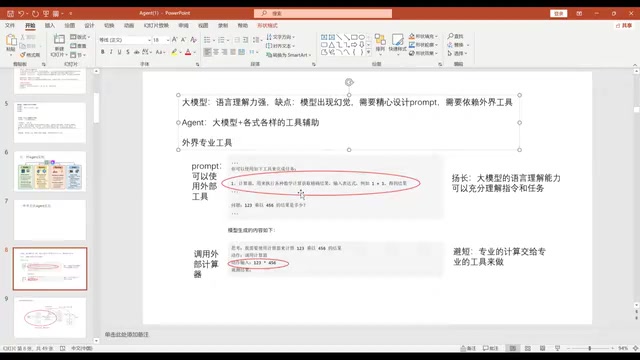
Current large language models (such as GPT-4, LLaMA, Claude, etc.) face several core problems: they hallucinate and output false information, cannot access real-time data (like today's weather or the latest news), and lack sufficient computational power for complex calculations. The design philosophy of Agents is to "leverage strengths and compensate for weaknesses"—using the LLM's powerful language understanding to "direct," while delegating specialized tasks to specialized tools.
For example: if you ask an LLM "what is 123×456?", it might get it wrong. But through an Agent architecture, the LLM understands your intent, then calls a calculator API to get the precise answer: 56,088. This is what it means to give an LLM "hands and feet."
Three Core Components of an AI Agent
A complete Agent architecture consists of three parts: the control module, the perception module, and the action module. Each has its own role while working closely together.
Control Module: The Agent's Brain
The control module is the core of the entire Agent, requiring five key capabilities:
- Natural Language Processing: Understanding user intent—this is the LLM's fundamental skill
- Knowledge Acquisition: Retrieving real-time information through external knowledge bases (e.g., RAG—Retrieval-Augmented Generation)
- Memory: Including short-term memory (multi-turn conversation context) and long-term memory (historical interaction records)
- Reasoning and Planning: Decomposing complex tasks into subtasks. For example, "Who was Alibaba's CTO during the Trump era?" requires first determining the time range, then finding the corresponding person
- Transfer and Generalization: Flexibly adapting to different scenarios and contexts
Perception Module: The Agent's Eyes and Ears
The perception module handles multimodal inputs—text, images, audio, etc. This is essentially an application of multimodal technology, such as converting images to text descriptions or encodings for interaction with the language model. With the development of multimodal LLMs, perception capabilities are improving rapidly.
Action Module: The Agent's Hands and Feet
The action module executes specific operations: calling calculators, accessing weather APIs, triggering search engines, and even invoking other AI models (like Stable Diffusion for image generation or TTS for speech synthesis). The LLM no longer just outputs text—it can actually "do things."
Deep Dive into Four Classic Agent Frameworks
Now that we understand the basic Agent architecture, let's examine the four most representative Agent frameworks in the industry, each representing a different design philosophy.
AutoGPT: Prompt Engineering Taken to the Extreme
AutoGPT was one of the earliest projects to ignite the Agent hype, and its core is essentially a carefully designed set of Prompt engineering. It explicitly tells the LLM in its prompts: what your goal is, what constraints exist, what tools are available (like Google Search, browsers), what resources you have, output format requirements, etc.
The advantage of this approach is maximizing the LLM's capabilities, but it has clear limitations: the model must be sufficiently large (at least tens of billions of parameters), and different models require different prompt adaptations, resulting in poor portability.
BabyAGI: Task Decomposition and Recursive Execution
BabyAGI's core idea is recursively decomposing complex tasks into subtasks. A simple example: you ask "How do I make tea?", and the LLM decomposes it into three steps—boil water, prepare tea leaves, brew. Then each subtask is sent back to the LLM for further refinement, e.g., "boil water" becomes "put cold water in the kettle → plug in the power."

The core challenge of this approach lies in workflow design—how to reasonably design the task decomposition and execution pipeline. The LLM itself hasn't changed; what changes is the workflow built around it. BabyAGI's approach has had a profound influence on many subsequent Agent frameworks.
HuggingGPT: An Orchestrator for Multi-Model Collaboration
HuggingGPT demonstrates a more complex Agent paradigm: one LLM orchestrating multiple specialized models to collaborate.
For example, given an image with the instruction "generate an image of a little girl reading a book, maintaining the same pose as the original," this task requires:
- Calling a pose detection model to extract the body pose
- Calling an image generation model to create the new image
- Calling an object detection model to highlight the results
- Calling a speech model to narrate the description
This architecture can solve complex cross-modal problems, but the downside is obvious—the pipeline is too long, and any single failure point affects the final result. Currently, such solutions remain mostly at the demo stage, solving the "can it be done" problem rather than the "can it be done reliably" problem.
LlamaIndex: Knowledge Augmentation and Efficient Retrieval
LlamaIndex focuses on solving the LLM's knowledge gap, with its core being storing external data in various structures and retrieving it efficiently. It's a key tool for building RAG systems.
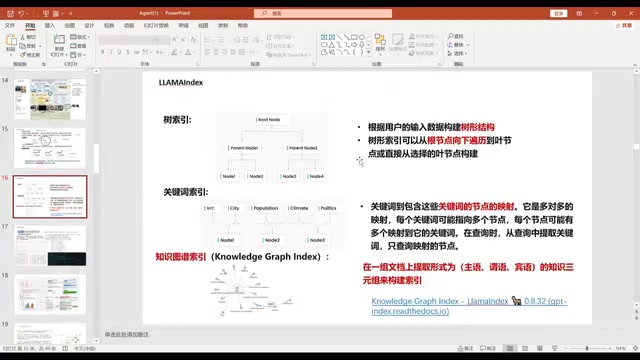
It supports multiple indexing methods:
- List Index: Simple keyword-based retrieval, suitable for structured data
- Vector Store Index: Retrieval through semantic similarity, finding related content beyond keyword matching. For example, searching "Hamas" can also surface related knowledge about "Palestine" and "Israel"
- Tree Index: Organizing knowledge in hierarchical structures, like "Middle East situation → Israeli-Palestinian conflict → Hamas," providing complete context during retrieval
- Knowledge Graph Index: Multi-hop retrieval through entity relationships, more flexible than tree structures, suitable for complex relational queries
Chain-of-Thought Techniques: Teaching LLMs Step-by-Step Reasoning
Chain of Thought (CoT) is a crucial reasoning technique in Agents. It makes LLMs stop "blurting out answers" and instead show their complete reasoning process.
Standard CoT: Teaching LLMs to "Copy the Solution Steps"
The core idea of standard CoT is: don't just give the LLM the answer—give it the reasoning process too. It's like copying homework in school—you can't just copy the answer; you need to copy the solution steps. For example, with "5+2×3=?", you demonstrate in the example: "first calculate 2×3=6, then calculate 5+6=11." The LLM then learns this step-by-step reasoning pattern.
CoT-SC (Self-Consistency): Multiple Votes for the Best Answer
CoT-SC leverages the randomness of LLM outputs by calling the same question multiple times and then taking a majority vote on the results. Alternatively, different models can answer the same question separately before voting—similar to the "wisdom of crowds" strategy. This method significantly improves the reliability of reasoning results.
ToT (Tree of Thoughts): Search, Evaluate, and Backtrack
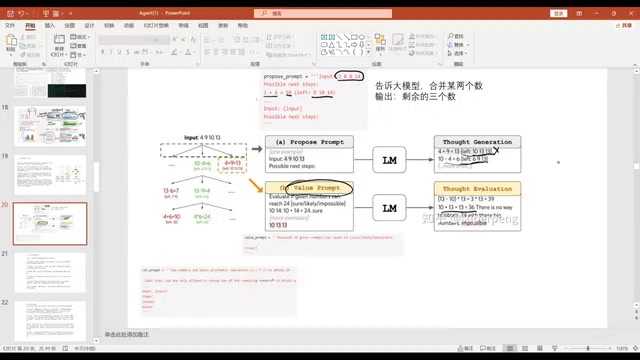
ToT (Tree of Thoughts) adds search, evaluation, and backtracking mechanisms on top of CoT, making it one of the most advanced reasoning frameworks.
Using the "24 game" as an example, the LLM first lists all possible two-number combination schemes, then self-evaluates the likelihood of each scheme reaching 24, eliminates infeasible branches, and finally finds the correct path. This "explore-evaluate-prune" strategy gives the LLM trial-and-error capabilities similar to humans.
Five Major Limitations of Agents and Future Outlook
Here's an analogy to summarize: If the LLM is the battery, then the Agent is the electric car. The battery is the core power source, but what users buy is the whole car. Agents are the necessary path for LLMs to become final products.
However, current Agent technology still faces five major challenges:
- Dependence on core LLM capabilities: If the battery is weak, the car won't go far no matter how good it is. The underlying model's reasoning ability directly determines the Agent's upper bound
- Long pipelines prone to errors: In serial architectures, failure at any point leads to overall failure, resulting in insufficient system robustness
- Low efficiency from multiple calls: Repeatedly calling the LLM introduces latency and cost issues, affecting user experience
- Weak cross-model portability: Prompts designed for GPT-4 might completely fail on LLaMA, making adaptation costs high
- Heavy dependence on prompt design quality: An Agent's capability ceiling largely depends on the prompt engineer's skill level
Nevertheless, relying solely on an LLM's end-to-end capabilities has its limits—many complex problems cannot be solved in a single step. The Agent paradigm of "decompose-invoke-compose" will be the mainstream direction for LLM application deployment. It's foreseeable that all user-facing LLM products will ultimately be delivered in the form of Agents.
Related articles
Deep Dive into AI Agent Skill Design: …
Deep Dive into AI Agent Skill Design: Engineering Practices from Anthropic and Perplexity
A deep dive into Skill design philosophy from Anthropic's Claude Code team and Perplexity's Agent team, covering the Tax Test, Gotchas Flywheel, progressive disclosure, and Eval-First practices for building high-quality AI Agent skill systems.
Deep Dive into OpenAI's Official GPT-5…
Deep Dive into OpenAI's Official GPT-5.6 Prompting Guide: The Shift from Manual to Automatic
A deep dive into OpenAI's official GPT-5.6 Sol prompting guide: conciseness-first, outcome-oriented design, autonomy boundaries, tool routing, and reasoning intensity tuning.
 Deep Dives
Deep Dive into How OpenClaw (Open-Source Crayfish) AI Agent Works
Deep analysis of OpenClaw AI Agent internals: System Prompt, tool calling, SubAgents, Skill system, memory, and Context Engineering explained.