AI Agent Debugging Bottlenecks: A Practical Guide to Production Observability
Why debugging AI Agents in production is uniquely hard — and how observability tools can help.
AI Agents introduce debugging challenges that traditional software tools aren't built for: non-deterministic LLM outputs, multi-step error propagation, and invisible context contamination from RAG. This article analyzes the three core bottlenecks — observability gaps, slow root cause analysis, and a fragmented toolchain — and outlines practical solutions including end-to-end tracing, eval datasets, and CI/CD-integrated regression testing.
Introduction: An Overlooked Engineering Challenge
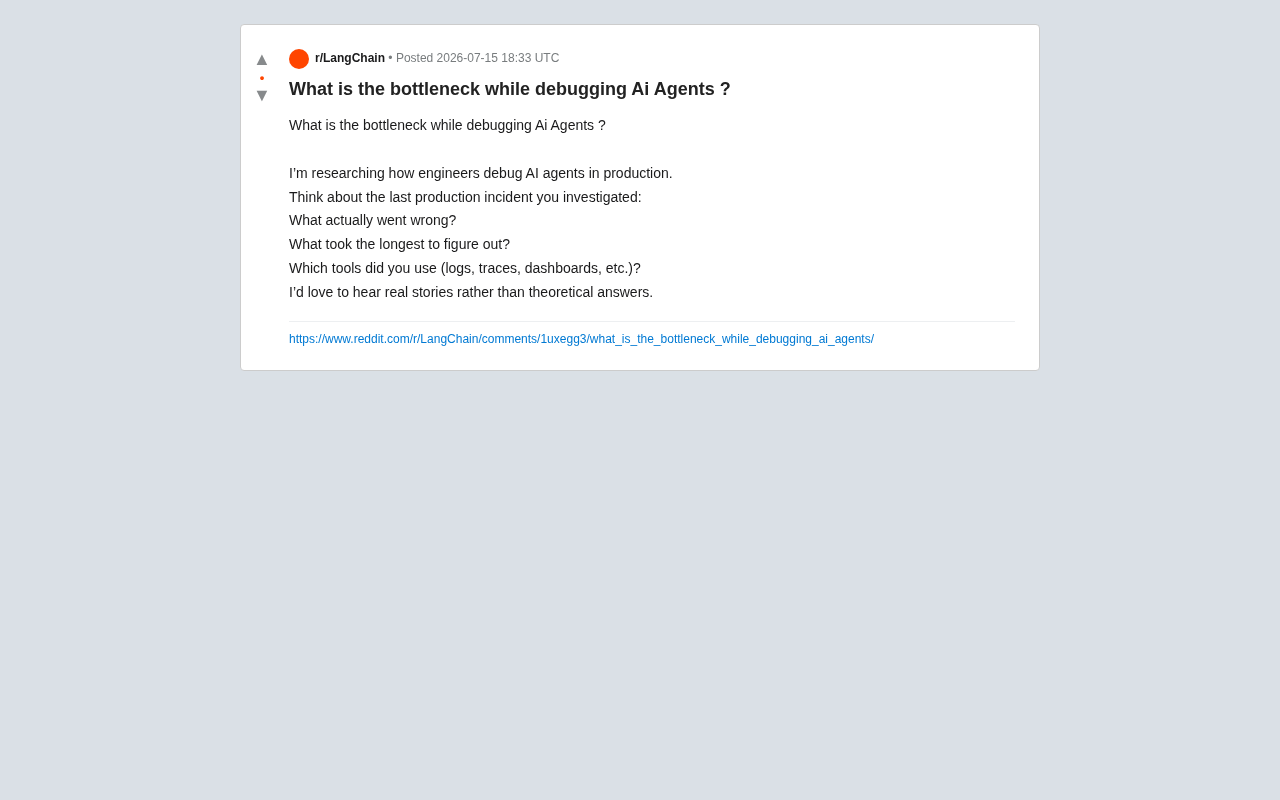
As AI Agents move from the lab into production environments, a pressing question has emerged: when an Agent fails, how should engineers debug it? Recently, a developer on Reddit sparked a valuable discussion by skipping the theory and posing a series of pointed questions directly to the community:
Think back to the last production incident you investigated — what actually went wrong? Which step took the longest to figure out? What tools did you use (logs, traces, dashboards, etc.)?
The value of this question lies in how it shifts the conversation from "how powerful is the AI Agent" to the more grounded reality of "how hard is the AI Agent to maintain." This article draws on that community discussion to dissect the core bottlenecks in AI Agent debugging.
Why Is Debugging AI Agents So Different?
Non-Determinism: Same Input, Different Output
The fundamental premise of traditional software debugging is reproducibility — given the same input, a program always produces the same output. AI Agents break this assumption. Large language models (LLMs) are inherently stochastic (due to temperature settings, sampling strategies, etc.), meaning the same prompt can yield completely different responses across two separate calls.
Why are LLMs non-deterministic by nature? It comes down to their underlying generation mechanism. When generating each token, an LLM is essentially performing a probabilistic sampling operation — the model outputs a probability distribution over its vocabulary, not a single deterministic answer. The temperature parameter controls how "sharp" this distribution is: a temperature of 0 approaches greedy decoding (most deterministic), while higher values introduce more randomness. Beyond temperature, top-p (nucleus sampling) and top-k sampling strategies also add stochasticity. Notably, even with temperature=0, subtle differences in inference frameworks or hardware (e.g., minor floating-point variations across GPUs) can cause outputs to diverge. This inherent unpredictability is a product of the LLM architecture design — not a bug — but it fundamentally upends the core assumptions of traditional software debugging.
This means that when an Agent goes wrong in production, engineers often cannot reproduce the issue simply by re-running the same inputs. Non-determinism transforms debugging from "logical reasoning" into "probabilistic investigation," dramatically increasing the difficulty of root cause analysis.
Multi-Step Pipelines: Which Link in the Chain Broke?
Modern AI Agents are typically composed of multiple steps chained together: understanding user intent → planning tasks → calling tools/APIs → processing results → generating a final response. Any failure at any point in this chain can cause the final output to go wrong.
What makes this especially tricky is that errors tend to propagate and compound. A small misinterpretation in an early step can be amplified through subsequent steps, ultimately manifesting as an error that appears completely unrelated to the actual cause. The "symptoms" an engineer observes are often separated from the true "root cause" by several layers of calls.
Three Core Bottlenecks in AI Agent Debugging
Bottleneck #1: Severely Lacking Observability
A clear consensus emerged from the community discussion: most teams lack observability tools designed specifically for Agents. Traditional logging systems capture code execution flow, but what engineers actually need to see for AI Agents includes:
- The complete input prompts and output content of every LLM call
- The Agent's reasoning trace — why did it make this decision?
- The parameters and return values of every tool call
- What information was actually present in the context window
When these intermediate states aren't fully captured, post-incident investigation becomes guesswork. Many engineers report that the most time-consuming work isn't fixing the bug itself — it's figuring out what the Agent actually experienced in the first place.
Bottleneck #2: The Long Road from Symptom to Root Cause
The original question specifically highlighted "which step took the longest to figure out" — pointing directly at the most painful part of debugging: root cause analysis.
In AI Agent scenarios, a bad output can originate from any of the following categories:
- Prompt engineering issues: Instructions weren't clear enough, causing the model to misunderstand
- Context contamination: RAG retrieved irrelevant or incorrect information
- Tool call failures: API timeouts, malformed parameters, etc.
- Model capability limits: The task exceeded the model's actual abilities
- State management errors: Memory or state became corrupted across a multi-turn conversation
Among these, context contamination from RAG is particularly insidious. Retrieval-Augmented Generation works by fetching relevant document chunks from a vector database and injecting them into the prompt before calling the LLM — greatly expanding the Agent's knowledge base, but also introducing unique debugging challenges. When retrieved documents don't match the question, contain outdated or incorrect information, or contradict each other, the model may generate a plausible-sounding but factually wrong response based on faulty "evidence" — a phenomenon sometimes called "retrieval-driven hallucination." Diagnosing this requires evaluating both retrieval quality (recall precision) and generation quality as separate dimensions, and neither is visible in traditional logs.
All five categories require completely different investigative approaches, yet they may present as similar error symptoms on the surface. Engineers must rule out each one in turn — a process that often burns through significant time and energy.
Bottleneck #3: A Fragmented Debugging Toolchain
The original question's mention of "logs, traces, dashboards" as separate tools reflects a real problem: there is still no unified, standardized debugging stack designed specifically for AI Agents. Engineers typically bounce between multiple tools — application logs for code logic, the LLM provider's console for token usage, a custom tracing system for call chains — with information scattered across disparate systems and no unified view for investigation.
The Path Forward: Observability Is Becoming a Hard Requirement
Structured End-to-End Tracing
Borrowing from the distributed systems world, more teams are adopting end-to-end tracing for AI Agents. This concept was first systematically described by Google in the 2010 Dapper paper, later evolving into open standards like OpenTelemetry, which became foundational infrastructure for microservices engineering. The core idea is to assign a unique trace_id to each request and generate span records at each node, linked together into a complete call tree.
AI Agent tracing tools apply this paradigm to the semantics of LLM call chains: treating a single Agent run as one trace, and each LLM call, tool call, and RAG retrieval as an individual span with recorded inputs, outputs, latency, and metadata. Every Agent run is captured as a complete trajectory, including all intermediate steps. Tools like LangSmith, Langfuse, and Arize Phoenix are purpose-built for this need, allowing engineers to inspect each of an Agent's decision steps the same way they would review a microservice call chain.
Evaluation Datasets and Regression Testing
For addressing non-determinism, one practical approach is building an evaluation dataset (eval set). By continuously monitoring Agent performance against a fixed set of test cases, teams can detect behavioral regressions early — rather than waiting for user complaints to signal that something has gone wrong.
A complete Agent evaluation framework typically combines three approaches: rule-based evaluation (e.g., is the output format correct? does it include required fields?); reference-based similarity scoring (e.g., BLEU, ROUGE metrics); and LLM-as-Judge — using a powerful model (like GPT-4) to assess output quality, an approach gaining widespread adoption due to its flexibility. Integrating Agent evaluation into CI/CD pipelines so that every prompt or model change automatically triggers regression tests is increasingly becoming standard practice at leading AI engineering teams.
Preserving Full Context in Production
The most basic yet most critical practice: log complete context at every step. Yes, this incurs additional storage costs — but when an incident occurs, having a complete "recording of the scene" is the fundamental prerequisite for rapid root cause analysis.
Conclusion: Debugging Capability Determines How Far Agents Can Go
This Reddit discussion surfaces a truth that's easy to overlook: the real bottleneck to deploying AI Agents in production may not be model capability itself, but engineering maintainability. No matter how intelligent an Agent is, if problems can't be quickly diagnosed and fixed, it will never truly earn trust in a production environment.
As AI Agents enter more mission-critical business scenarios, the toolchain around observability, call chain tracing, and automated evaluation will become the foundational infrastructure of the entire ecosystem. Whoever solves the "debugging problem" engineering pain point first will be the one to help AI Agents evolve from "impressive demos" into "reliable production systems." This may well be one of the most worthwhile areas to invest in across the current AI engineering landscape.
Related articles

Disaster and Glory of the Apollo Program: The History We Must Revisit Before Returning to the Moon
From the fatal Apollo 1 fire to Apollo 8's daring lunar orbit to Apollo 11's successful landing—revisiting the disasters, fears, and compromises of the Apollo program and their lessons for today's return to the Moon.

Netflix Trust Exercise Turns Into Firing Trap: Where Are the Boundaries of Corporate Trust?
A Netflix employee was fired after sharing private info in a trust exercise. We analyze the risks of corporate trust exercises and how employees can protect themselves.

AMD CDNA5 Architecture Deep Dive: Technical Evolution and the AI Computing Competition Landscape
Deep analysis of AMD's CDNA5 architecture covering Chiplet packaging upgrades, HBM memory evolution, and low-precision compute optimization, examining how AMD challenges NVIDIA's AI chip dominance.