AI Agent Development: A Three-Stage Learning Roadmap from Zero to One

A structured three-stage learning path for AI Agent development from zero to enterprise-level.
This article presents a systematic three-stage learning roadmap for AI Agent development. Stage one covers Python fundamentals, LLM basics, and framework awareness. Stage two focuses on five core Agent capabilities: task planning, tool use, memory management, self-reflection, and context optimization. Stage three emphasizes hands-on projects, particularly RAG knowledge bases, to bridge theory and real-world application.
Want to get started with AI Agent development but don't know where to begin? Faced with a bewildering array of frameworks and tools, many beginners stumble repeatedly and waste enormous amounts of energy. Based on a systematic learning roadmap shared by a Bilibili content creator, this article outlines a clear path from zero foundation to enterprise-level Agent development, helping you avoid detours and get up to speed quickly.
What Is an AI Agent? Why Is It Worth Learning?
AI Agent is one of the hottest directions in the current large model application space. Unlike simple conversational AI, Agents possess capabilities such as autonomous planning, tool invocation, and memory management, enabling them to independently complete complex tasks like a "digital employee."
The concept of Agents originates from classical theory in artificial intelligence—the intelligent agent architecture. As early as the symbolic AI era, researchers proposed the BDI (Belief-Desire-Intention) model to describe autonomous decision-making entities. Today's AI Agents build upon the powerful language understanding and reasoning capabilities of large language models, adding tool usage, environment perception, and action execution abilities. Compared to traditional RPA (Robotic Process Automation), AI Agents possess greater flexibility and generalization capability, able to handle unstructured and ambiguous task instructions. This gives them far superior adaptability over rule engines in scenarios like customer service, data analysis, and code development.
Whether it's internal enterprise process automation or user-facing intelligent assistant products, Agents have demonstrated enormous potential for real-world deployment. For developers and career changers, mastering Agent development skills means having a significant competitive advantage in the job market. The challenge, however, is that this field evolves too rapidly, learning materials are scattered, and many people spend considerable time yet remain stuck at the stage of "understanding concepts but unable to build anything."
Let's break down this AI Agent learning roadmap step by step across three stages.
Stage One: Building a Solid Foundation
Every great structure starts from the ground up. The fundamentals of Agent development include three core modules:
Python Programming Basics
Python is the primary language for Agent development. You don't need to master every syntax detail, but you should at least be proficient in: function definition and invocation, classes and object-oriented programming, asynchronous programming (async/await), and commonly used data processing libraries. It's recommended to spend 1-2 weeks on intensive study—being able to read and modify open-source project code is sufficient.
Among these, asynchronous programming is particularly important in Agent development. Agents typically need to handle multiple I/O-intensive operations simultaneously: calling LLM APIs and waiting for responses, querying external databases, requesting search engine results, etc. With synchronous programming, each API call blocks the entire program, making the Agent extremely slow to respond. Python's asyncio library allows switching to other tasks while waiting for an operation to complete, dramatically improving the Agent's concurrent processing capability and response speed. This is also why mainstream frameworks like LangChain universally provide asynchronous interfaces.
Large Model Fundamentals
Understand the basic principles of Large Language Models (LLMs): what Tokens are, what Prompt Engineering is, API calling methods, and the capability boundaries of models. You don't need to dive deep into model training, but you must be clear about what models can and cannot do—this directly determines your approach when designing Agents.
Here, the concept of Token deserves special attention. A Token is the smallest unit that LLMs use to process text—not simply characters or words, but sub-word segments split by tokenization algorithms like BPE (Byte Pair Encoding). For example, in English, "understanding" might be split into two Tokens: "under" and "standing"; in Chinese, a single character typically corresponds to 1-2 Tokens. The Context Window is the maximum number of Tokens a model can process in a single call—GPT-4 Turbo supports 128K Tokens, and Claude supports 200K Tokens. In Agent development, you must precisely manage Token consumption because information exceeding the window gets truncated, and Token count directly correlates with API call costs.
Agent Core Terminology and Framework Awareness
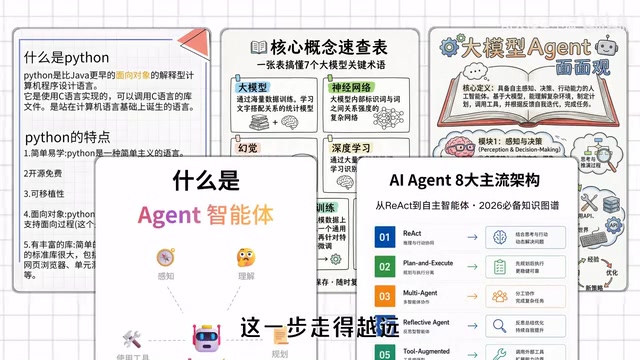
Understand the fundamental difference between Agents and ordinary Chatbots, and familiarize yourself with the positioning and applicable scenarios of mainstream frameworks (such as LangChain, LangGraph, AutoGen, etc.). This step may seem "theoretical," but the more solidly you build this foundation, the smoother your subsequent enterprise deployment and hands-on practice will be.
Specifically, LangChain was the earliest popular LLM application development framework, providing a Chain abstraction that strings together Prompt templates, model calls, output parsing, and other steps. However, as Agent complexity increased, linear chain structures became inadequate for expressing complex control flows like loops and conditional branches. LangGraph emerged to address this—based on the concept of directed acyclic graphs (DAGs), it explicitly models each decision node and state transition of an Agent as a graph structure, supporting cyclic execution, conditional routing, and state persistence, making it more suitable for building complex Agents that require multi-step reasoning and iterative refinement. AutoGen, released by Microsoft, focuses on multi-Agent collaboration scenarios, achieving task division through defined conversation protocols between Agents. Understanding the design philosophy differences among these frameworks helps you make correct technology choices in real projects.
Stage Two: Mastering Core Skills and Tools
Once the fundamentals are solid, you need to focus on conquering the five core capabilities of Agents—this is the critical dividing line between "beginners" and "practitioners."
The Five Core Capabilities Explained
-
Task Planning: The Agent's ability to decompose complex tasks into multiple sub-steps and formulate execution plans. This is the core manifestation of Agent "intelligence."
Task planning capability typically relies on several classic strategies: Chain-of-Thought enables the model to reason step by step; the ReAct (Reasoning + Acting) framework allows the Agent to alternate between thinking and acting; the Plan-and-Execute pattern generates a complete plan first, then executes it step by step. More advanced methods like Tree-of-Thought allow the Agent to explore multiple reasoning paths and select the optimal solution. In engineering practice, the reliability of planning capability remains the biggest challenge—models may generate non-executable plans or miss critical steps, so verification mechanisms and human fallback strategies are usually needed.
-
Tool Use: Enabling the Agent to use external tools—search engines, database queries, API interfaces, code executors, etc. Tool-calling capability directly determines the Agent's practical utility.
-
Memory Management: Including short-term memory (conversation context) and long-term memory (knowledge accumulation across sessions), this is the foundation for continuous Agent service.
Agent memory systems typically follow a three-layer architecture: working memory (current conversation context, stored directly in the Prompt), short-term memory (summaries of recent interactions, implemented through sliding windows or summary compression), and long-term memory (persistently stored knowledge and experience, usually implemented using vector databases like Pinecone, Milvus, Chroma, etc.). The core technology behind long-term memory is converting text into high-dimensional vectors through Embedding models and storing them in vector databases. During retrieval, algorithms like cosine similarity find the most relevant historical information. This enables Agents to "remember" user preferences, historical decisions, and accumulated domain knowledge, providing personalized and continuous service experiences.
-
Self-Reflection: The Agent's ability to evaluate the quality of its own output, detect errors, and self-correct—a key mechanism for improving reliability.
-
Context Optimization: How to efficiently organize and compress contextual information within a limited Token window directly affects the Agent's performance ceiling.
Hands-on with Mainstream Frameworks
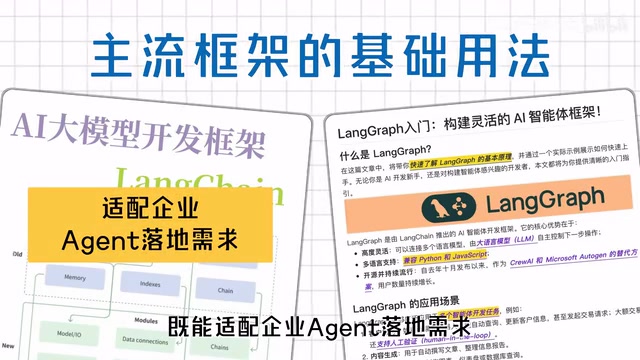
While mastering core concepts, simultaneously get hands-on with the basic usage of mainstream frameworks like LangChain and LangGraph. These frameworks provide rich abstraction layers and toolchains that significantly lower the development barrier. It's recommended to start with the Quick Start in official documentation, run through a few basic examples, and then dive deeper into understanding their design philosophies.
Stage Three: Hands-on Practice and Advanced Development
With theory and tools prepared, the most critical step is building projects. A progressive strategy is recommended for this stage:
From Simple Demos to Complete Projects
Starting phase: Begin with the simplest demos—for example, building a basic Agent that can call search tools to answer questions, or a code assistant that can execute simple Python code. The goal is to run through the complete workflow and build confidence.
Advanced phase: Gradually increase complexity by attempting multi-tool coordination, multi-Agent collaboration, and other scenarios. For each project, focus on code quality and engineering mindset rather than just "making it work."
RAG Knowledge Base: The Best Practice Project

A local document RAG knowledge base is currently one of the most recommended practice projects for Agent development. RAG (Retrieval-Augmented Generation) combines document retrieval with LLM generation and is the most common deployment scenario in enterprise applications.
The complete RAG technology stack includes two phases: offline indexing and online retrieval. Offline phase: Documents are processed through PDF parsers, OCR, and other tools to extract text, then chunked by semantic meaning or fixed length. Each text chunk is converted into vectors through Embedding models (such as OpenAI's text-embedding-3, or open-source models like BGE) and stored in a vector database. Online phase: User queries undergo the same vectorization process, and ANN (Approximate Nearest Neighbor) algorithms retrieve the most relevant text chunks, which are injected as context into the Prompt for the LLM to generate answers based on the retrieved information.
A complete RAG project involves multiple components: document parsing and chunking, vector storage, similarity retrieval, Prompt assembly and generation—comprehensively exercising your engineering capabilities. Advanced optimization directions include: hybrid retrieval (vector + keyword BM25), reranking, query rewriting, multi-path recall, and other strategies, each of which can significantly improve retrieval quality. More importantly, such projects directly correspond to real enterprise needs and are highly compelling whether as business deployment solutions or job portfolio pieces.
Learning Tips and Pitfall Avoidance Guide
Based on the roadmap above, here are a few additional practical suggestions:
-
Don't try to learn everything: Frameworks and tools emerge endlessly. Choosing one primary framework to study deeply is far more valuable than superficially exploring ten frameworks.
-
Prioritize Prompt Engineering: Many Agent capabilities fundamentally depend on carefully designed Prompts—this is a skill that requires iterative refinement.
-
Focus on cost and efficiency: Enterprise-level Agents must not only "work" but also consider Token consumption, response speed, error handling, and other engineering concerns.
-
Stay current with cutting-edge developments: The Agent field iterates extremely fast—new trends like the MCP protocol and Function Calling standardization are worth continuous tracking.
Regarding these cutting-edge trends: MCP (Model Context Protocol) is an open protocol released by Anthropic in late 2024, aimed at standardizing how large models connect with external tools and data sources. Before MCP, integrating each tool required developers to write specific adapter code. MCP defines a unified communication specification, enabling Agents to connect to various tools and services in a plug-and-play manner, much like a USB interface. Function Calling is a capability first introduced by OpenAI that allows models to declare needed function calls and parameters in a structured way during conversations, rather than triggering tools through natural language descriptions. These two standardization trends are reshaping the Agent tool ecosystem, reducing the development cost of tool integration, and deserve developers' focused attention.
Conclusion
AI Agent development is not out of reach. Through systematic learning across three stages—"fundamentals → core skills → hands-on advancement"—even learners with zero background can develop the ability to independently build simple Agents within 2-3 months. The keys are: a clear roadmap, a steady pace, and early hands-on practice. Rather than getting lost in the flood of information, follow this learning path and make every step count.
Related articles

Disaster and Glory of the Apollo Program: The History We Must Revisit Before Returning to the Moon
From the fatal Apollo 1 fire to Apollo 8's daring lunar orbit to Apollo 11's successful landing—revisiting the disasters, fears, and compromises of the Apollo program and their lessons for today's return to the Moon.

Netflix Trust Exercise Turns Into Firing Trap: Where Are the Boundaries of Corporate Trust?
A Netflix employee was fired after sharing private info in a trust exercise. We analyze the risks of corporate trust exercises and how employees can protect themselves.

AMD CDNA5 Architecture Deep Dive: Technical Evolution and the AI Computing Competition Landscape
Deep analysis of AMD's CDNA5 architecture covering Chiplet packaging upgrades, HBM memory evolution, and low-precision compute optimization, examining how AMD challenges NVIDIA's AI chip dominance.