AI Agent Development in Practice: A Complete Path from Zero to Production

A complete practical guide to AI Agent development from architecture design to production deployment.
This article systematically outlines the full AI Agent development lifecycle, covering the distinction between Agents and chatbots, core components (LLM reasoning, tool calling, memory management), framework selection (LangChain, LangGraph, CrewAI, AutoGen), and a five-step development process from defining task boundaries to production deployment. It also addresses common pitfalls and engineering best practices for cost control, security, and error handling.
Why Now Is the Boom Period for AI Agents
Over the past year, nearly every tech community has been repeating the same phrase: Agents are the next big thing. Enterprise demand has surged, market size continues to expand, and both investment and hiring are tilting in this direction. But behind the hype lies an awkward reality: Everyone is telling you that Agents are important, yet very few people actually explain clearly how to build one.
No one systematically covers the development process, engineering techniques are left to figure out on your own, and hard-won lessons from mistakes are scattered everywhere. From framework selection to tool calling, from data preparation to production deployment—it's all a blur for beginners. Based on extensive hands-on tutorials and engineering experience, this article outlines a clear AI Agent development path to help developers—whether experienced or just starting out—avoid detours.
The Fundamental Difference Between AI Agents and Regular Chatbots
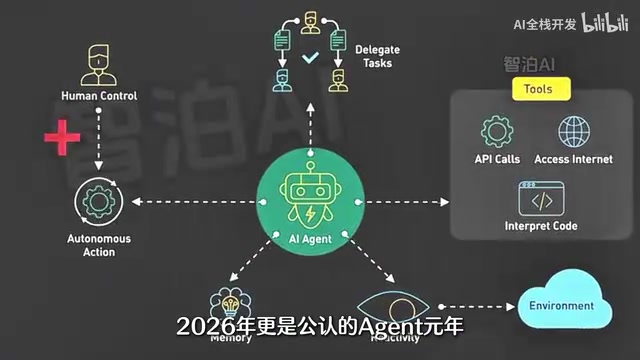
Many people can't distinguish between AI Agents and traditional chatbots. Simply put, a regular Chatbot is a passive response system based on single question-and-answer exchanges—it receives input, generates a reply, and the process ends there. An Agent's core lies in "autonomy"—it can decompose tasks, plan steps, invoke external tools, dynamically adjust strategies based on execution results, and ultimately accomplish a multi-step goal.
The AI Agent's "perceive—decide—act" loop didn't emerge from nothing. It originates from the classic BDI (Belief-Desire-Intention) architecture in agent theory. In this architecture, an Agent maintains beliefs about the world, has clear goals, and forms execution intentions accordingly. Traditional BDI systems relied on symbolic reasoning and hand-coded rules, which were limited in capability and difficult to scale. The breakthrough of modern AI Agents lies in replacing the symbolic reasoning engine with large language models, giving Agents the ability to understand natural language, handle ambiguous instructions, and tackle open-domain problems. This paradigm shift is the fundamental reason Agents have moved from academic concepts to commercial deployment.
For example, a Chatbot answers "What's the weather like in Beijing today?" while an Agent can "Check the Beijing weather for me, and if it's raining, cancel today's outdoor itinerary and notify all participants." The latter involves information retrieval, conditional judgment, tool invocation (calendar, messaging), and a series of other actions. This "perceive—decide—act" closed loop is precisely where AI Agents deliver value, and it's the capability that enterprise scenarios truly need.
Core Components of AI Agent Development
A production-ready AI Agent typically consists of several key modules. Understanding the relationships between these modules is more important than blindly jumping into writing code.
Large Language Model: The Agent's Reasoning Brain
The large language model is the Agent's reasoning core, responsible for understanding intent, decomposing tasks, and generating decisions. When selecting a model, don't blindly chase the most powerful option—instead, weigh task complexity, budget constraints, and latency requirements holistically. For simple information organization tasks, mid-sized models are often sufficient; only when dealing with complex reasoning and long-chain planning do you need more powerful model support.
Specifically, current model selection involves choosing between closed-source and open-source paths. Closed-source models like GPT-4 and Claude excel at complex reasoning and instruction following, but come with high API call costs, data sovereignty concerns, and service availability limitations. Open-source models like LLaMA, Qwen, and DeepSeek offer the possibility of local private deployment, suitable for enterprise scenarios with strict data security and compliance requirements. Regarding latency, a single GPT-4-level inference call typically takes 2-8 seconds, while lightweight models with dedicated hardware can respond in under 100 milliseconds. In Agent scenarios, since completing a task usually requires 5-20 model calls (forming a so-called "reasoning chain"), latency and cost are significantly amplified. Therefore, many engineering practices adopt a "routing" strategy—dispatching simple subtasks to smaller models while reserving large models for complex decision nodes—to balance cost and effectiveness.
Tool Calling: The Key to Connecting the Real World
The reason AI Agents can actually "get things done" is their tool-calling capability (Function Calling / Tool Use). Search engines, database queries, API endpoints, code execution environments—these are all the Agent's "hands and feet." The key to designing tools is providing clear functional descriptions and parameter definitions so the model can accurately determine when to call which tool and what parameters to pass. The more standardized the tool design, the higher the Agent's execution success rate.
The technical mechanism of Function Calling deserves deeper understanding. This capability was first introduced by OpenAI in June 2023, followed quickly by Anthropic, Google, and others. The core process works as follows: developers pre-define a set of available functions in JSON Schema format—including function names, functional descriptions, parameter types, and meaning explanations. During inference, the model determines whether the current task requires calling a function, and if so, generates a structured call request (rather than free-form text). The developer executes that function at the application layer and returns the result to the model for continued reasoning. This structured mechanism represents a qualitative improvement in accuracy and reliability compared to earlier approaches that relied on regex to parse tool calls from model output. The recently emerging MCP (Model Context Protocol) further attempts to standardize the communication interface between Agents and external tools, aiming to establish a universal tool integration standard similar to USB, allowing any tool provider to connect to any Agent system in a unified way.
Memory and Context Management
During long task execution, managing context is a major challenge. Short-term memory maintains the current conversation state, while long-term memory stores historical information through vector databases and similar methods for the Agent to retrieve on demand. Context management directly affects the Agent's coherence and accuracy across multi-turn interactions.
An Agent's long-term memory is typically implemented using RAG (Retrieval-Augmented Generation) architecture. It works as follows: historical conversation records, business documents, user preferences, and other information are converted into high-dimensional vector representations through Embedding models (such as OpenAI's text-embedding-3 or the open-source BGE series) and stored in specialized vector databases (popular choices include Pinecone, Milvus, Chroma, and Weaviate). When the Agent needs to retrieve relevant information during task execution, the current query is similarly vectorized, then the most relevant information fragments are retrieved from the database using algorithms like cosine similarity and injected into the model's context window to assist reasoning. On the short-term memory side, since LLMs have context window length limits (currently mainstream at 128K-200K tokens), and even within the window there exists the "Lost in the Middle" phenomenon—where the model's attention to information in the middle of the context decreases—engineering practice typically employs strategies like sliding window truncation, conversation summary compression, or priority arrangement of key information to optimize memory effectiveness.
Complete Development Process Breakdown
Step 1: Define Task Boundaries
The most common pitfall is trying to build a "can-do-everything" general-purpose Agent right from the start. In actual engineering, the more focused the Agent, the easier it is to deploy. First clearly define: What specific problem is this Agent solving? What are the inputs, and what are the expected outputs? How do you measure success? Only when boundaries are clearly drawn do all subsequent design decisions have a basis.
Step 2: Agent Framework Selection
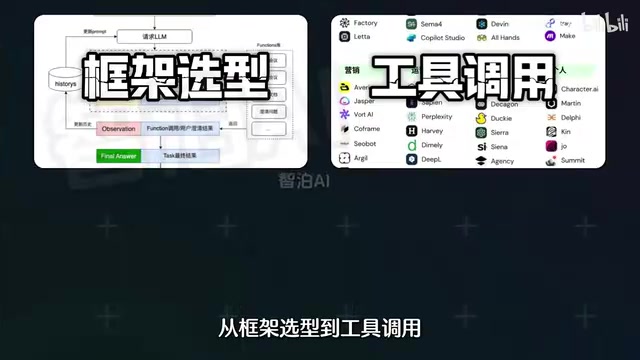
Agent development frameworks on the market each have different strengths. Some excel at rapid prototyping, others at complex workflow orchestration, and still others are better suited for production deployment. The advice for beginners is: Start by running through a minimum viable case using a mainstream, well-documented framework, understand the Agent's operating mechanism, and then decide whether to switch or build your own based on actual needs. Don't overthink framework selection—getting your hands dirty is more important than anything else.
The current AI Agent framework landscape has formed a fairly clear picture, with different frameworks suited to different stages and scenarios. LangChain and its advanced version LangGraph represent the most complete ecosystem choice—LangChain provides modular chain-call abstractions, while LangGraph builds on this with stateful Graph workflows supporting loops, conditional branches, and persistent state management, making it better suited for complex Agent construction. CrewAI focuses on multi-Agent collaboration scenarios, orchestrating Agent teams by defining different Roles and task divisions, suitable for complex business processes requiring "expert collaboration." Microsoft's AutoGen excels at multi-Agent dialogue orchestration, completing tasks through message passing between Agents. OpenAI's Assistants API provides the lightest out-of-the-box single-Agent capability with built-in tools like code interpreter and file retrieval. The core principle of selection is: understand that all frameworks are essentially engineering encapsulations of the Agent runtime core loop (Observe → Think → Act → Observe), and mastering the logic of this core loop is more important than being proficient in any specific framework's API.
Step 3: Data Preparation and Tool Integration
This step is often underestimated. The upper bound of an Agent's capabilities largely depends on the quality of data and tools it can access. You need to organize business data, build knowledge bases, standardize API interfaces, and properly format tool return results. Dirty data and messy interfaces can't be carried by even the strongest model.

Step 4: Testing and Iterative Optimization
Agent development is not a one-shot process. Build test cases covering typical scenarios and edge cases, observe the Agent's performance in real tasks, and focus on: whether tasks are fully executed, whether tool calls are accurate, and how exceptions are handled. Use logging and tracing tools to locate problems, and iteratively optimize prompts, tool descriptions, and process logic.
Step 5: Production Deployment
From demo to production environment, there's still a distance to cover. You need to consider engineering challenges like concurrency handling, cost control, error retry, and security protection. Cost deserves special attention—LLM calls are billed by usage, and a poorly designed Agent might generate staggering bills through recursive calls, making it essential to set reasonable call limits and termination conditions.
The challenges of production deployment far exceed what the demo stage might suggest. Take cost as an example: GPT-4-level model input token pricing is approximately $10-30 per million tokens, with output tokens being even more expensive. An Agent requiring 10 reasoning steps might consume 30,000-50,000 tokens per task. At 1,000 daily calls, monthly costs can reach thousands or even tens of thousands of dollars. If an Agent falls into a loop due to logic flaws, costs can spiral out of control in a short time. Engineering practice typically deploys multiple layers of protection: setting maximum reasoning steps (Max Steps, typically 15-25), per-task token budget caps, automatic timeout termination mechanisms, and abnormal call frequency alerts. For concurrency handling, since LLM APIs generally have rate limits, you need to implement request queues, Exponential Backoff retry, and multi-key load balancing. On the security front, you must guard against Prompt Injection attacks—malicious users may craft inputs designed to induce the Agent to execute unintended tool calls, such as unauthorized data access or dangerous system operations. Common protective measures include input sanitization, tiered tool-call permissions, and human confirmation nodes before critical operations.
Most Common Pitfalls for Beginners
Based on various tutorials and practical feedback, recurring problems in AI Agent development concentrate on several points.
First, over-reliance on model autonomy. Delegating all decisions to the model seems elegant but is actually uncontrollable. The sensible approach is to add rule constraints and human verification at critical nodes, forming a hybrid "model + rules" architecture.
Second, neglecting error handling mechanisms. Tool call failures, malformed model outputs, tasks stuck in infinite loops—these occur frequently in real environments. A robust Agent must have comprehensive exception catching and graceful degradation mechanisms.
Third, careless prompt design. The system prompt is the "constitution" of Agent behavior—vague instructions lead to behavioral drift. Clear, structured prompts with examples can significantly improve the stability of Agent operation.
Final Thoughts
AI Agents are indeed one of the most worthwhile technology directions to invest in right now, with enterprise demand and market opportunity expanding rapidly. But a trending opportunity is not a shortcut—the real barrier isn't whether you can call a particular framework, but whether you can decompose a vague business requirement into an executable, testable, deployable Agent engineering solution.
For beginners, the best way to learn is to start with a small, concrete project: clearly define the task, run through the minimum closed loop, and accumulate lessons from mistakes through iteration. When you personally deploy your first AI Agent that truly solves a problem, those frameworks and concepts will finally transform into real capability. The prerequisite for capturing a technology dividend is always to thoroughly walk through the fundamentals first.
Related articles

Formally Verifying 3D CSG: Trusting 93 Lines of Specification Over Thousands of Lines of AI Code
Exploring how formal verification solves the trust crisis of AI-generated code. Through a 3D CSG project, learn why reviewing 93 lines of specification beats checking thousands of lines of AI code.

150,000 Flights in a Single Day Sets Global Record: Deep Dive into Data Tracking and Airspace Challenges
Global airlines operated over 150,000 flights in a single day, setting a civil aviation record. This article analyzes the drivers, ADS-B tracking technology, high-density airspace challenges, and AI applications in air traffic optimization.

Segue: A Deep Dive into the Cross-Platform AI Conversation Context Migration Tool
Segue is an AI context migration tool that uses short handles to seamlessly transfer conversation context across ChatGPT, Claude, and other AI platforms, solving the context-reset problem when switching tools.