AI Agent Learning Roadmap: A Four-Stage Guide from Beginner to Practical Mastery

A four-stage AI Agent roadmap taking you from fundamentals to multi-agent collaboration in three months.
This guide breaks AI Agent learning into four progressive stages: mastering large-model fundamentals, the ReAct paradigm, memory and tool capabilities via RAG and Function Calling, and finally multi-agent collaboration with frameworks like AutoGen and CrewAI—helping beginners become practical developers.
Why You Need a Clear AI Agent Learning Roadmap
As the capabilities of large models continue to leap forward, AI Agents are becoming one of the hottest technical directions. Unlike simple Q&A-style conversation, Agents emphasize giving models the ability to think autonomously, call tools, and complete complex tasks—which is why they have become one of the core skills most valued by enterprises.
However, many beginners tend to fall into two traps: either staying at the superficial level of merely calling APIs, or blindly chasing frameworks without understanding the underlying principles. This article breaks down AI Agent learning into four progressive stages, helping you grow from a novice to a practical developer capable of handling mainstream AI roles within three months.
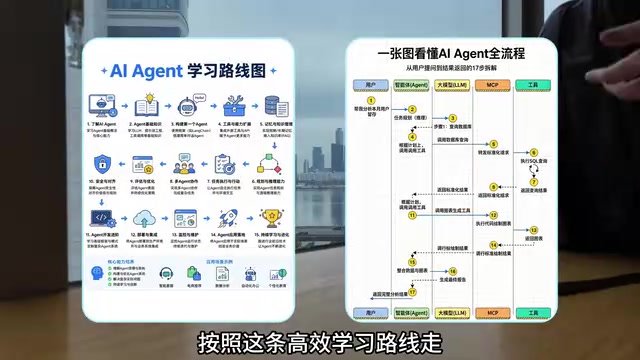
Stage One: Build a Solid Technical Foundation
Any advancement is inseparable from a solid foundation. The core goal of Stage One is to understand the underlying working logic of large models—to grasp fundamental concepts like the Transformer architecture, tokens, and context windows, and to figure out why models can generate text and why they hallucinate.
The Transformer is the foundational architecture underpinning nearly all modern large language models. It was proposed by Google in 2017 in the paper "Attention Is All You Need." Its core innovation is the self-attention mechanism: when processing each token, the model simultaneously computes the relationship weights between it and all other tokens in the sequence, thereby capturing long-range semantic dependencies—this is precisely what allowed the Transformer to surpass the earlier RNN/LSTM architectures.
To understand the historical significance of the Transformer, it's worth understanding the predecessor architectures it replaced. RNNs (Recurrent Neural Networks) and LSTMs (Long Short-Term Memory networks) process text in a sequential manner—reading tokens one by one and compressing prior information into a fixed-size "hidden state" vector that is passed along. This design inherently suffers from two bottlenecks: first, information tends to "dilute" over long distances, making it difficult for the model to capture dependencies between the beginning and end of a sentence (the "long-range dependency problem"); second, sequential computation cannot fully leverage the parallel computing power of GPUs, resulting in extremely low training efficiency. The Transformer's self-attention mechanism fully solves the first problem by letting each position in the sequence interact with all other positions simultaneously, while its inherently parallelizable structure solves the second—together, these two points laid the technical foundation that made large-scale pretrained models possible.
A token is the basic unit through which a model processes text, usually corresponding to a word or a subword fragment (for example, "learning" might be split into two tokens, "learn" and "ing"). The context window defines the maximum number of tokens a model can process at once—GPT-4's context window can reach 128K tokens. A deep understanding of these concepts helps developers make more reasonable engineering decisions: sensibly splitting documents, controlling prompt length, and understanding why extremely long contexts can lead to degraded performance or increased hallucination.
While understanding the principles, you should focus on mastering the following two practical skills:
Prompt Engineering
Prompts are the bridge between humans and models. Learning to write prompts in a structured way—including role setting, task description, few-shot guidance, and Chain-of-Thought techniques—can significantly improve the quality and stability of model outputs. Among these, Few-shot means providing a small number of demonstration examples in the prompt to guide the model's output format; Chain-of-Thought guides the model to "reason step by step" rather than giving an answer directly. Both techniques are heavily reused in Agent development.
Prompt engineering is not merely a "writing skill"—it is backed by deep cognitive science and language model training mechanisms. During pretraining, large language models learn the statistical patterns of human language from vast amounts of text, so carefully designed prompts essentially activate the model's existing "implicit knowledge." Few-shot prompting is effective because the examples in the context provide the model with "meta-information" about the task format, enabling it to rapidly adapt to new tasks without updating any model parameters. Researchers call this phenomenon In-Context Learning, one of the important characteristics distinguishing large models from traditional machine learning models.
For a traditional machine learning model to adapt to a new task, it must go through the full process of recollecting data and retraining or fine-tuning—a time-consuming and labor-intensive effort. Large language models, through In-Context Learning, can accomplish task transfer with just a few examples in the prompt. Essentially, this is because during pretraining the model has implicitly learned the meta-ability of "how to induce patterns from examples" (Meta-learning). The discovery of this trait has prompted the research community to reexamine the very definition of "learning": when a model can solve task formats it has never seen before using only context, the line between "learning" and "inference" becomes blurred—an open question that academia continues to explore in depth.
The effectiveness of Chain-of-Thought was first systematically validated by a 2022 Google research paper—researchers found that simply adding "Let's think step by step" at the end of a prompt could significantly improve the model's accuracy on mathematical reasoning tasks. This finding profoundly revealed that having the model "speak out its thinking process" is itself an effective mechanism for improving reasoning quality, not merely a change in presentation format.
API Calling Practice
Master how to call the APIs of mainstream large models, understand the roles of core parameters like temperature (controlling output randomness) and max_tokens (limiting generation length), and be able to integrate model capabilities into your own applications through code. It's worth developing a deeper understanding of a few key parameters: temperature essentially performs a "softening" or "sharpening" operation on the model's output probability distribution—the lower the temperature, the more the model tends to choose the highest-probability words (more deterministic, more conservative output); the higher the temperature, the greater the chance that low-probability words are selected (more diverse, more creative output, but also more error-prone). In Agent development scenarios, tool calling and structured output are generally recommended to set temperature to 0 to ensure output format stability, while creative writing tasks can appropriately raise it. Understanding the mathematical meaning behind these parameters helps developers intervene more purposefully when debugging Agent behavior, rather than relying on "mysticism" and repeated trial and error. This is a key step in moving from "user" to "developer."
Stage Two: Master the Core Agent Paradigm
Once the foundation is solid, Stage Two focuses on the core working mechanisms of Agents. Here, there is one classic paradigm you cannot bypass—ReAct (Reasoning + Acting).

ReAct was jointly proposed by Google Research and Princeton University in 2022. Its core insight is that pure reasoning easily produces hallucinations, while pure action lacks planning—and interleaving "thinking" and "acting" can significantly improve an Agent's performance on complex tasks. ReAct's technical implementation relies on the few-shot prompting capability of large models—by providing several "Thought → Action → Observation" demonstration cases in the prompt, the model is guided to complete reasoning step by step in the same format.
Worth noting is that ReAct was proposed against the backdrop of the research community's debate over two approaches: the pure-reasoning path represented by Chain-of-Thought (CoT), while able to display reasoning steps, relies entirely on the model's internal knowledge and easily produces hallucinations once knowledge boundaries are touched; the pure tool-calling path represented by web search, while able to obtain accurate information, lacks the ability to deeply process that information. ReAct's core contribution lies in organically fusing the two: reasoning steps (Thought) help the Agent decide what tool to call next and how to interpret returned results; tool calling (Action) provides reasoning with information anchors from the real world, fundamentally suppressing the spread of hallucinations. This framework aligns highly with the human cognitive process of problem solving: when tackling complex problems, we too often "think a step, do a step, look at the result, then think about the next step." The emergence of ReAct marks an important paradigm shift for LLMs from "passively answering" to "actively solving problems," and is an essential concept for understanding the theoretical core of modern AI Agents.
The essence of ReAct lies in having the Agent follow a "Thought—Action—Observation" loop: the model first analyzes the current situation and reasons about what to do next, then executes a specific action (such as calling a search tool), then continues reasoning based on the returned results, and so on until the task is complete.
Understanding this loop captures the fundamental difference between an AI Agent and an ordinary conversational model. Building on this, you also need to become proficient with mainstream Agent development frameworks like LangChain, turning theory into runnable code. LangChain provides a standardized encapsulation of the ReAct loop, so developers don't need to build the reasoning loop from scratch and can focus more energy on tool design and business logic.
Stage Three: Give the Agent Memory and Tool Capabilities
A truly practical Agent cannot have only a "goldfish memory." Stage Three requires a deep understanding of the Agent's memory mechanism and learning how to equip it with real, usable tools.
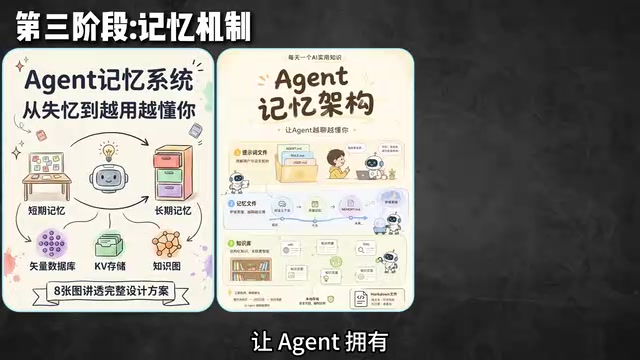
Short-Term Memory and Long-Term Memory
- Short-term memory: refers to the context of the current session, allowing the Agent to remember content within this conversation. In essence, it concatenates the conversation history into the prompt of each request;
- Long-term memory: uses technologies like vector databases to persist historical information, enabling the Agent to call upon past knowledge across sessions.
The vector database is the key infrastructure supporting an Agent's long-term memory, and its working principle is worth understanding in depth. Text is first converted into high-dimensional numerical vectors through an embedding model—semantically similar text is closer together in this high-dimensional space. These vectors are then stored in a specially optimized database. When the Agent needs to retrieve historical memory, it converts the query text into a vector as well, then searches the database for entries with the highest cosine similarity, a process called Approximate Nearest Neighbor Search (ANN Search).
Understanding "why semantically similar text is closer in vector space" helps you use this technology better. Embedding models (such as OpenAI's text-embedding-ada-002 or the open-source BGE series) are themselves neural networks trained on large-scale text contrastive data, with the training objective of bringing semantically similar text pairs closer together in vector space while pushing semantically unrelated pairs apart. It's worth noting that the embedding model and the generation model are two independent components—choosing a higher-quality embedding model (especially one that matches your business's language style) often improves the overall retrieval quality of a RAG system more than upgrading the generation model. Currently, mainstream vector databases include Pinecone, Weaviate, Milvus, and Chroma, among which Chroma is widely adopted for prototyping due to its lightweight and ease of use.
This semantic-similarity-based retrieval approach, known as RAG (Retrieval-Augmented Generation), enables the Agent to break through the physical limitations of the context window and access external knowledge bases far exceeding a million tokens. Note that RAG is not a panacea—retrieval quality heavily depends on the embedding model's semantic understanding and the document chunking strategy, which is also a core area requiring repeated tuning in long-term memory engineering practice. In practice, the choice of document chunking strategy is especially critical: chunks that are too small lack sufficient context individually, while chunks that are too large introduce excessive noise and consume precious context window space. Advanced strategies commonly used in the industry include: splitting by semantic boundaries (rather than fixed character counts), attaching parent document summaries to each chunk (Parent-Child Chunking), and re-ranking candidate chunks after retrieval (Re-ranking)—these details are often the true dividing line between good and poor performance for a RAG system in production.
Connecting to Real-World Tools
Beyond memory, an Agent also needs to be able to call external tools—search engines, databases, calculators, third-party APIs, and so on. Tool-calling capability allows the Agent to break through the limitations of pure text generation and truly gain the ability to solve real-world problems. Modern large models (such as GPT-4 and Claude) natively support "Function Calling," which allows developers to define tool input/output specifications in a structured way, while the model autonomously decides when and how to call these tools.
The underlying mechanism of Function Calling is not that the model actually "executes" the function, but a carefully designed structured-output protocol. Its workflow has three steps: ① the developer describes the name, parameter types, and functional descriptions of available tools to the model in JSON Schema format; ② during inference, the model determines whether it needs to call a tool, and if so, outputs a structured JSON object specifying the tool name and parameter values; ③ an external program captures this output, actually executes the function call, and then injects the result back into the subsequent conversation as a "tool return value."
The key to this mechanism is that through a dedicated fine-tuning stage, the model learns to recognize "when it should output structured call instructions rather than natural language." OpenAI was the first to launch this feature in June 2023, which subsequently became an industry standard—Anthropic's Claude and Google's Gemini both introduced similar mechanisms, collectively referred to as "Tool Use." Understanding this underlying protocol is crucial for engineering practice: the quality of the tool description (i.e., the description field in the JSON Schema) directly determines whether the model can call the right tool at the right time—vague descriptions lead to frequent misfires or missed calls. In addition, when an Agent needs to call multiple tools in parallel, modern large models support Parallel Function Calling, which can output multiple call instructions simultaneously in a single round of inference, significantly reducing the number of round-trips needed to complete complex tasks—a performance optimization not to be overlooked when designing efficient Agent workflows.
Practical advice for this stage: build a smart customer service agent with memory. Through this project, you can fully experience the entire process of memory storage, semantic retrieval, and tool calling—a rare opportunity for comprehensive hands-on practice.
Stage Four: Multi-Agent Collaboration
The capabilities of a single Agent are ultimately limited, and complex tasks often require multiple agents to divide the work and collaborate. The focus of Stage Four is mastering the design approach and engineering implementation of multi-agent collaboration.
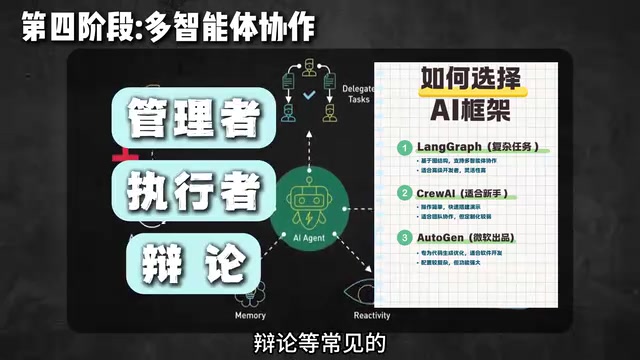
The concept of a Multi-Agent System originated in the field of distributed artificial intelligence. Its core idea is to decompose a complex task into multiple subtasks, handled in parallel or collaboratively by specialized Agents, thereby breaking through the capability boundaries and context limitations of a single model. In engineering practice, multi-agent architectures need to focus on three core challenges: the design of the communication protocol between Agents (message format, transmission mechanism), task allocation and dependency management (who goes first, who depends on whose output), and the isolation of error propagation and fault-tolerance mechanisms (how to prevent an overall collapse when a single Agent fails).
These three challenges are not unique to the AI field but are the concrete manifestation of classic problems in distributed systems engineering within the Agent context. Take error propagation as an example: unstable output quality from a single Agent is an inherent characteristic of current LLMs, so production-grade multi-agent systems must introduce a Critic/Validator Agent to check the output quality at key nodes, or design retry and fallback strategies to handle tool-call failures. Furthermore, when multiple Agents share the same tool (such as a database write interface), you must also consider concurrent access control—these engineering details are often glossed over in tutorials and framework documentation, yet they are the true guarantee of production system stability. Understanding these engineering points is the key leap from "getting a demo to run" to "building a production-grade system."
Mainstream Multi-Agent Frameworks
Focus on learning frameworks like AutoGen or CrewAI. AutoGen was developed by Microsoft Research and supports collaboration between Agents in a conversational manner, while allowing human supervision (Human-in-the-Loop). CrewAI, on the other hand, focuses more on "role-playing" style task orchestration—developers can assign responsibilities and tools to each Agent just like forming a real team, making it suitable for quickly building business-oriented multi-agent pipelines.
Although AutoGen and CrewAI are both multi-agent frameworks, there is a fundamental difference in their design philosophies, and their applicable scenarios each have their own emphasis. AutoGen adopts a conversation-driven architecture: each Agent is a conversation participant, and task progress unfolds naturally through message passing between Agents. The framework itself intervenes little in the task flow, offering extremely high flexibility—especially suitable for research scenarios requiring dynamic negotiation and complex reasoning. CrewAI is closer to a process-driven design: developers predefine each Agent's Role, Goal, Backstory, and available tools, and task execution proceeds along a preset pipeline. The code structure is clearer, making it suitable for production environments with fixed business logic.
From a more macro perspective, the entire multi-agent framework ecosystem is undergoing rapid evolution. Since 2024, Microsoft has undertaken a large-scale refactoring of AutoGen and released AutoGen 0.4, introducing a clearer event-driven architecture. Meanwhile, LangGraph (launched by the LangChain team) defines Agent workflows in the form of a Directed Acyclic Graph (DAG), providing more fine-grained process control than the previous two, and has attracted much attention in scenarios requiring complex branching logic. OpenAI also launched an official Agents SDK in 2025, further advancing the standardization of this ecosystem. Engineering selection advice: if task boundaries are fuzzy and multiple rounds of autonomous negotiation are needed, prioritize AutoGen; if the task flow is relatively fixed and you seek rapid deployment, CrewAI is a more pragmatic choice; if you need fine control over complex branching processes and deep integration with the LangChain ecosystem, LangGraph is worth serious attention.
Common Collaboration Patterns
- Manager–Worker pattern: one Agent is responsible for task planning and scheduling, while the others handle specific execution;
- Debate pattern: multiple Agents discuss the same problem from different perspectives, improving decision quality through "adversarial" exchange. This pattern is especially effective in scenarios requiring highly reliable output (such as code review and solution evaluation).
It's recommended to complete 2-3 full projects at this stage, such as a smart customer service system or an automated research assistant, weaving together the knowledge from the previous stages into solid engineering capability.
Summary: With the Right Direction, Persistence Is the Core
This four-stage AI Agent learning roadmap has clear logic: start from the underlying principles, master the ReAct core paradigm, build memory and tool capabilities, and finally move toward multi-agent collaboration—layer by layer, each step interlocking with the next.
The real barrier lies not in the roadmap itself, but in whether "your energy can keep up and it's not just a three-minute enthusiasm." There are no shortcuts in learning technology; only through step-by-step practice, combined with the refinement of real projects, can you internalize knowledge into capability.
For learners who want to enter the field of AI Agent development, this roadmap provides a framework worth referencing. As a reminder, any claim of "becoming a master in seven days" should be viewed rationally—a solid three months of systematic learning is far more valuable than blindly pursuing a quick fix.
Key Takeaways
Related articles

How to Choose an AI Agent Platform for Your Team: 5 Evaluation Dimensions and a Decision Framework
Choose the right AI Agent platform by evaluating model flexibility, observability, tool integration, security compliance, and total cost. A complete decision framework to help technical leaders avoid vendor lock-in.

Fable 5 vs GPT-5.6: An In-Depth Head-to-Head Comparison of Two Top-Tier Coding Models
In-depth comparison of Fable 5 vs GPT-5.6 (Sol) for AI coding. Covering token efficiency, code quality, design, cost, and safety based on $10K+ real usage data.

Fable 5 vs GPT-5.6: An In-Depth Head-to-Head Comparison of Two Top-Tier Coding Models
In-depth comparison of Fable 5 vs GPT-5.6 (Sol) for AI coding. Real-world data on token efficiency, code quality, design capability, and cost from $10K+ testing.