AI Agent Primer: The Core Differences Between Workflows and Intelligent Agents — and How to Build Them

A practical guide to understanding AI Agents vs. workflows and building intelligent agents with Python and LangChain.
This article clarifies the fundamental distinction between workflow platforms (like Coze and Dify) and true AI Agents, explains how the ReAct paradigm enables dynamic task decomposition and tool calling, and explores why Agents are critical for enterprise automation. It also covers practical implementation using Python and LangChain.
Why Agent Is the Core Technology You Need to Master Right Now
As the large model application development industry matures, more practitioners and enterprises are shifting their attention from simple conversational interfaces toward AI systems that can truly "get things done." Across technical communities, RAG (Retrieval-Augmented Generation), AI Agents, and model fine-tuning are consistently highlighted as the three directions most worth investing in.
It's worth noting that each addresses a fundamentally different problem: RAG compensates for a model's knowledge cutoff by dynamically retrieving from external knowledge bases at inference time; fine-tuning continues training on domain-specific data to internalize specialized knowledge; while Agents focus on connecting a model's reasoning capabilities with external tools and systems to enable end-to-end task automation. The three tackle the "knowledge boundary," "capability boundary," and execution boundary, respectively — and Agents are widely regarded as the critical bridge between large model capabilities and real-world business scenarios.
So why isn't relying on general-purpose large models alone sufficient? To answer that, we first need to address a widespread misconception.
Coze and Dify Are Workflows, Not True Agents
Many newcomers have a skewed understanding of what an Agent actually is. A telling example: many learners mistakenly assume that Coze is an intelligent agent. From a technical standpoint, however, platforms like Coze and Dify are fundamentally "Workflows," not true Agents in the strict sense.
The underlying architectures differ in a fundamental way: workflow platforms use a Directed Acyclic Graph (DAG) structure, where each node's trigger conditions and execution order are fixed at design time — essentially "deterministic process orchestration" with no dynamic decision-making capability. A true Agent, by contrast, is built around dynamic planning paradigms like ReAct (Reasoning + Acting): at every step, the model autonomously decides which tool to call next and with what parameters, based on the current state and prior feedback. The entire execution path is generated dynamically at runtime, enabling genuine adaptive behavior. Clarifying this distinction is the starting point for understanding what Agents are really worth.

The Limitations of General-Purpose LLMs: They Can "Think" but Can't "Do"
A concrete scenario illustrates why Agents are necessary: ask a large model to book you a flight from Beijing to Shenzhen departing tomorrow afternoon.
Handling this with a general-purpose LLM like DeepSeek immediately exposes its limitations:
- No access to real-time data: Today's leading large models (including GPT-4, DeepSeek, Claude, etc.) are trained on static corpora and have a defined Knowledge Cutoff. Once training is complete, model parameters are frozen — the model cannot autonomously sense events, price changes, or status updates that occur after the training cutoff. It has no way of knowing current flight availability, live pricing, or seat inventory.
- Can think, but cannot act: It can tell you which platform to use for booking, but it stays at the "recommendation" level — it cannot actually complete the purchase on your behalf.
Addressing the real-time data problem typically involves one of two approaches: integrating a live database via RAG, or equipping the Agent with a toolset that can call real-time APIs, allowing the Agent to proactively fetch the latest data during reasoning. The "cannot act" problem, however, requires the Agent architecture to solve it at a fundamental level.

The Leap from "Thinking Layer" to "Execution Layer"
This points to a critical distinction in capability layers. General-purpose large models operate at the Thinking Layer — they excel at writing copy, answering questions, and providing recommendations. Agents build on this by adding an Execution Layer — the ability to actually carry out actions.
Only when AI can genuinely execute actions can it solve problems in real business scenarios. This reflects a straightforward truth: all large model technology must ultimately be grounded in concrete business use cases. Mastering the technology but failing to apply it in practice significantly diminishes its value — whether for personal career development or enterprise hiring assessments — because the benchmark always comes down to "which specific business problems can your skills actually solve."
How Agents Work: Task Decomposition and Tool Calling
The core working mechanism of an Agent is based on the ReAct paradigm (Reasoning and Acting, proposed by Princeton University in 2022). Its core loop is: Thought (assess the gap between current state and goal) → Action (select and invoke a tool) → Observation (receive the tool's output) → Thought again, repeating until the task is complete. This iterative "think-act-observe" cycle gives Agents the ability to handle multi-step tasks with inherent uncertainty.
At a high level, an Agent's working pipeline can be summarized as: receive user instruction → decompose the complex task into sub-steps → sequentially invoke the appropriate tools → aggregate results and deliver output.
Taking the flight booking example: a fully capable Agent would identify the user's intent (book a ticket) → decompose into sub-tasks (search flights, compare prices, confirm timing) → invoke the corresponding tools (flight search API, booking interface) → complete the purchase and report back. This closed-loop capability of "task decomposition + tool calling" is precisely what differentiates Agents from ordinary Q&A systems.
Static Q&A vs. Dynamic Tasks: Two Categories of Use Cases
Understanding where Agents apply requires distinguishing between two types of needs:
- Static Q&A: Such as RAG-based knowledge base Q&A, document Q&A, and multimodal content understanding — these can be handled with relatively straightforward API calls.
- Dynamic tasks: Such as booking flights or hotels for a user, querying and aggregating data from multiple sources, or executing multi-step workflows involving real-time information and dynamic decision-making — this is where Agents truly deliver value.
The Business Value of Agents: Driving Cost Reduction and Efficiency Gains
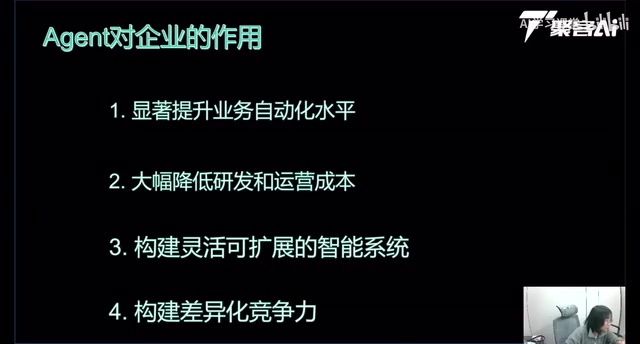
From an enterprise perspective, the strategic significance of Agents runs even deeper. The primary driver for enterprise AI adoption today centers on cost reduction and efficiency gains — achieving greater business output at lower cost.
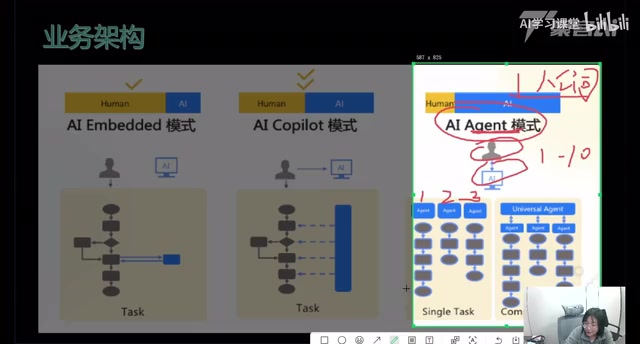
Enterprise AI transformation typically progresses through three stages (a trajectory widely validated in research from McKinsey, Gartner, and others):
- Entry stage: AI is introduced in Copilot mode — as an assistive tool for human workers, such as code completion or document summarization, applied selectively to specific workflows;
- Collaboration stage: A division of labor emerges between humans and AI, with AI handling repetitive, low-judgment tasks while humans handle review and decision-making — deep human-AI collaboration;
- Agent execution stage: Agents acquire sufficient tool-calling and error-recovery capabilities to autonomously take on and complete entire business processes within boundaries set by humans, shifting the human role from "executor" to "supervisor" and "goal setter."
The Agent model represents the ultimate direction of enterprise intelligent transformation. The emerging concept of the "solo company" — one person leveraging AI to perform the functions of multiple roles — is underpinned precisely by the Agent model: by connecting large models to various business systems, AI becomes genuinely embedded in operational workflows, meaningfully reducing labor costs and improving operational efficiency.
Technology Stack: Building an Agent from Scratch with Python
For practical implementation, the recommended approach is to use Python combined with the LangChain framework's Agent module, with the goal of building an intelligent assistant that can automatically identify tasks and dynamically invoke multiple tools.
LangChain is one of the most widely adopted frameworks for large model application development. Released by Harrison Chase in late 2022, its core design philosophy is to standardize the integration of large models with external resources (tools, databases, APIs, etc.). Its Agent module provides core components including Tool abstractions, Memory management, and Chain-based invocation. By defining a toolset (e.g., search APIs, database queries, code executors) and combining it with different Agent execution strategies (such as Zero-shot ReAct Agent or Conversational Agent), developers can rapidly build intelligent agents with dynamic decision-making capabilities — significantly reducing engineering complexity compared to calling model APIs directly.
Compared to RAG-based knowledge Q&A, Agent development demands stronger engineering skills and covers more complex dynamic task scenarios, making it more valuable as a practical project credential. For practitioners looking to build differentiated competitiveness in the large model application development space, Agent development is a direction well worth serious investment.
Summary
The transition from workflows to intelligent agents marks a critical leap in AI applications — from "advisory assistance" to "autonomous execution." Understanding the fundamental difference between workflow platforms like Coze and Dify (DAG-based deterministic orchestration) and true Agents (ReAct-based dynamic planning), and grasping the capability upgrade from the "Thinking Layer" to the "Execution Layer," are the foundational mental models every large model application developer needs to establish. As enterprise demand for cost reduction and efficiency gains continues to intensify, the ability to deploy Agent technology in production is becoming a core metric for both individual career competitiveness and enterprise intelligent transformation success.
Related articles

The Truth Behind Codex 'Build a Website in 5 Minutes': AI Isn't Creating Sites—It's Helping You Copy Them
Exposing the truth behind viral Codex 5-minute website videos: creators aren't building original sites with AI—they're copying shared prompts or scraping others' work. Learn AI coding tools' real limits.

Getting Started with AI Agent Development: A Complete Guide from Concept to Practice
A comprehensive guide to AI Agent architecture and development, covering automated marketing, intelligent customer service, and investment analysis scenarios with single and multi-agent collaboration.

The Truth Behind Codex 'Build a Website in 5 Minutes': AI Isn't Creating Sites — It's Helping You Copy Them
Exposing the truth behind viral Codex 5-minute website videos: creators aren't building original sites with AI — they're copying shared prompts or scraping others' work.