AI Agents Reshape the Testing Workflow: A Paradigm Revolution from LLMs to Agents

How AI Agents move testing from 'thinking' LLMs to 'doing' automation for 10x efficiency gains.
AI Agent technology is reshaping software testing by adding four key capabilities—task planning, memory, tool invocation, and skill extension—on top of LLMs. This article explains the difference between LLMs and Agents and how testers can leverage Agents to automate case generation and boost efficiency tenfold.
From LLMs to Agents: The Fundamental Shift in the Testing Industry
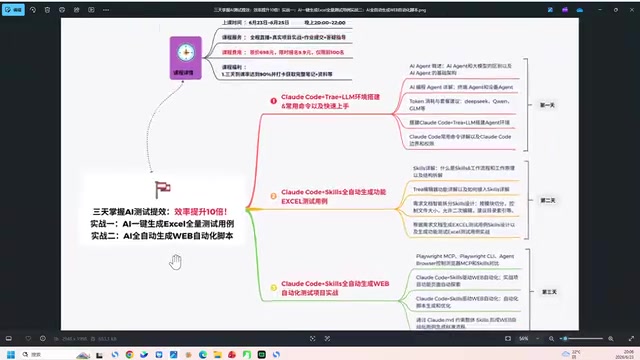
If AI's contribution to software testing was previously limited to the "assistive Q&A" level, the rise of Agent technology is now completely reshaping how test engineers work. According to a relevant AI testing training course on Bilibili, a senior instructor with 13 years of IT experience (including 3 years in development and testing) pointed out: when only LLMs were available, AI's role in testing was actually quite limited. But with the maturation of Agent technology, AI testing has evolved from an "optional feature" into a "must-have skill" for test engineers.
Behind this assessment lies a deep restructuring of the testing skill map. The core competencies of traditional testing roles include functional testing, interface testing, automated testing, and performance testing. In the AI era, this skill list has been rewritten as: functional testing, AI testing (which runs through automation), and performance testing—AI testing has become an independent and core component.
LLM vs. Agent: The Cognitive Boundary You Must Clarify
To understand the essence of AI testing, you must first clarify the difference between LLMs and Agents—this is also a key concept that many beginners tend to confuse.
The LLMs we use daily, such as DeepSeek and Tongyi Qianwen, are essentially a form of Q&A-based interaction: you input a question, and it gives a reply. While this mode is powerful, it has inherent limitations.

The instructor offered an elegant analogy: an LLM is like the human brain. It can think and reason—for example, if you ask "what is 1+1," it can immediately give the answer. But if you ask it to "output test cases as an Excel file," a pure LLM cannot do it—because the brain can only "think," but has no "hands and feet" to execute.
The Four Core Capabilities of Agents
The reason Agents can reshape testing workflows is that, building on top of LLMs, they complete the key capabilities at the execution level. Compared with LLMs, Agents add the following four dimensions:
1. Task Planning Capability
When you hand an Agent a complex task, it won't just give a one-time answer like an LLM would. Instead, it can autonomously break down the task and formulate an execution plan. This planning capability allows it to handle multi-step, dependency-laden complex testing scenarios.
2. Memory Capability
This is key to how Agents solve the LLM's "forgetfulness" pain point. Traditional LLMs tend to lose earlier context in long conversations, causing previously stated requirements to be forgotten in subsequent interactions. Agents, however, can record completed work as a basis for subsequent steps.

This means that in a testing project spanning multiple days, an Agent can remember previously generated cases, discovered defects, and executed operations, thereby maintaining continuity in its work.
3. Tool Invocation Capability
An Agent can automatically invoke external tools to accomplish goals—this is the core of what truly enables it to "take action," such as automatically generating Excel test case files, executing web automation scripts, and calling various testing platform APIs. This is a capability boundary that pure LLMs cannot touch at all.
4. Skill Extension Capability
An Agent can also combine specific "Skills" to accomplish specialized tasks. In the testing field, whether generating test cases, writing web automation scripts, or covering various business testing scenarios, all can be flexibly achieved through Agents.

How Agents Reshape the Testing Workflow
To summarize with a formula: Agent = Brain (LLM) + Limbs (planning, memory, tools, skills). This combination allows AI to truly evolve from "being able to think" to "being able to do."
In actual testing work, the efficiency gains brought by this capability leap are quite significant. Taking the goal demonstrated in the course as an example, by combining Claude Code with tools like Kiro, you can achieve fully automated test case generation—from functional test cases to interface test cases (hands-on VM-based project), boosting efficiency "tenfold" or even more.
Classification of Agents: Project-Level and System-Level
Currently, there are many Agent products on the market, which can be broadly divided into two categories:
- Project-Level Agents: Aimed at testing tasks for specific projects, focusing on concrete steps like case generation and script writing.
- System-Level Agents: Equipped with broader system integration and workflow orchestration capabilities, suitable for building enterprise-level testing systems.
For test engineers, starting with project-level Agents and gradually mastering environment setup, common commands, and hands-on techniques is the most pragmatic path into the AI testing field.
Takeaways for Test Engineers
This technological transformation has a profound impact on practitioners at different experience levels. Whether you're a newcomer just entering the field or a senior test engineer with years of experience, you need to re-examine your skill structure.
It's worth emphasizing that AI testing is not meant to replace test engineers, but to change how engineers work. Testers who master Agent tools can delegate repetitive case writing and script generation to AI, thereby focusing their energy on higher-value work such as test strategy design and complex scenario analysis.
For testing practitioners who want to stay competitive, understanding the fundamental difference between LLMs and Agents and mastering the practical application of Agent toolchains has shifted from a "bonus" to a "survival skill." This is precisely the fundamental reason behind the continued rise in popularity of AI testing training—the underlying logic of the technology has changed, and practitioners' capability models must evolve accordingly.
Related articles

The Truth Behind Codex 'Build a Website in 5 Minutes': AI Isn't Creating Sites—It's Helping You Copy Them
Exposing the truth behind viral Codex 5-minute website videos: creators aren't building original sites with AI—they're copying shared prompts or scraping others' work. Learn AI coding tools' real limits.

Getting Started with AI Agent Development: A Complete Guide from Concept to Practice
A comprehensive guide to AI Agent architecture and development, covering automated marketing, intelligent customer service, and investment analysis scenarios with single and multi-agent collaboration.

The Truth Behind Codex 'Build a Website in 5 Minutes': AI Isn't Creating Sites — It's Helping You Copy Them
Exposing the truth behind viral Codex 5-minute website videos: creators aren't building original sites with AI — they're copying shared prompts or scraping others' work.