AI Crushes Humans! OpenAI Model Solves All 5 Problems in AtCoder World Tour Finals Algorithm Contest

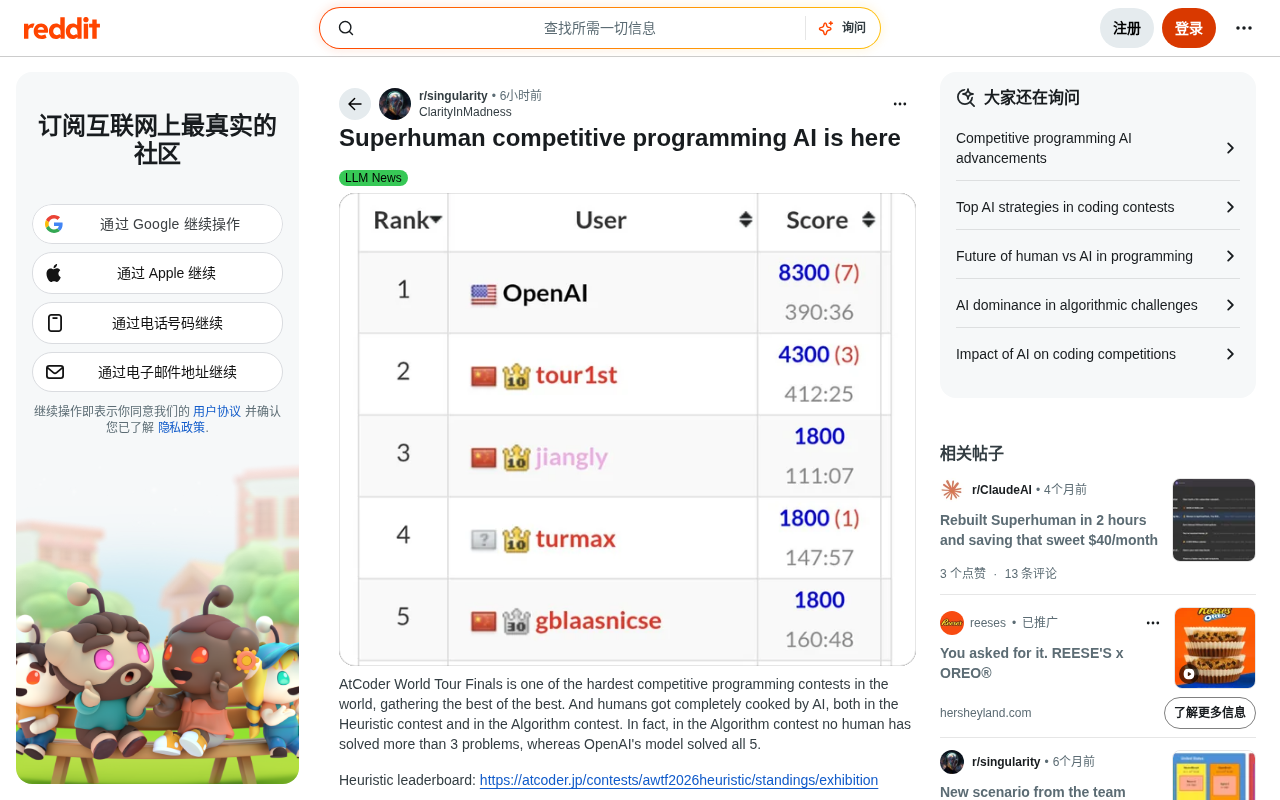
OpenAI's model solved all 5 algorithm problems at AtCoder World Tour Finals; no human topped 3.
At the AtCoder World Tour Finals, OpenAI's model completely solved all 5 Algorithm Contest problems while no human competitor exceeded 3, and it also beat humans in the Heuristic Contest. This marks a critical inflection point where AI surpasses top programmers on structured reasoning — though contest results still differ from real software engineering ability.
Top Human Programmers "Wiped Out" by AI at an Elite Competition
The AtCoder World Tour Finals (AWTF) is widely recognized as one of the most difficult competitive programming events in the world. AtCoder is Japan's most influential online algorithm competition platform, founded in 2012 by engineers who themselves came from a competitive programming background. Qualification for its highest-tier annual event, AWTF, requires passing a year-long points-based ranking filter. Those who make the cut are typically professional competitors or student contest champions with top ratings on platforms like Codeforces and LeetCode — it is truly the ultimate stage for the "greatest minds." As a distinct technical subculture, competitive programming has long served as an important channel for top tech companies (such as Google, Meta, and Jane Street) to identify algorithmic talent. Yet in the latest edition of the competition, AI's performance sent shockwaves through the entire competitive programming community.
According to results circulating in the Reddit community, OpenAI's model demonstrated overwhelming dominance over human competitors in both the Algorithm Contest and the Heuristic Contest tracks. Most striking was the Algorithm Contest: no human competitor solved more than 3 problems, while the OpenAI model completely solved all 5. This is no longer an incremental catch-up, but a discontinuous leap.
Two Tracks, Total Domination Across Two Dimensions
Algorithm Contest: A Battle of Pure Intellect
The Algorithm Contest tests a competitor's comprehensive ability to understand complex problems, design correct algorithms, and implement them efficiently within a limited time. It typically demands a solid foundation in data structures, sharp mathematical insight, and the mental fortitude to maintain rigorous logic under intense pressure.
AI solving all 5 problems in the Algorithm Contest means it can not only handle standard problem types but also crack the extreme challenges specifically designed to "stump" the best humans. Consider that AWTF's difficulty far exceeds that of ordinary online competitions — solving even 3 problems is already world-class. AI's performance shows that it has reached, or even surpassed, the human peak in symbolic reasoning, combinatorial optimization, and code generation.
Heuristic Contest: Continuous Optimization on Open Problems
The Heuristic Contest is a different kind of test — problems often have no known optimal solution, and competitors must continuously iterate and tune within the allotted time to get as close as possible to the theoretical upper bound.
To understand this track, one must first grasp the essence of heuristic algorithms: they are a practical methodology in computer science for solving problems of extremely high computational complexity, such as NP-hard problems. Unlike exact algorithms that pursue the optimal solution, heuristic methods use techniques such as Simulated Annealing, Genetic Algorithms, and Monte Carlo Tree Search (MCTS) to find sufficiently good approximate solutions within acceptable time. AtCoder's heuristic track ranks competitors by relative score rather than absolute correctness, requiring them to continually refine parameters and restructure strategies. It is considered the competition format closest to industrial-grade optimization engineering — testing not the ability to find the "standard answer" but the capacity for engineered exploration and trade-offs.
AI also defeated humans in this track, which is perhaps even more thought-provoking. Heuristic problems have traditionally been seen as more dependent on human intuition, experience, and creative trial-and-error — a domain where humans held a relative advantage over AI. AI's victory in the Heuristic Contest shows it now possesses genuine ability to effectively explore and optimize open-ended problems with no standard answer.
What This Milestone Means
Competitive Programming: The Best Litmus Test for AI Reasoning
Competitive programming has long been an important benchmark for measuring AI reasoning ability. Of particular note is the issue of data contamination — if an AI's training corpus includes the evaluation problems or their solutions, then high scores merely reflect memorization rather than genuine reasoning. Live events like AWTF use entirely new problems that are never made public before the competition begins, which structurally rules out contamination. This makes its conclusions far more convincing than tests conducted on public problem sets (such as LeetCode).
The OpenAI model achieving superhuman results on such a "clean," high-difficulty battlefield shows that today's large models are no longer performing simple pattern matching or problem-bank memorization, but have truly mastered some form of transferable problem-solving ability — an ability rooted in genuine generalization of algorithmic thinking. This is consistent with AI's earlier breakthroughs in events such as the IOI (International Olympiad in Informatics) and the IMO (International Mathematical Olympiad).
A Critical Inflection Point: From "Approaching Human" to "Comprehensive Superiority"
Over the past few years, AI's progress in programming has accelerated markedly: from simple code completion at first, to passing some algorithm competitions, to now crushing humans at the very top events — this evolutionary process has been dramatically compressed. Behind this series of advances lies a fundamental architectural evolution of large language models from autoregressive prediction to reinforcement-learning-driven reasoning enhancement (such as Chain-of-Thought reasoning and Process Reward Models), which has given models the ability to transfer abstract reasoning across problem types. In 2024, Google DeepMind's AlphaProof reached silver-medal level at the IMO, and official Codeforces data also showed top AI models entering the "red" rating tier (2800+). The AWTF results are the latest and most powerful confirmation of this trend to date.
One detail worth noting: this was not a case of AI "barely defeating" some mid-level competitor, but of AI comprehensively surpassing the world's strongest humans on the highest stage. Such a discontinuous gap suggests that on intellectual tasks with clear rules and formal verifiability, AI may have already crossed a critical, hard-to-reverse inflection point.
Staying Rational: Contest Results ≠ Software Engineering Ability
As stunning as these results are, we must interpret them cautiously. There are profound structural differences between competitive programming and professional software engineering: the former is characterized by fully formalized problems, clearly defined inputs and outputs, automated judging, and closed time windows; the latter is full of requirement ambiguity, cross-system dependencies, legacy code debt, team collaboration friction, and long-term maintainability constraints. Researchers have encapsulated real engineering tasks into benchmarks like SWE-bench, and current top AI models still solve them at rates far below what contest results might imply. Competitive programming is a closed domain with clear rules and automatically verifiable outcomes, fundamentally different from real software engineering. AI's superhuman performance in competitions cannot be directly equated with the ability to replace software engineers.
Moreover, in the competition, AI may possess computational speed and parallel-attempt advantages that humans cannot match, which is not entirely comparable to a scenario where humans manually code under time pressure. The relevant data currently comes mainly from community discussions and leaderboard screenshots; details such as competition rules and AI compute configuration still await further official disclosure.
Still, even accounting for these factors, the fact that AI can correctly understand and solve problems that even the top human competitors cannot crack is itself a milestone that cannot be ignored — it marks that AI now possesses genuinely "superhuman" capability on structured reasoning tasks. Algorithmic reasoning ability is a necessary but not sufficient condition for software engineering ability. Between AI's superiority on closed intellectual tasks and its ability to autonomously deliver in open engineering environments, there remains a gap yet to be bridged.
Conclusion: The Human-Machine Boundary Is Rapidly Dissolving
This scene at the AtCoder World Tour Finals may well become a symbolically significant node in the history of AI development. When humanity's most elite algorithm experts are comprehensively surpassed by AI on their own home turf, we are forced to reconsider: in intellectual domains that can be clearly defined and verified, the boundary between humans and machines is dissolving at a visible pace.
For developers and the entire tech industry, rather than fretting about "being replaced," it is better to actively consider how to collaborate with these increasingly powerful reasoning tools. This competitive programming "wipeout" is both a warning and a window into new possibilities.
Key Takeaways
Related articles

WebMCP in Practice: How MakeMyTrip Is Reshaping the Travel Booking Experience
India's largest OTA platform MakeMyTrip uses WebMCP to standardize AI Agent interactions with web apps, replacing fragile DOM scraping with natural language-driven test automation and simplified complex booking scenarios.

Deep Dive into the EYG Programming Language: A New Portable Programming Paradigm Designed for Humans
Deep analysis of the EYG programming language's core design, including algebraic effects, program state persistence, and cross-platform portability, exploring how it addresses modern software fragmentation.

WebMCP in Practice: How MakeMyTrip Is Reshaping the Travel Booking Experience
India's largest OTA platform MakeMyTrip uses WebMCP to standardize AI Agent interaction with web apps, solving DOM scraping fragility, enabling natural language test automation, and simplifying complex international flight bookings.