AI Manga Series Production: A Complete Guide from Script to Storyboard

A step-by-step guide to creating AI manga series, from script formula to storyboard generation.
This guide walks through the full AI manga production workflow, covering the key difference between AI scripts and regular screenplays, a universal script formula with episode basics, character cards, and scene descriptions, and how to generate and review storyboard scripts. It also explains why detailed prompts matter and which techniques require manual revision.
What Is an AI Manga Series and Why It's Worth Getting Into
AI manga series are essentially those animated short dramas you can't stop scrolling through — one episode after another. The business model is straightforward: viewers either pay to unlock the next episode or watch a few seconds of ads that earn revenue for the creator. Those brief monetization touchpoints — paid unlocks or ad views — form a content revenue model that can be replicated indefinitely.
This model draws heavily from the proven "micro short drama paywall" logic that's dominated the short-form video space. Between 2022 and 2023, as vertical-format short dramas exploded on Douyin and Kuaishou, the commercial loop of "end each episode on a cliffhanger, drive viewers to unlock the next one" was thoroughly validated. AI's entry into this space dramatically cuts content production costs. Traditional short dramas require on-location shooting, actor scheduling, and editing teams. AI manga series only need a script, image generation tools, and voice synthesis. Per-episode production costs can drop from thousands of yuan to just hundreds — or even less — making it viable for individual creators to compete.
From an industry perspective, the central question around AI manga has shifted from "can it be done" to "who can be the first to run the complete workflow end-to-end." Once a series is in serialization, ad unlocks and paid unlocks create continuous positive feedback for creators. In practice, however, a huge number of newcomers get stuck at step one — without a structured guide, they don't know where to start or which pitfalls will trip them up.
This article is based on a practical tutorial by an AI manga creator on Bilibili. It maps out the complete workflow from scriptwriting to storyboard generation, with a particular focus on the scripting phase — the most easily overlooked, yet most critical, step.
The Mistakes Beginners Make When Writing AI Scripts
Many people jump straight in and type something like "write me a revenge-themed manga drama script" into Doubao (or another LLM), then wait for the AI to churn it out. The result can look decent at first glance — there's a hook, there are characters, there's a plot. But you've actually been led astray by the AI's "hallucination."
The concept of AI "hallucination" refers to the tendency of large language models to output content that seems plausible but doesn't actually match what the user needs — and to do so with high confidence. This stems from how LLMs work: models predict the next token based on probability distributions without truly "understanding" meaning. When a prompt is vague, the model fills the output with the most common patterns from its training data. Ask for a "revenge-themed drama script" and you'll get the most generic revenge tropes imaginable — not something tailored to your actual creative vision. The solution to hallucinations, as this article emphasizes, is providing clear constraints and structured instructions.

This approach has three hard flaws:
- The request is too vague: Ambiguous instructions produce ambiguous output that can't be used in production.
- Characters lack critical information: Characters have no defined age, yet age directly affects facial features — which is crucial for AI image generation later.
- Hooks are just buzzwords: Labels like "reincarnation with a twist" or "mutual-pining romance" are rarely what you actually want. Every change means regenerating from scratch, killing efficiency.
The deeper problem: you haven't mapped out the script's core elements before you start writing. If you don't know your protagonist's age, key traits, or signature phrases, the content won't just be hard to monetize — you'll find it boring yourself.
The Fundamental Difference Between an AI Manga Script and a Regular Script
Here's a key insight: an AI manga script is completely different from a conventional novel or screenplay.
A regular script might only need dialogue and basic scene descriptions. But an AI manga script inherently requires extremely detailed descriptions — because the script text will ultimately be handed to an AI (or an artist) to render as visuals. Without enough detail, the scenes can't be "locked in."
An AI script must include as much of the following information as possible:
- Scene setting (time of day, location, atmosphere, day or night)
- Character expressions and demeanor
- Character actions
- Dialogue and narration
Only by loading these elements into the text — whether you're handing it to a human artist or feeding it to an AI — can you accurately reproduce the visuals you have in your head.
The Universal AI Manga Script Formula, Explained
The tutorial's author has distilled a "standard universal formula." Follow this structure and you'll produce a solid script framework every time:
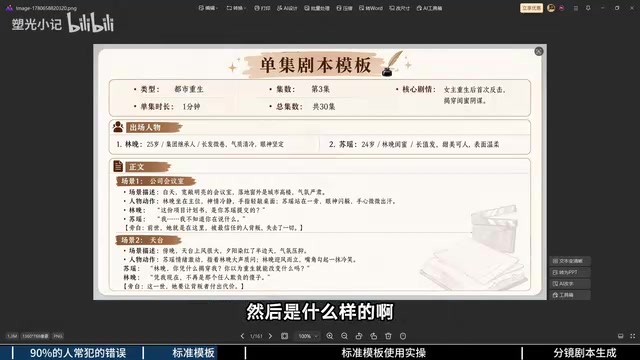
Episode basics + Character introductions + Body (scene + scene description + character actions + dialogue + narration)
Episode Basics
This section needs to nail down the following key fields:
- Genre: e.g., "urban reincarnation" — lets the AI immediately recognize the direction.
- Total episode count: e.g., 37 episodes total.
- Current episode number: which episode you're writing.
- Episode length: the current mainstream is around 1 minute.
- Core plot: summarize this episode in one sentence — precise enough to guide the AI, but leaving some room for creative expression.
Character Setup
For each character who appears, you need to specify: age, role/identity, and key physical traits. This step is critical — only by anchoring the character profiles can the AI consistently render them.
This is directly related to how LLMs handle context windows. A context window is the total amount of text a model can "remember" and reference within a single conversation. Information beyond this window gets cut off. Even though today's leading models support context windows of tens of thousands to hundreds of thousands of tokens, character details, world-building specifics, and personality quirks still face a "drift" risk in long serialized works — by episode 15, the model may no longer have full access to the character age or catchphrases you defined in episode 1. This is exactly why creators need to manually attach a "character card" to each prompt as a hard constraint.
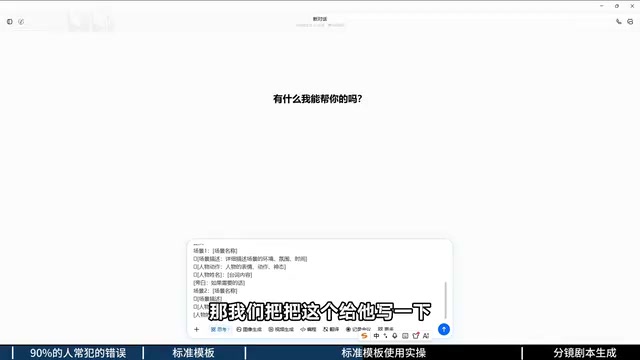
Body Content and Scene Descriptions
The body section doesn't need to be written word for word by hand — you let the AI fill it in for you. This is the essence of "AI-assisted creation": the creator builds the structure and defines the constraints; the AI creates within that structure; then you evaluate and revise.
Scene descriptions should include: location (e.g., a company conference room), time of day (day or night), exterior atmosphere, and the specific actions characters take in that scene. Once these template fields are locked in, the AI can create within the defined boundaries rather than going off in random directions.
Hands-On Demo: From Template to a Finished Script
Paste the formula template into Doubao and fill in each field: genre set to "urban reincarnation," episode length 1 minute, 37 total episodes writing episode 1, a one-sentence core plot, and the character card details for all appearing characters. For the body section, keep only the placeholder fields for scene description and character expression/action/demeanor — delete anything you don't need. Finally, add the line "Please follow the template above."
The resulting episode 1 script is noticeably more detailed than what you'd get from a vague prompt. The output includes specific time-and-place descriptions (e.g., "deep in the night, past midnight"), character action descriptions (e.g., "bends down," "rummages through"), and context-appropriate narration (e.g., "the biting cold wind"). These detailed action and scene descriptions are the foundation for storyboarding — only when character states are clearly defined can the AI accurately generate corresponding visuals.
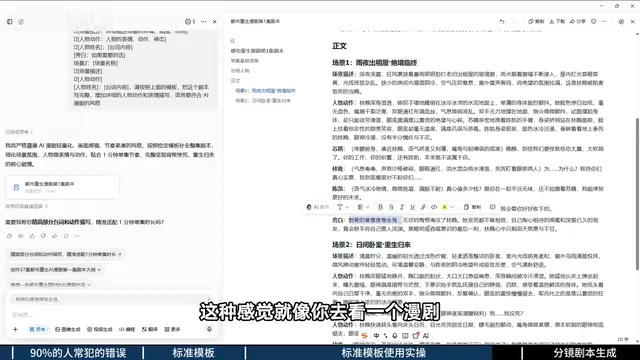
After generation, always review the script with a director's eye: check for any hard errors, assess whether scenes are logically sound, and verify that character states are on point. Once everything checks out, instruct the AI to "continue generating a shot-by-shot storyboard script."
Key Checkpoints for the Storyboard Script
In traditional animation production, a storyboard script bridges the written screenplay and the visual imagery — specifying shot type, camera movement, duration, and visual content for each shot. In the AI manga workflow, this document takes on even greater importance: it serves directly as the source for prompts fed into image generation tools like Midjourney or Stable Diffusion. Shot types and camera movement descriptions translate into compositional instructions for image generation; scene atmosphere and character actions influence the generated lighting, color grading, and character postures. The more precise the storyboard, the smaller the gap between what the AI generates and what the creator intended — and the lower the cost of post-generation fixes and re-generations.
When generating the storyboard, focus on verifying that the following elements are consistent with the script:
- Shot types: Are wide shots, close-ups, extreme close-ups, etc. used appropriately?
- Camera movement: Does the AI's suggested camera motion match the narrative pacing?
- Visual content and dialogue: Confirm alignment with the established script.
- Ambient sound effects: Assess whether the matched audio fits the scene.
- Individual shot duration: Keep pacing controlled — avoid shots that run too long or cut too short.
The author specifically flags that techniques like "montage" and "fade to black" are areas requiring heavy manual revision. Montage is a core technique in film editing language — it conveys the passage of time, emotional tone, or cause and effect by rapidly cutting between and juxtaposing multiple shots. It's a narrative mode that depends on the relationship between shots, not a single image. Fade to black uses a black-screen transition to signal a scene change or time jump. Both techniques are difficult for AI to reproduce within a single static image: montage requires the orchestration of multiple images; fade to black requires a video-level transition. Whenever these appear in an AI-generated storyboard, the creator must intervene manually and replace them with static or animated visuals that can actually be executed. Carefully checking and revising these points will dramatically reduce rework later.
Summary: Humans Build the Framework, AI Fills It In, the Director Signs Off
The core logic of this workflow is clear: humans are responsible for building the structure, defining constraints, and making judgment calls; AI is responsible for creating within that structure. The level of detail in the scripting phase directly determines the quality of image generation downstream — and that's exactly what distinguishes AI manga creation from traditional content production.
For newcomers looking to break into AI manga, getting the "universal formula" to run smoothly is the first step to avoiding most of the common pitfalls. The more advanced challenges — like maintaining a consistent world-building across a serialized run and anchoring character consistency — are the next mountain to climb. These represent the most stubborn "consistency problem" in AI content creation: as episode count grows, the constraints of model context windows, the randomness inherent in AI character image generation, and the gradual drift of world-building details all combine to make quality control exponentially harder over a long run. This is ultimately the deciding variable in whether an AI manga series can sustain long-term serialization.
Key Takeaways
Related articles

Disaster and Glory of the Apollo Program: The History We Must Revisit Before Returning to the Moon
From the fatal Apollo 1 fire to Apollo 8's daring lunar orbit to Apollo 11's successful landing—revisiting the disasters, fears, and compromises of the Apollo program and their lessons for today's return to the Moon.
Netflix Trust Exercise Turns Into Firing Trap: Where Are the Boundaries of Corporate Trust?
A Netflix employee was fired after sharing private info in a trust exercise. We analyze the risks of corporate trust exercises and how employees can protect themselves.

AMD CDNA5 Architecture Deep Dive: Technical Evolution and the AI Computing Competition Landscape
Deep analysis of AMD's CDNA5 architecture covering Chiplet packaging upgrades, HBM memory evolution, and low-precision compute optimization, examining how AMD challenges NVIDIA's AI chip dominance.