AI Workbench: One-Click Content Creation from Topic Research to Final Output

AI Workbenches automate research, writing, and visualization in one transparent, multi-model platform.
AI Workbenches use multi-agent architecture to automate the entire content creation pipeline — from topic research and document generation to visual output — all from a single prompt. Key features include transparent execution with real-time source citations, flexible iterative editing via natural language, multi-model routing for cost and quality optimization, and the ability to package personal workflows into reusable, shareable templates.
From "Topic" to "Finished Product": How AI Workbenches Are Reshaping Content Production
For content creators, the most time-consuming part of the job is rarely the writing itself — it's the upstream work: topic research, material gathering, and information synthesis. A new category of tool, the "AI Workbench," is now automating all of that. Just give it a topic, and it handles everything from research and structured document generation to polished, visual content output.
At its core, an AI Workbench is a productivity platform built on a Multi-Agent System (MAS) architecture. MAS research dates back to the 1980s as a branch of distributed AI, with the central idea of decomposing complex tasks into subtasks executed by specialized AI agents in parallel or in sequence. In early implementations, each agent's behavior was rigidly pre-defined using hand-coded rules and finite state machines — flexible enough for closed-domain problems, but ill-suited to open-ended tasks. The deep learning era gave agents better perception and decision-making capabilities, though they remained constrained by domain-specific training data.
The true paradigm shift came with the rise of large language models (LLMs). Each agent is no longer a simple rule engine, but an intelligent entity capable of natural language understanding and generation — able to dynamically interpret task instructions and flexibly invoke external tools such as web search APIs, code execution sandboxes, and image generation interfaces. This transformation dramatically reduced the design complexity of MAS: task scenarios that once required hundreds of rules can now be driven by a carefully crafted natural language prompt. Each agent has its own "role definition" and "tool access permissions" — one agent handles web retrieval, another handles writing, another handles image generation — coordinating through structured message passing. Compared to single large models, this architecture offers clearer division of labor, localized error isolation, and more stable overall output quality.
Also worth noting is the critical role of the Orchestration Layer in multi-agent systems. It handles task decomposition, agent scheduling sequences, and the passing and validation of intermediate results — its design quality directly determines the robustness of the entire system. The orchestration layer typically involves Directed Acyclic Graph (DAG) scheduling, conditional branching logic, and exception fallback mechanisms, allowing complex multi-step tasks to degrade gracefully on partial failure rather than collapsing entirely. A DAG is a graph-theoretic structure where nodes represent task units and directed edges represent dependencies; the "acyclic" property ensures execution never deadlocks. This data structure is widely used in workflow scheduling systems like Apache Airflow and Prefect, and is a foundational infrastructure element for modern data pipelines and AI workflow orchestration. Leading multi-agent frameworks today include AutoGen, CrewAI, and LangGraph, while commercial AI Workbench products wrap these underlying frameworks in more user-friendly interfaces.
In a hands-on demo by a Bilibili content creator, the degree of automation was striking: after entering a topic, the AI automatically conducted video research and generated a well-structured, information-rich document — then converted that document into polished visual content, ready for use in social media posts or formal documentation.

This "all-in-one" workflow essentially consolidates skills that creators previously spread across multiple tools — searching, organizing, writing, formatting, and sourcing images — into a single unified platform, dramatically compressing the time cost of content production.
AI Team Collaboration: Full Execution Transparency
One of the most notable design choices in this AI Workbench is its "AI professional team" collaboration mechanism.
In the demo, the creator was setting up a new AI tech account. After selecting a trending topic, he simply entered his instructions into the research field. A full "AI professional team" immediately appeared on the right side of the interface, with the system assigning relevant domain "experts" based on the type of content being produced.
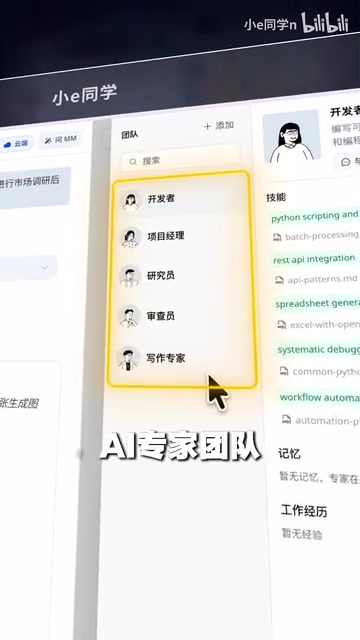
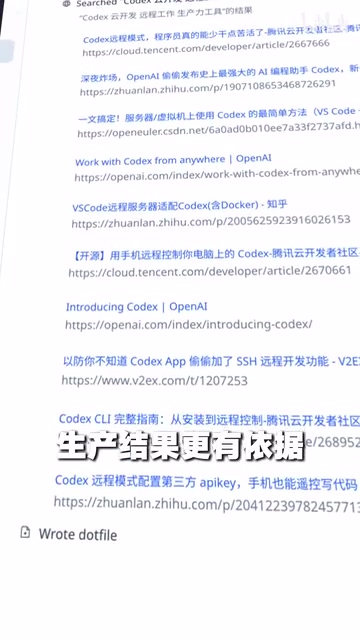
More critically, the execution process is fully transparent. Every action taken by the AI experts in the background — and their current progress — is clearly visible. Even the source materials and references being consulted are displayed in real time. This directly addresses a core pain point of traditional AI tools: the "black box" problem. Outputs are no longer pulled from thin air; they are traceable and verifiable, which significantly enhances content credibility and professionalism.
The "black box" problem is one of the central obstacles to deploying LLMs in professional settings. Traditional AI tools typically only present final outputs, leaving users with no insight into what information the model drew on or what reasoning path it followed — a particularly serious risk in fields like content creation, medicine, and law where accuracy is paramount. The industry has developed several technical approaches to address this: Retrieval-Augmented Generation (RAG), which enables models to retrieve from external knowledge bases and cite sources in real time; Chain-of-Thought prompting, which guides models to show their reasoning step by step; and citation anchoring, which binds each segment of generated content to a specific source reference.
The core engineering challenge in RAG is retrieval quality. The system must convert a user query into a vector embedding, locate the most semantically relevant document fragments in a knowledge base, and inject them into the model's context window. Vector embeddings map text into high-dimensional numerical vectors in semantic space, where semantically similar texts are positioned closer together — enabling efficient retrieval via cosine similarity or Euclidean distance. This process involves two critical engineering considerations: first, chunking strategy — how to split source documents into appropriately sized semantic units. Chunks that are too large dilute key information; chunks that are too small lose contextual coherence. Industry practice typically uses "sliding window chunking" or "semantic-aware chunking" to balance this tradeoff, with the latter leveraging sentence boundary detection and paragraph structure to keep each chunk as semantically complete as possible. Second, reranking — after an initial retrieval pass produces candidate documents, a cross-encoder model performs fine-grained re-sorting to ensure the most relevant fragments are prioritized for the model. Compared to the bi-encoders used in initial retrieval, cross-encoders jointly model both query and document together, yielding higher ranking accuracy at greater computational cost — which is why they are typically reserved for second-pass re-ranking of initial results. Retrieval precision directly determines the accuracy of generated content, which is why both of these techniques remain active areas of optimization in RAG engineering. The AI Workbench's real-time citation display is a product-level realization of RAG and source-attribution technology, making the model's "thought process" visible and fundamentally improving the trustworthiness of outputs.
For serious content creation, source traceability is non-negotiable. When every claim maps back to a specific reference, creators can use AI-generated research results with far greater confidence.
Automatic Visualization and Flexible Iterative Editing
Once research and planning are complete, the AI Workbench automatically moves to the next phase — visual output — producing image-and-text content with a consistent visual style and clear information layout.
A particularly creator-friendly feature is its flexible iteration capability. If you're unhappy with the overall result, you can re-run the entire workflow. If you only want to adjust a specific image, you can simply tell the AI what you want in the chat box using natural language, and it will continue from there — no need to start from scratch.

This combination of "full re-run" and "local fine-tuning" corresponds to the engineering concept of a Stateful Workflow. The system must persist the output state of each intermediate node, allowing users to resume from any checkpoint rather than restarting from zero. This capability relies on the workflow engine's fine-grained management of "node state," typically using key-value stores or graph databases to persist intermediate results, and version control mechanisms to track the diff of each modification. The analogy to software engineering's "Git commit" is apt: each checkpoint is a revertible snapshot, and users can branch off from any historical node without losing prior work.
It's worth noting that achieving true "rollback to any node" is non-trivial in practice. The system must store not only each node's output data, but also the complete execution context at the time that node ran — including the states of all upstream nodes — to guarantee consistency when resuming from a checkpoint. In distributed systems, this is known as the Consistent Snapshot problem, and its classic solution is the Chandy-Lamport algorithm, which coordinates global state capture by passing special marker messages between nodes, ensuring logical consistency in the snapshot even when physical clocks are out of sync. The AI Workbench translates this classic distributed systems challenge into a user-perceptible "local edit" experience — a textbook example of converting deep engineering capability into tangible product value. This is one of the core engineering capabilities that distinguishes an AI Workbench from simple scripted automation: it balances efficiency with precision, eliminating wasteful full re-runs for minor changes while preserving the flexibility for complete reconstruction.
Multi-Model Invocation and Workflow Templatization
Another major advantage of this AI content creation platform is its ability to call multiple leading large models. Whether for deep research, content writing, image generation, or programming tasks, everything can be accomplished within a single platform — no context-switching between tools required.
Behind "multi-model invocation" lies a key engineering decision: Model Routing. Different LLMs have meaningfully different capability profiles. GPT-4o and Claude 3.5 Sonnet excel at long-form comprehension and creative writing; DeepSeek and the o1 series have an edge in complex reasoning and math; Stable Diffusion, Midjourney, and DALL-E 3 specialize in image generation; while Codex and Claude each have distinct strengths in code generation. The goal of a model routing strategy is to automatically select the optimal model based on task type, cost budget, and latency requirements. Advanced routing systems can even dynamically adjust model selection based on historical task performance, forming an adaptive "capability map" — as usage data accumulates, the system becomes increasingly precise at predicting which model handles which type of task best. This adaptive routing typically relies on statistical analysis of historical call data, and may incorporate lightweight Meta-Learning mechanisms to give routing decisions their own capacity for continuous improvement. Meta-learning, also known as "learning to learn," involves models extracting cross-task generalizable patterns from a large collection of historical tasks, enabling rapid adaptation to new tasks. Applied to model routing, the system can automatically infer from historical call records which task features correspond to which model performing better, converting these patterns into routing priors for ongoing self-optimization.
From a cost perspective, model routing also serves a cost-reduction function. For simple formatting tasks, the routing system prioritizes smaller, lower-cost lightweight models (such as GPT-4o mini or Claude Haiku), reserving flagship models only for tasks requiring deep reasoning or creative generation. According to industry experience, a well-designed model routing strategy can reduce overall inference costs by 40–70% — a significant economic advantage in high-frequency content production scenarios. For AI Workbenches, multi-model invocation is not just a feature highlight; it's an engineering practice that seeks the optimal trade-off in the "quality–cost–speed" triangle, avoiding the quality degradation that comes from forcing a single model to handle all task types.
The creator in the demo also mentioned that he had packaged his personal content workflow into a reusable template for others to call directly. Packaging a personal creative workflow into a reusable template is, in essence, a productization of Prompt Engineering and workflow orchestration capabilities. Prompt engineering — the craft of designing input instructions to guide models toward high-quality outputs — was once considered a core skill of the AI era. But as workflow tooling matures, this capability is undergoing a "democratization" shift: expert-level prompting strategies and task orchestration logic can be encapsulated into templates that ordinary users can invoke without understanding the underlying mechanics. This mirrors the evolution of "libraries" and "frameworks" in software engineering: developers wrap complex implementations into callable interfaces, lowering the barrier for those who come after.
From an economic standpoint, this creates a new form of "knowledge asset" — a creator's methodology no longer needs to be transmitted only through tutorials or courses, but can be delivered directly as an "executable workflow," and may give rise to an entirely new market for workflow template transactions. Some platforms are already exploring a Workflow Marketplace business model, allowing creators to price and sell their refined workflow templates. This logic closely resembles the early App Store: the platform provides infrastructure and distribution, creators contribute specialized "apps" (i.e., workflow templates), and users purchase on demand. As the AI Workbench ecosystem matures, "workflows" will become a new category of tradable digital asset — alongside plugins and themes — and may give rise to the emerging profession of the "workflow designer": someone whose core competitive value lies not in directly producing content, but in designing efficient, stable, and reusable production processes.
This reveals the deeper value proposition of the AI Workbench model: creative skills are no longer irreplicable personal experience — they are "workflow assets" that can be packaged, shared, and reused.
Closing Thoughts: Creator Capabilities Are Being "Productized"
This demonstration makes clear that AI Workbenches are propelling content creation into a new phase. In the past, the value of experienced creators resided in their research methods, writing frameworks, and aesthetic judgment. Now, these tacit skills are being progressively "productized" — packaged into runnable, shareable workflows.
For everyday creators, this means a dramatically lowered barrier to entry: with a template built by someone else, even an inexperienced creator can rapidly produce structurally sound, visually professional content. For seasoned creators, distilling their methodology into templates may become an entirely new avenue for monetizing their expertise.
That said, it's worth maintaining perspective: these tools are currently best suited to process-driven, structured content production. The insights that determine genuine depth and originality still require the creator's own thinking. AI Workbenches liberate the execution layer — they don't replace the creative act itself.
Related articles

Disaster and Glory of the Apollo Program: The History We Must Revisit Before Returning to the Moon
From the fatal Apollo 1 fire to Apollo 8's daring lunar orbit to Apollo 11's successful landing—revisiting the disasters, fears, and compromises of the Apollo program and their lessons for today's return to the Moon.

Netflix Trust Exercise Turns Into Firing Trap: Where Are the Boundaries of Corporate Trust?
A Netflix employee was fired after sharing private info in a trust exercise. We analyze the risks of corporate trust exercises and how employees can protect themselves.

AMD CDNA5 Architecture Deep Dive: Technical Evolution and the AI Computing Competition Landscape
Deep analysis of AMD's CDNA5 architecture covering Chiplet packaging upgrades, HBM memory evolution, and low-precision compute optimization, examining how AMD challenges NVIDIA's AI chip dominance.