AITS Intelligent Testing Platform: How AI Agents Are Transforming Test Engineers from Script Writers to AI Commanders

Software testing is shifting from automation to AI Agent-driven intelligence, requiring engineers to become AI strategy commanders.
The software testing industry is undergoing a paradigm shift from automation to AI-driven intelligence. Traditional automated testing struggles with high script maintenance costs and frequent changes, while AI Agents — with capabilities like auto-generating test cases, self-healing scripts, and exploratory testing — are redefining the field. Platforms like AITS bring these capabilities to real workflows, elevating test engineers from script writers to strategic decision-makers and AI commanders.
The Critical Shift in Software Testing: From Automation to Intelligence
The software testing industry is undergoing a profound paradigm shift. Over the past decade, automated testing has become a standard practice for most teams — but the next phase, intelligent testing driven by AI Agents, is accelerating fast.
For test engineers, the question isn't whether this will happen, but whether you're ready.
If you're still writing repetitive regression scripts every day, that work will soon be taken over by AI. But if you can become the person who directs AI to do the testing, your professional value will be in an entirely different league.
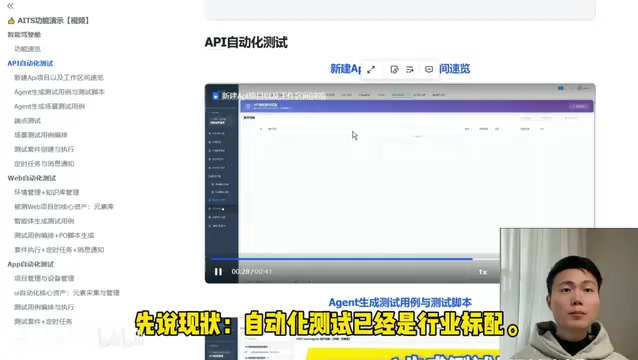
The Current State and Bottlenecks of Automated Testing
Tool-Level Limitations
The value of automated testing is undeniable: it frees up human effort, ensures regression quality, and keeps CI/CD pipelines running continuously. CI/CD (Continuous Integration/Continuous Delivery) is a cornerstone of modern software engineering — CI requires developers to frequently merge code into the main branch, triggering automated builds and tests with each merge, while CD automatically deploys code that passes testing to production. Automated testing serves as the "quality gate" in this pipeline; without reliable automation, high-velocity iteration simply isn't possible. Yet as microservice architectures become widespread, a mid-sized system may have dozens of services and thousands of interfaces, causing test case counts to explode.
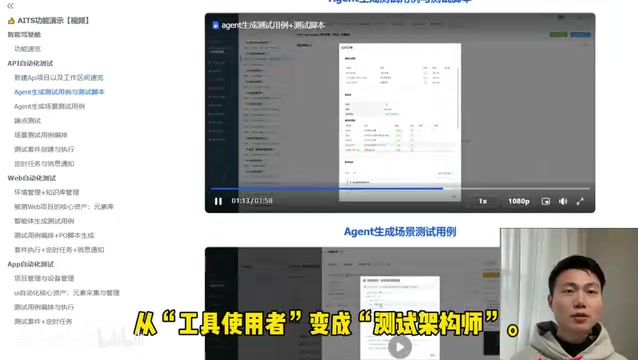
In practice, many teams still rely on tools like JMeter and Postman, which struggle with complex business logic. The real differentiator is writing automation scripts in code — transitioning from a tool user to a test architect. However, this path has a steep learning curve, and script maintenance costs grow exponentially with project scale.
The Dilemma of Traditional Testing Platforms
Once you have scripts, managing them becomes the next challenge. Traditional testing platforms emerged to address this, wrapping scripts in a visual interface so non-developers could operate them.
But they only solved the collaboration problem — scripts still had to be written by humans, test cases still had to be maintained by humans, and testing itself didn't get any smarter. When UI elements change or business logic is updated, large numbers of scripts require manual fixes one by one. This is the biggest pain point of traditional automated testing, and the core problem that intelligent testing aims to solve.
AI Agents: Redefining the Future of Software Testing
The Technical Essence of AI Agents
An AI Agent is an AI system capable of perceiving its environment, autonomously planning, and executing actions to achieve goals — fundamentally different from traditional "input-output" AI models. In the testing domain, AI Agents typically use a large language model (LLM, such as GPT-4 or Claude) as their "brain," combined with tool use, memory modules, and feedback loops to form a complete system. An AI Agent can read requirements documents, analyze code structure, invoke browsers or APIs to execute tests, interpret results, and adjust its next actions accordingly. This "plan-execute-reflect" loop is the core characteristic that distinguishes Agents from ordinary automation scripts. Frameworks like ReAct and AutoGPT have already validated this paradigm in engineering practice.
What AI-Driven Intelligent Testing Actually Means
Unlike traditional automation tools that execute predefined scripts, AI Agents possess three core capabilities that make testing genuinely "smart":
- Automatic test case generation: Based on requirements documents or API definitions, AI can automatically generate test cases covering a wide range of scenarios, including boundary conditions that humans often overlook.
- Self-healing scripts: When UI element changes cause scripts to break, AI Agents can automatically identify the changes and repair the scripts, dramatically reducing maintenance costs.
- Exploratory testing: Like a curious and tireless user, the AI actively explores the application to discover hidden edge cases and potential defects.
It's worth noting that exploratory testing was introduced by software testing pioneer Cem Kaner in 1984. It's a method that simultaneously designs, executes, and learns from testing, relying on the tester's intuition and creativity — historically considered the type of manual testing hardest to replace with automation. AI Agents, through reinforcement learning and model-based testing techniques, can simulate real users' random behavior, conducting large-scale, tireless exploration across an application. The path combinations they cover far exceed what any human could enumerate, while also automatically recording and reproducing discovered defect paths — fundamentally breaking through this bottleneck.
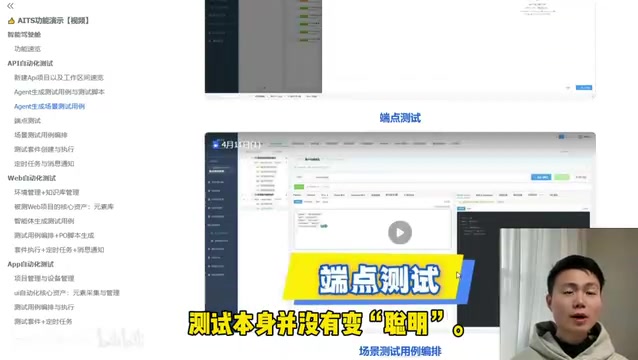
These three capabilities combined mean the focus of testing work shifts from "how to write scripts" to "how to define strategy."
AITS Intelligent Testing Platform: From Concept to Practice
Turning Vision into Reality
The scenario described above isn't science fiction. Intelligent testing platforms like AITS (AI Testing System) are already bringing AI Agent capabilities into real-world testing workflows.
Imagine this work scenario: you simply type "Please run a regression test on the payment feature," and AITS automatically plans the testing strategy, generates and executes test cases, and produces a complete test report — all without a single line of script written by hand.
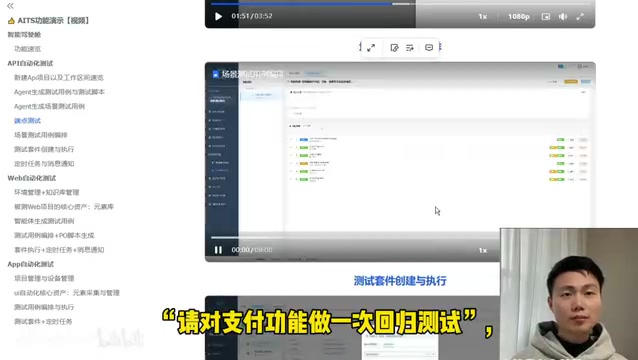
AITS frees test engineers from the tedious work of writing and maintaining scripts, allowing them to invest their energy in higher-value quality assurance activities.
The Career Upgrade Path for Test Engineers
From Executor to Strategic Decision-Maker
The rise of intelligent testing doesn't mean test engineers become obsolete — it means a major upgrade in their role:
- Past: Script writers focused on how to test
- Present: Coordinators who issue instructions, focused on what to test
- Future: Decision-makers who define strategy, focused on why to test
Your core work will shift to: defining testing strategies, making quality risk decisions, and training and fine-tuning AI testing models. This is a transformation from "manual craftsperson" to "AI commander."
Four Steps to Begin Your Intelligent Testing Transformation
For engineers looking to embrace AI-driven testing, here's a practical starting point:
- Understand AI's capability boundaries: Learn what large language models can and cannot do, and set realistic expectations.
- Master prompt engineering: Prompt engineering refers to the techniques and methodology of carefully designing input instructions to guide LLMs toward high-quality outputs. In AI-driven testing, an effective test prompt needs to clearly define the testing scope, specify output formats (e.g., "generate test cases in Gherkin syntax"), and provide necessary business context. Mastering techniques like Chain-of-Thought and Few-shot prompting is a foundational skill for collaborating effectively with AI Agents — the same AI model can produce outputs that vary in effectiveness by several times depending on prompt quality.
- Practice with intelligent testing tools: Get hands-on with platforms like AITS, validate results in real projects, and build first-hand experience.
- Develop a holistic architectural mindset: Design testing strategies from the perspective of overall quality assurance, rather than focusing narrowly on writing individual test cases.
Conclusion: Seize the Window of Opportunity in Intelligent Testing
The intelligent transformation of the testing industry is irreversible. Tools are changing, but the essence of testing — ensuring software quality — remains constant. What's truly changing is the approach: from manually writing scripts to AI Agents automatically generating, executing, and maintaining them.
Seizing this window of opportunity, leveraging intelligent testing platforms like AITS, and upgrading from "someone who writes scripts" to "someone who commands AI" is the most pragmatic choice for test engineers facing this industry transformation.
Key Takeaways
- The testing industry is moving from automation to intelligence; AI Agents can automatically generate test cases, repair scripts, and explore edge cases.
- Traditional testing platforms only solved the collaboration problem — script writing and maintenance still depend on humans and can't keep up with frequent changes.
- AI Agents use LLMs as their core, achieving truly autonomous testing through a "plan-execute-reflect" loop.
- AI-driven intelligent testing platforms (like AITS) can complete test planning, execution, and report generation through natural language instructions.
- Test engineers' roles will evolve from script writers to strategy architects and AI commanders.
- Transformation roadmap: learn prompt engineering, understand AI capability boundaries, practice with intelligent testing tools, and develop architectural thinking.
Related articles
Deep Dive into AI Agent Skill Design: …
Deep Dive into AI Agent Skill Design: Engineering Practices from Anthropic and Perplexity
A deep dive into Skill design philosophy from Anthropic's Claude Code team and Perplexity's Agent team, covering the Tax Test, Gotchas Flywheel, progressive disclosure, and Eval-First practices for building high-quality AI Agent skill systems.
Deep Dive into OpenAI's Official GPT-5…
Deep Dive into OpenAI's Official GPT-5.6 Prompting Guide: The Shift from Manual to Automatic
A deep dive into OpenAI's official GPT-5.6 Sol prompting guide: conciseness-first, outcome-oriented design, autonomy boundaries, tool routing, and reasoning intensity tuning.
 Deep Dives
Deep Dive into How OpenClaw (Open-Source Crayfish) AI Agent Works
Deep analysis of OpenClaw AI Agent internals: System Prompt, tool calling, SubAgents, Skill system, memory, and Context Engineering explained.