Andrew Ng Partners with Anthropic: A Deep Dive into the Claude Code Practical Course

Andrew Ng and Anthropic release a hands-on Claude Code course covering agentic coding best practices.
DeepLearning.ai and Anthropic have partnered to release a practical Claude Code course taught by Anthropic's Eddie Shovik. It covers three real-world projects — a RAG chatbot, a data dashboard, and a Figma-to-frontend app — while teaching advanced techniques like Git Worktrees for parallel instances and MCP server integration.
The "Definitive Course" on Claude Code
DeepLearning.ai, Andrew Ng's platform, has once again teamed up with Anthropic to release a short course focused on Claude Code best practices. Taught by Anthropic's Eddie Shovik, the course starts from the tool's core principles and progresses to advanced topics like multi-instance parallel orchestration using Git Worktrees and MCP servers.
Git Worktrees is an advanced Git feature that allows a single repository to be checked out into multiple working directories simultaneously. In traditional workflows, developers who want to work on multiple branches in parallel often need to constantly switch contexts or maintain multiple repository clones. Worktrees let each directory independently hold a branch state without interference. In multi-instance Claude Code orchestration scenarios, this capability becomes even more powerful: different Claude Code instances can each operate on their own Worktree, advancing in parallel across different modules of the same codebase — eliminating file conflicts while fully leveraging modern multi-core hardware concurrency.
MCP (Model Context Protocol) is an open protocol proposed by Anthropic in late 2024, designed to standardize communication between AI models and external tools and data sources. Analogous to what the USB interface means for hardware, MCP provides a unified "socket" for AI assistants — developers simply implement an MCP server according to the spec, and Claude can access databases, call APIs, manipulate local file systems, and more.
Andrew Ng opened the course by stating plainly that Claude Code is currently his personal favorite AI coding assistant, saying it has "significantly boosted my productivity and that of many developers." More importantly, it's a tool with "tremendous depth" — which is precisely why learning to use it systematically is so valuable.
The Evolution of AI Coding Assistants
When GitHub Copilot launched in 2021, its capabilities were primarily focused on line-level and function-level code completion — essentially statistical prediction based on context. Subsequently, ChatGPT, powered by GPT-4, demonstrated the potential for cross-file comprehension and complex logical reasoning, though developers still had to manually copy and paste code. Tools like Cursor and Windsurf then embedded model capabilities directly into the IDE, enabling a more fluid multi-turn conversational editing experience. The "agentic coding" paradigm that Claude Code represents marks the next paradigm shift: the model no longer passively waits for instructions but proactively plans task decomposition, invokes terminal commands, reads and writes files, and runs tests — forming a complete "perceive-plan-execute" feedback loop.
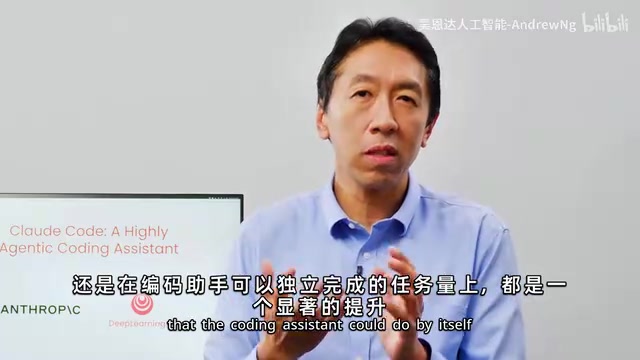
Over the past few years, AI-assisted programming capabilities have iterated rapidly: from initially asking LLMs occasional coding questions, to GitHub Copilot-style autocomplete, to today's proliferation of agentic tools. Claude Code's release marks a significant leap in the degree of "agency" — the scale of tasks it can autonomously execute far surpasses anything before it.
Many developers are surprised that Claude Code can work continuously on a single task for several minutes or even longer. Today, teams are no longer running just a single instance — they're orchestrating multiple Claude Code instances simultaneously, advancing in parallel across different parts of the codebase.
The Core Principle: Providing Claude Code with Clear Context
One key lesson the course repeatedly emphasizes is: providing Claude Code with clear context is the prerequisite for completing tasks efficiently. This encompasses three dimensions:
- Pointing Claude Code precisely to the relevant code files;
- Clearly describing the desired functionality and features;
- Reasonably extending Claude Code's capability boundaries through MCP servers and ecosystem tools.
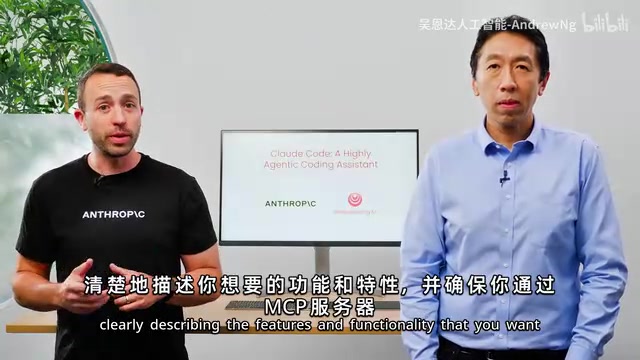
These three points may seem simple, but they are the dividing line that determines collaboration efficiency. Andrew Ng notes that if you've never worked close to best practices before, mastering these techniques can unlock enormous productivity gains.
Three Hands-On Projects: From Backend to Visualization
The course features three progressively challenging hands-on projects covering typical real-world development scenarios.
Project 1: Full-Stack RAG Chatbot Development
The first project involves building a RAG (Retrieval-Augmented Generation) chatbot. RAG is an architectural paradigm that combines large language models with external knowledge bases: before generating an answer, it retrieves the most relevant document chunks from a vector database and injects them as context into the prompt — enabling the model to answer questions beyond its training data. The rise of RAG addressed two major pain points of pure generative models — knowledge cutoff dates and hallucinations — making it quickly become the mainstream technical approach for enterprise AI applications.
Learners will implement the full stack from frontend to backend, including refactoring code and writing tests, and use GitHub integration to handle Pull Requests and fix Issues.
This process leverages multiple core Claude Code features: Planning mode, Thinking Modes, creating parallel sessions, and managing Claude's Memory. This project essentially distills the complete workflow of everyday engineering work.
Project 2: Jupyter Notebook and Data Dashboard
The second project shifts to a data analysis scenario, using Jupyter Notebook to explore e-commerce data. Learners will use Claude Code to refactor the notebook, remove redundant code, and build a fully functional web application dashboard.
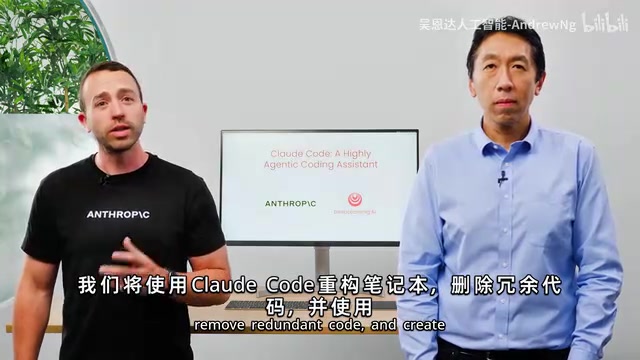
This section showcases Claude Code's value in data science workflows — it doesn't just generate code, it also helps untangle and optimize messy exploratory code, genuinely improving the productivity of data engineers.
Project 3: From Figma Design to Frontend Application
The third project is the most imaginative: starting from a visual mockup in Figma, learners use Claude Code, the Figma MCP server, and other tools to complete design import, iteration, and testing — ultimately building a complete frontend application in an agentic manner. The Figma MCP server is a prime example of the MCP ecosystem — it allows Claude to directly read the structure and style information of Figma design files, from component hierarchies to color tokens, from auto-layout constraints to interactive prototypes, all programmatically accessible, enabling high-fidelity automated conversion from design to code. This workflow directly bridges the gap from design to implementation.
A Surprisingly Simple Underlying Architecture
One noteworthy detail in the course is the "simplicity" of Claude Code's underlying architecture — Andrew Ng specifically points out that this may surprise many people.

Claude Code relies on only a small set of tools to get its work done: searching for patterns in code files, listing directories, and viewing files via regular expressions. It does not rely on embedding code semantics into the codebase, nor does it need to convert it into a searchable structure.
Code semantic embedding was the technical approach adopted by many early AI coding tools: converting functions, classes, and comments in a codebase into high-dimensional vectors stored in a vector database, then using cosine similarity at query time to quickly locate relevant code snippets. This approach has advantages in retrieval speed, but brings significant side effects: code must be uploaded to cloud servers for indexing — an almost insurmountable compliance barrier in heavily regulated industries like finance and healthcare. Claude Code opts for regex search and agentic layer-by-layer reading instead of vector indexing, keeping the entire code processing pipeline local while sacrificing only minimal retrieval performance.
What truly makes Claude Code efficient is its agentic approach of reading code layer by layer, writing comprehension notes into .md files, and thereby independently grasping how the codebase works — which then drives subsequent development decisions.
Security Advantages of a Local-First Architecture
Because no indexing of the codebase is required, one direct advantage of Claude Code is that the codebase can remain entirely local. This fundamentally eliminates the possibility of sensitive code leakage — all file reads, writes, searches, and modifications are performed on the developer's machine without passing through any intermediate cloud storage. For teams that prioritize data privacy, this is a significant advantage that cannot be overlooked. The course also explores the resulting security and compliance implications, particularly in enterprise deployment scenarios where this architectural choice often directly determines whether the tool can pass internal security reviews.
Worth Learning for Both Beginners and Experienced Developers
Andrew Ng offers a clear verdict: if you're not yet a Claude Code user, learning this framework will significantly accelerate how you build systems; even if you're already an experienced user, Eddie's systematic and comprehensive sharing of best practices will likely surface new approaches worth trying.
At a time when AI coding assistant capabilities are expanding at breakneck speed, the power of the tool itself is only the starting point — how to systematically harness it is what truly differentiates developers. The value of this course lies in transforming best practices that "only a few people know" into a reproducible methodology that anyone can learn.
Key Takeaways
Related articles

Disaster and Glory of the Apollo Program: The History We Must Revisit Before Returning to the Moon
From the fatal Apollo 1 fire to Apollo 8's daring lunar orbit to Apollo 11's successful landing—revisiting the disasters, fears, and compromises of the Apollo program and their lessons for today's return to the Moon.
Netflix Trust Exercise Turns Into Firing Trap: Where Are the Boundaries of Corporate Trust?
A Netflix employee was fired after sharing private info in a trust exercise. We analyze the risks of corporate trust exercises and how employees can protect themselves.

AMD CDNA5 Architecture Deep Dive: Technical Evolution and the AI Computing Competition Landscape
Deep analysis of AMD's CDNA5 architecture covering Chiplet packaging upgrades, HBM memory evolution, and low-precision compute optimization, examining how AMD challenges NVIDIA's AI chip dominance.