APA: A New Enterprise-Grade Automation Approach Merging Agents with RPA

APA merges LLM agents with RPA to deliver intelligent yet secure enterprise-grade automation.
APA (Agentic Process Automation) installs an intelligent brain into RPA, letting business users build scripts via natural language, operation manuals, or video recordings. Backed by a financial-grade security foundation and three-layer protection (pre-planning, in-process HITL, after-the-fact traceability), it balances intelligence with enterprise controllability.
In the field of enterprise automation, a long-standing dilemma has persisted: traditional RPA (Robotic Process Automation) is stable and controllable but lacks intelligence, capable only of mechanically executing scripts; while emerging Agent technology is smart enough, yet security concerns keep enterprises from truly deploying it in production environments. A new form called APA (Agentic Process Automation) is attempting to bridge this gap—installing an intelligent brain into RPA while retaining an enterprise-grade, financial-grade security foundation.
The Core Pain Point of RPA: Strong in Execution, Weak in Intelligence
The core capability of RPA is repeatedly executing operations according to preset scripts, offering high stability but also clear limitations.
RPA originated in the early 2000s, with vendors such as Blue Prism, UiPath, and Automation Anywhere pioneering its commercialization. Blue Prism first introduced the concept of "digital workforce" and achieved commercialization in 2001, after which UiPath and Automation Anywhere rapidly expanded the market with lower deployment barriers. According to Gartner data, RPA was for several consecutive years among the fastest-growing enterprise software categories, but its market growth slowed noticeably after 2022—precisely because intelligence bottlenecks began to become the main constraining factor.
Its core principle is to replace repetitive manual labor by simulating human operations on the GUI interface—clicking, typing, copying, and pasting. The underlying technology of RPA actually combines three types of capabilities: screen scraping, workflow automation, and AI-based rule engines. Unlike integration approaches that directly call underlying APIs, RPA operates at the presentation layer like a "digital employee," allowing rapid deployment without modifying existing IT infrastructure—but this also makes it highly dependent on interface stability: once the system interface changes, scripts can easily break.
The biggest problem lies in build cost. Traditional RPA scripts essentially rely on code development, requiring enterprises to employ specialized technical personnel to build and maintain them, bringing a long learning curve and continuous labor investment. Even more challenging is that once a business process changes, existing scripts are often difficult to adapt quickly and need to be redeveloped and adjusted.
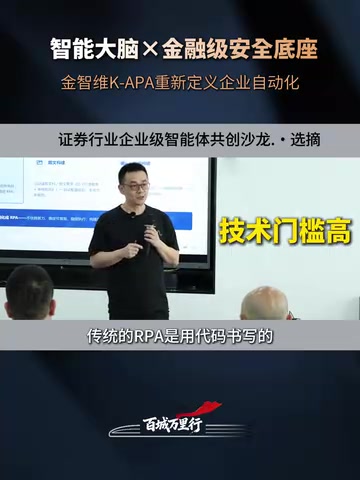
In other words, RPA has nimble "hands and feet" but lacks a "brain"—it cannot understand business intent and cannot handle unexpected situations beyond preset scopes. This is exactly the core problem APA aims to solve.
What Is APA: Enabling Business Users to Build Automation
The "A" in APA stands for Agentic, meaning achieving process automation in an intelligent manner by deeply integrating Agents into the RPA system. Its most direct value lies in using large language models to help enterprises quickly capture business logic and automatically generate RPA scripts, thereby significantly lowering the build barrier.
It's worth noting that an AI Agent is not equivalent to ordinary large-model Q&A. An Agent possesses a "think-act-observe" loop capability, which stems from the ReAct (Reasoning + Acting) framework—formally proposed by Yao et al. in the 2022 paper ReAct: Synergizing Reasoning and Acting in Language Models. Its core idea is to have large models alternate between "reasoning trace generation" and "external tool invocation" when executing tasks, thereby breaking through the context limitations of a single inference pass. Compared with pure Chain-of-Thought, ReAct can obtain external information in real time and correct the direction of reasoning; compared with pure action execution, it retains an interpretable reasoning process. This framework has now become the foundational design of mainstream Agent frameworks such as LangChain, AutoGen, and CrewAI.
Agents can call external tools, search for information, and execute code to complete complex tasks spanning multiple steps. However, early Agent frameworks represented by AutoGPT exposed problems in enterprise deployment such as high hallucination rates, unpredictable behavior, and difficult auditing, severely limiting their adoption in highly regulated industries like finance and healthcare—which is precisely the fundamental reason why APA must place emphasis on solving security issues beyond just intelligence.
APA currently offers three ways to build RPA scripts:
Three Script Generation Methods
First: Natural language description. Users only need to describe their needs in a single sentence, such as "log into a certain system and export data," and the large model can translate this intent into an executable script.
Second: Uploading an operation manual. If an enterprise already has documents containing system screenshots and operation steps, they can upload them directly, and APA will automatically generate the corresponding RPA script based on them.
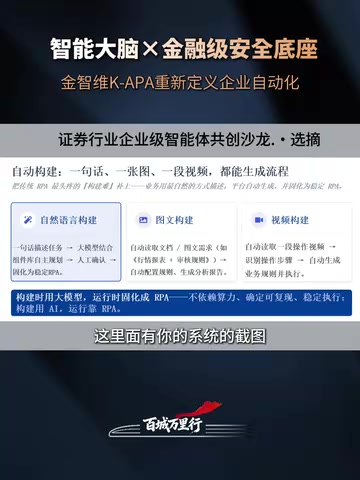
Third: Recording video for generation. Users record a video during actual operation, and after uploading, the system automatically parses the video content and generates an RPA script—suitable for scenarios where the operation process is complex and difficult to describe in text. This method is technically the most challenging—the model needs to complete three steps: action recognition (identifying mouse trajectories and click positions), interface semantic understanding (recognizing button text and form fields), and operation intent inference, all of which rely on a deep combination of multimodal LLMs and code generation capabilities.
The core technical challenges here lie in: the visual recognition accuracy of GUI elements (pixel-level coordinate localization), semantic coherence understanding of cross-frame temporal actions, and contextual inference of operation intent. Models such as OpenAI GPT-4o and Google Gemini 1.5 Pro already possess preliminary frame-level interface understanding capabilities, but accuracy in complex enterprise systems (such as SAP and Oracle ERP) still has room for improvement. This technical path aligns closely with the technological evolution direction of products like Microsoft Copilot Studio and Google Duet AI, representing the mainstream paradigm for next-generation RPA script generation.
Behind these three methods lies the same core philosophy: enabling business users to build RPA. When script generation no longer depends on code, frontline business personnel can directly participate in automation construction, fundamentally changing how RPA is deployed.
Intelligent Integration: Breaking Through RPA's Execution Boundaries
The second focus of APA is its intelligent integration capability. RPA excels at executing clearly defined fixed tasks, but once a task exceeds the preset scope, traditional RPA becomes helpless.
Agents happen to excel at handling such uncertainty—they can effectively perform task decomposition and orchestrate available resources to accomplish open-ended goals. APA integrates relatively advanced industry large-model capabilities into the entire RPA orchestration system, enabling the automation platform not only to execute fixed processes but also to plan and make decisions when facing complex tasks.
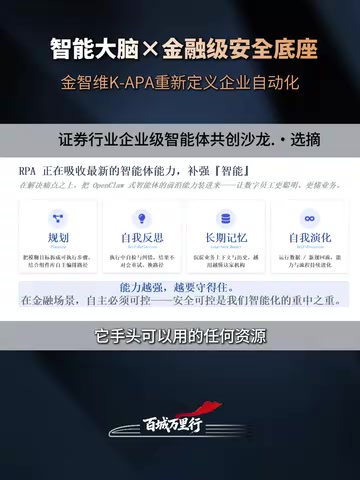
The logic of this "Agent + RPA" combination is clear: the Agent handles understanding, planning, and orchestration, while RPA handles stable and precise execution. The two complement each other, forming a complete automation loop with both a brain and hands and feet.
Security and Controllability: An Enterprise-Grade, Financial-Grade Execution Foundation
If intelligence is the highlight of APA, then security and controllability are the keys to its true adoption in enterprise environments. This is also a core barrier that consumer-grade products often struggle to reach.
APA's RPA foundation, accumulated over many years, possesses enterprise-grade security capabilities including identity authentication, single sign-on (SSO), sandbox isolation, security controls, network communication protection, and high-performance support, making it genuinely usable in enterprises and even financial institutions. Among these, sandbox isolation is one of the core mechanisms of financial-grade security—it strictly isolates the running environment of automation bots from the enterprise host system, so that even if execution fails or is attacked, it will not affect core business systems.
This capability typically also needs to be combined with network micro-segmentation, the principle of least privilege, and complete operation audit logs to meet regulatory requirements such as MLPS 2.0, SOX compliance, or PCI-DSS. Specifically: MLPS 2.0 (Multi-Level Protection Scheme / Cybersecurity Classified Protection 2.0) is a Chinese national standard that classifies information systems into five security levels, with financial institutions typically required to meet Level 3 or Level 4 requirements, covering more than ten technical control measures including identity authentication, access control, and security auditing; SOX (the Sarbanes-Oxley Act) primarily targets companies listed in the US, requiring complete internal controls and audit trails for financial data processing workflows; PCI-DSS (Payment Card Industry Data Security Standard) targets systems processing credit card data, mandating network segmentation, least-privilege access, and complete log retention. If automation bots need to operate the aforementioned regulated systems, their execution environment must meet the corresponding compliance framework, otherwise they will face regulatory penalties and legal risks.
Three Layers of Security Protection: Before, During, and After
When building Agents, APA focuses on security protection across three stages:
-
Pre-planning: Planning is combined with the enterprise's existing knowledge base, established plans, or regulations to avoid the Agent "acting blindly," ensuring that behavior complies with enterprise norms.
-
In-process collaboration: A human-machine collaboration mechanism (Human-in-the-Loop, HITL) is deliberately introduced. Once the system identifies a risky operation, it proactively requests human confirmation rather than executing on its own. HITL was first proposed as a machine learning training paradigm—continuously optimizing models through real-time feedback from human annotators, with RLHF (Reinforcement Learning from Human Feedback) being its most typical application, as ChatGPT's alignment training uses this mechanism. In the context of enterprise AI deployment, the meaning of HITL is further extended to the design of runtime human approval nodes. The EU AI Act explicitly requires that high-risk AI systems must retain human oversight capabilities, making HITL a statutory requirement for compliance design rather than an optional feature. In financial automation scenarios, this mechanism is especially critical—erroneous automatic transfers or permission operations are often irreversible, and the cost of in-process interception is far lower than after-the-fact accountability.

- After-the-fact traceability: All execution logs are strictly recorded. All operations can be fully traced—whether generating a document or completing a system operation, the source of information and the execution process are all verifiable.
This mechanism of constraining Agents at the detail level is the core guarantee of APA's security and controllability.
Conclusion: Finding a Balance Between Intelligence and Security
The path represented by APA is essentially about seeking a balance between "intelligence" and "security." Pure RPA lacks intelligence, pure Agents lack enterprise-grade controllability, and APA integrates the strengths of both through a combination of "intelligent brain + financial-grade security foundation."
For enterprises exploring automation transformation, this approach is worth attention: it lowers the barrier to building automation, allowing business personnel to participate; at the same time, through three layers of security protection, it addresses the compliance and risk-control concerns that enterprises care about most. Of course, how well it performs in practice still needs further validation in real business scenarios.
Key Takeaways
Key Takeaways
Related articles

Ollama API Key Proxy: Multi-Key Rotation to Solve Rate Limiting Issues
Learn how Ollama API Key Proxy solves cloud LLM rate limiting through reverse proxy with round-robin key rotation, 429 auto-cooldown, and smart retry logic.

Project Rai-chan Technical Breakdown: A Complete Guide to Building a Fully Local AI Companion
Deep dive into Project Rai-chan's tech stack: Ollama+Gemma local LLM, Unity rendering, VOICEVOX speech synthesis, and more — exploring the technical path for local AI companions.

Ollama vs OpenCode: Real-World GLM Quota Difference Analysis (380 vs 880 Requests)
Real-world comparison of Ollama vs OpenCode GLM5.2 quota consumption — from 380 to 880 requests. Analyzing context length, billing differences, and key factors for AI coding tool users.