Are DeepSeek Tutorial Books Worth Buying? Deconstructing the Marketing Tactics of AI Get-Rich-Quick Books

Deconstructing DeepSeek tutorial book marketing tactics and advocating free self-directed AI learning
This article examines a DeepSeek tutorial book that claims to teach people how to make money with AI, deconstructing its three core marketing tactics: manufacturing anxiety, overpromising, and price anchoring. It points out that most content in such books is freely available online and that print books inherently lag behind AI's rapid iteration cycle. The article offers 5 free learning methods including hands-on practice and official documentation, emphasizing that independent thinking is the most important skill in the AI era.
Another "AI Get-Rich-Quick Bible" Has Appeared
Recently I came across a promotional video on Bilibili pushing a book claiming to be the "first DeepSeek tutorial book in China," promising to teach you step-by-step how to make money with AI and achieve financial freedom. The video was packed with sensational claims like "one million a day" and "life on cheat mode," combined with classic anxiety-driven marketing tactics designed to get viewers to place an order immediately.

As a content creator who's been following the AI space for a long time, I feel it's necessary to calmly deconstruct the marketing playbook behind these DeepSeek tutorial books and help people make rational decisions before hitting "buy."
Marketing Tactics Deconstructed: The Classic Three-Step Anxiety Harvest
Step One: Manufacturing Anxiety
The video opens with lines like "I was still lost and directionless last year" and "no matter how hard I tried, nothing worked out" — precisely targeting the career anxiety of ordinary people. Then, through a fictional authority figure ("my uncle who researches AI"), it implies that if you don't learn this, you'll be left behind by your peers.
This is a textbook FOMO (Fear of Missing Out) marketing strategy — making you feel like you'll lose out if you don't buy, that missing this means missing an entire era. Nearly all AI get-rich-quick books use the same playbook, exploiting information asymmetry to create urgency.
Step Two: Overpromising
"Ready-to-use practical tips," "effortlessly create viral copy," "achieve traffic conversion," "the only limit is your imagination" — these promises cover virtually every money-making scenario without providing a single piece of concrete data or real case study.
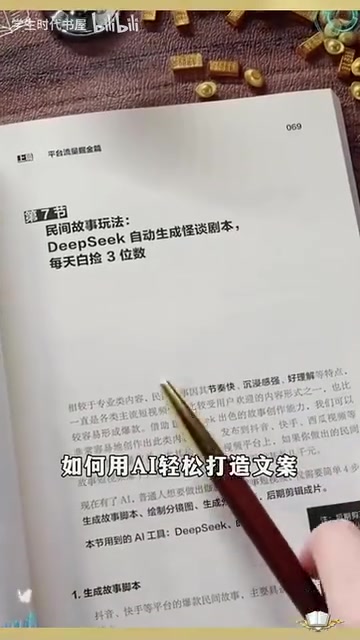
A truly valuable AI tutorial will tell you where the tool's capabilities end, rather than endlessly hyping "there's nothing it can't do." DeepSeek is indeed an excellent domestically-developed large language model, but it's not a magical money-printing machine.
Step Three: Price Anchoring
"Compared to courses on the market that cost thousands, this is easy to understand and a much better deal" — first they throw out a high price anchor, then make you feel like this book is an incredible bargain. This is the most basic consumer psychology technique, and it's ubiquitous in promotions for AI money-making courses.

A Clear-Headed Analysis: Do These AI Tutorial Books Actually Have Value?
What the Content Most Likely Looks Like
Based on similar books already on the market, these "AI money-making tutorials" typically contain:
- Basic operation guides: How to register an account, how to ask questions, basic Prompt techniques — all of which are freely available in DeepSeek's official documentation and free tutorials
- Case demonstrations: Scenarios showing AI writing copy, making PPTs, generating images — Bilibili and YouTube have tons of free video tutorials that are updated more frequently
- Business model overviews: Vague discussions of AI + e-commerce, AI + content creation, etc. — lacking depth; truly actionable business insights won't appear in a book costing a few dozen yuan
In other words, most of what you'd pay for can be found online for free, and online resources tend to be more current and comprehensive.
The Fundamental Contradiction of Teaching AI Through Print Books
AI tools iterate at extreme speed. DeepSeek has evolved from V2 to V3 to R1, with model capabilities and interaction methods changing rapidly. A print book takes at least 3-6 months from writing to publication, and by the time it's published, the content may already be outdated.
Learning AI from a print book is like navigating newly built roads with last year's map — there's a fundamental contradiction between the medium and the content. This is also why real AI practitioners rarely learn about the latest tools from print books.

5 Correct Ways for Ordinary People to Learn AI for Free
Instead of spending money on these quick-fix books, try these strategies — they're more effective and completely free:
- Just start using it: DeepSeek is free. Open the official website and start using it. The best way to learn is to repeatedly experiment with real needs — for example, use it to help write weekly reports, organize materials, or analyze data
- Follow official documentation and communities: DeepSeek's official docs, GitHub repository, and technical blog are the most authoritative and timely learning resources
- Learn Prompt Engineering fundamentals: There are plenty of free, high-quality resources available, such as Andrew Ng's free course created in collaboration with OpenAI, which is far more systematic than any quick-fix book
- Find specific use cases: Don't vaguely "learn AI" — think about which specific problem in your work AI can solve. Learning with a concrete problem in mind is what makes it effective
- Stay continuously informed: The AI field sees new developments every week. Following a few reliable information sources and keeping up consistently is far more practical than hoping one book will solve everything once and for all
Final Thoughts: Independent Thinking Is the Most Valuable Skill in the AI Era
AI is indeed changing how many industries work, and learning AI tools genuinely has value. But anyone telling you "buy one book and achieve financial freedom" is most likely harvesting your anxiety. Real wealth never comes from a single book — it comes from continuous learning, deep thinking, and solid execution.
In the AI era, the most important skill isn't knowing how to use a particular tool — it's the ability to think independently and distinguish truth from hype. For example, recognizing that this video is essentially just a paid advertisement. Instead of being exploited through information asymmetry, try things out yourself — that's the most reliable way to learn AI.
Related articles
 Expert Opinions
The Lazy Person's Productivity Theory: Why Being 'Lazy' Actually Drives Peak Performance
Explore the engineering philosophy behind 'lazy people are most productive': how constructive laziness drives automation, AI tools amplify efficiency, and systems thinking eliminates wasted effort.
 Expert Opinions
Outdoor Coding: You Can Touch Grass AND Build Things
When AI coding assistants free developers from their desks, outdoor coding becomes a real trend. Explore how cloud IDEs, voice coding, and AI tools enable creativity in nature.
When AI Treats Humans as Subagents: Ro…
When AI Treats Humans as Subagents: Role Reversal and Hidden Risks in Human-AI Collaboration
Exploring the paradigm shift where humans become "subagents" in AI Agent architectures. Analyzes human node design in LangChain and AutoGen, and the risks of ceding control and cognitive atrophy.