Beyond Voice Commands: The Future Evolution of Multimodal Human-Robot Interaction

How multimodal interaction — gestures, gaze, and context — is moving robots beyond voice commands.
A Reddit discussion sparked deeper reflection on robot interaction design: what if robots didn't need voice commands at all? This article explores how multimodal technologies — gesture recognition, eye tracking, environmental sensing, and VLA models — are shifting human-robot interaction from explicit command-giving to intuitive intent understanding, and what technical and ethical challenges lie ahead.
Introduction: When Robots No Longer Need to "Hear You Speak"
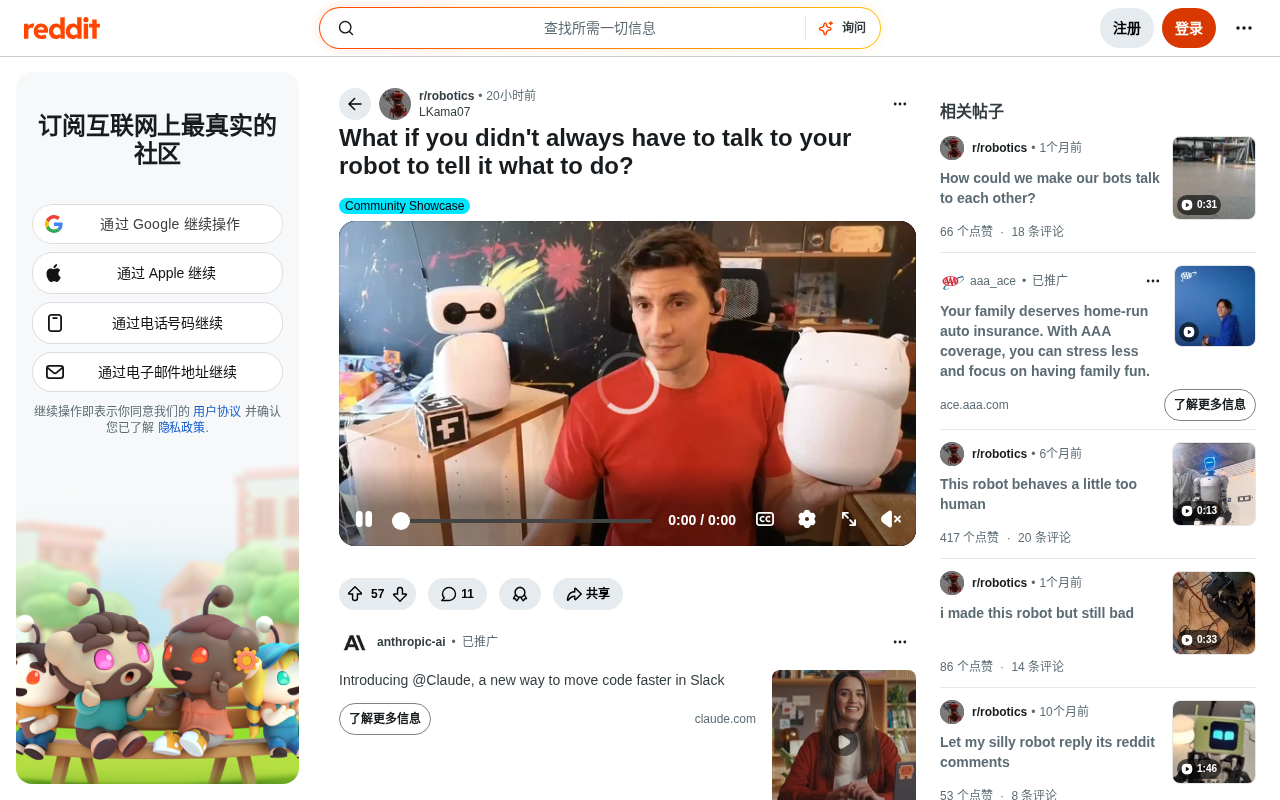
A thought-provoking discussion recently emerged on the Reddit robotics community (r/robotics), drawing widespread attention. User LKama07 posed a seemingly simple yet deeply insightful question: "What if you didn't always have to talk to tell a robot what to do?"
This question cuts to the heart of a core pain point in the field of Human-Computer Interaction (HCI). HCI is an interdisciplinary field that studies how humans interact with computer systems, encompassing cognitive science, design, and computer engineering. With the rise of large language models (LLMs) like GPT-4 and Claude, voice assistants have evolved from rule-based command parsing into context-aware conversational systems, making the design philosophy of "conversation as interface" increasingly dominant. Yet HCI researchers have long argued that speech is only a subset of human communication, and over-reliance on voice interfaces effectively imposes the limitations of computer interaction onto human users. In today's era of exploding LLM and voice assistant technology, we habitually assume that "conversation" is the most natural way to interact with intelligent robots. But is that really true? This discussion reminds us that voice may not always be the optimal solution in every context.
The Limitations of Voice Interaction
Not Every Scenario Is Suited for "Speaking Up"
While voice interaction is intuitive, it has clear boundary conditions. Consider a few real-world scenarios: in a noisy factory floor, speech recognition accuracy drops dramatically; in a library or late-night home environment, issuing commands out loud feels wholly out of place; for users with speech impairments, or in multilingual work environments, a pure voice-based solution becomes a significant barrier.
Furthermore, voice interaction is inherently "explicit command" based — you must clearly and verbally tell the robot exactly what to do. This is not only inefficient, but also runs counter to our higher expectations of "intelligence." A truly intelligent robot should be able to understand human intent through observation, perception, and reasoning, rather than passively waiting for every spoken command.
From "Command-Driven" to "Intent-Understanding"
Behind this discussion lies a deeper proposition: robot interaction is evolving from "command-driven" to "intent-understanding." When robots can read gestures, recognize expressions, perceive environmental changes, and even predict user needs, human-robot collaboration will enter an entirely new dimension — and that is precisely the direction multimodal interaction technology is heading.
Multimodal Interaction: The Mainstream Trend in Human-Robot Interaction
Gesture Recognition, Eye Tracking, and Body Language
In human-to-human communication, spoken language accounts for only a small fraction. Research shows that a significant amount of information is conveyed through body language, facial expressions, and tone of voice. Applying this logic to robotics, multimodal interaction has become an inevitable trend. Multimodal interaction refers to systems that simultaneously process two or more input modalities (such as visual, auditory, tactile, and text). In robotics, this technology relies on multimodal fusion architectures in deep learning — the canonical example being Transformer-based cross-modal attention mechanisms — which can map heterogeneous data from different sensors into a unified semantic space. Models such as Meta's ImageBind and Google's PaLM-E have demonstrated that jointly encoding visual, linguistic, and inertial data can significantly improve a robot's ability to understand complex scenes.
Using computer vision, robots can capture a user's pointing gestures, head orientation, and body posture. Gesture recognition currently relies on two main technical approaches: RGB camera-based pose estimation (e.g., MediaPipe Hands) and depth sensor (ToF/structured light)-based 3D skeleton reconstruction. The former has lower computational cost but is sensitive to occlusion, while the latter offers higher accuracy but requires specialized hardware. For example, simply pointing at an object on a table allows the robot to understand the intent of "pass me that" — without ever needing to say the object's name. Eye tracking uses infrared light projected onto the cornea and captures reflected light points to calculate gaze direction with accuracy up to 0.5°, enabling the robot to perceive where your attention is focused and proactively offer assistance. By prioritizing the objects or areas the user is looking at, it dramatically reduces ambiguous commands and elevates the interaction experience to a new level.
Environmental Awareness and Proactive Service
Robots equipped with rich sensor arrays can also perform environmental context reasoning, shifting from passive response to proactive service. When a robot "sees" you walking toward a door with your arms full, it can proactively open it for you; when an obstacle appears on the floor, it can autonomously plan a detour — all without requiring human intervention or direction. This proactive service model, grounded in environmental awareness, will significantly reduce the cognitive burden on humans and allow robots to genuinely integrate into everyday life.
Technical Challenges and Implementation Pathways
The Complete Pipeline from Perception to Decision-Making
Achieving "voice-free" robot interaction requires technically bridging the complete pipeline from perception to decision-making. First is multi-sensor fusion — cameras, depth sensors, microphone arrays, force-tactile sensors, and others must work in concert to build a comprehensive, three-dimensional understanding of the environment and human state. Sensor fusion aims to integrate data from sensors operating on different physical principles into a coherent environmental representation. Common methods include Kalman filtering (for continuous state estimation), Bayesian networks (for uncertainty reasoning), and the recently prominent neural implicit representations (e.g., NeRF for scene reconstruction). In service robots, a typical sensor suite consists of: RGB-D cameras (color + depth), LiDAR (for precise distance measurement), IMU (inertial measurement unit, for attitude estimation), and force/torque sensors (for contact sensing). Time synchronization and spatial calibration across these sensors are key engineering challenges for real-world deployment.
Second is the construction of intent recognition models. This requires robots to infer human intent from sparse, ambiguous multimodal signals. Current research in Embodied AI is advancing rapidly in this direction. Embodied AI emphasizes that an agent must develop cognitive abilities through real interaction with a physical environment, rather than relying solely on offline data training. The Vision-Language-Action Model (VLA) is the latest paradigm in Embodied AI, with representative works including Google DeepMind's RT-2 and Physical Intelligence (π0). VLA directly connects pretrained vision-language models with robot action policies, enabling robots to jointly process natural language instructions, camera images, and low-level motor control — allowing robots to handle open-world scenarios through generalization rather than task-specific training, making it possible to truly "read" human behavior.
Balancing Privacy Protection and Behavioral Controllability
Notably, enabling robots to "proactively understand" intent means they need to continuously observe and analyze the surrounding environment — which inevitably raises privacy concerns. The privacy issues stemming from continuous environmental sensing have already spurred several technical countermeasures: Federated Learning allows models to be trained on local devices without uploading raw data; Differential Privacy adds mathematical noise to statistical queries to protect individual information; and edge computing architectures push inference tasks down to local chips, preventing sensitive data from flowing to the cloud. On the ethical framework side, the IEEE published the Ethically Aligned Design (EAD) standard in 2019, and the EU's AI Act has established transparency and accountability requirements for high-risk AI systems (including service robots). How to ensure user controllability and transparency over robot behavior while delivering intelligent convenience is an ethical and engineering challenge that must be confronted head-on during productization — explainability design, i.e., enabling robots to explain to users "why I did this," is emerging as an indispensable core dimension of competitiveness in the commercialization of service robots.
Conclusion: The Silent Revolution in Interaction Paradigms
This simple question from a Reddit community actually points to a critical inflection point in robotics development. Only when we no longer need to "speak up" for every task can human-robot collaboration truly integrate into the natural rhythm of daily life.
The intelligent robot of the future should not be a tool requiring precise commands, but a collaborative partner capable of reading the room and grasping intent intuitively. From voice commands to multimodal intent understanding, this silent revolution in interaction paradigms may well be the necessary path toward truly practical service robots. For developers and researchers, rethinking the fundamental nature of "interaction" may carry far greater long-term value than simply stacking more compute and model parameters.
Key Takeaways
Related articles
The Open-Weights Model Debate: Balancing Safety and Openness
An in-depth analysis of the open-weights model debate: public release brings transparency and innovation, but raises safety and misuse risks. Exploring tiered release, red-teaming, and governance challenges.
How Complaining Erodes Your Mind: Understanding the Self-Reinforcing Nature of Attention
Habitual complaining trains your brain to find more negativity, creating a vicious cycle. Learn about the self-reinforcing nature of attention and practical ways to break free from negative loops.
The Depth Perception Challenge for Transparent Objects: How LingBot-Depth Breaks Through with Masked Depth Modeling
Depth perception for transparent and reflective objects has long been a core challenge in robotic grasping. LingBot-Depth uses masked depth modeling to turn sensor failure into supervisory signals, inferring glass depth from RGB context.