Blue Origin's New Glenn Rocket Cleared to Fly Again: Engine Failure Cause Identified

Blue Origin's New Glenn rocket cleared to fly again after April engine failure caused satellite loss
Blue Origin's New Glenn rocket lost an AST SpaceMobile satellite due to a BE-4 engine failure during an April launch. After approximately one month of FAA investigation and corrective action, the rocket has been cleared to resume flights. As Blue Origin's core product for competing in the heavy-lift market — carrying major contracts including Amazon Kuiper — New Glenn's future launch reliability will determine the company's standing in commercial space.
Blue Origin New Glenn Return to Flight: Event Overview
Blue Origin, the space company owned by Jeff Bezos, recently announced that its New Glenn heavy-lift rocket has been cleared to resume flights. The rocket suffered an engine failure during an April launch mission that resulted in the loss of an AST SpaceMobile satellite, drawing widespread attention across the industry.
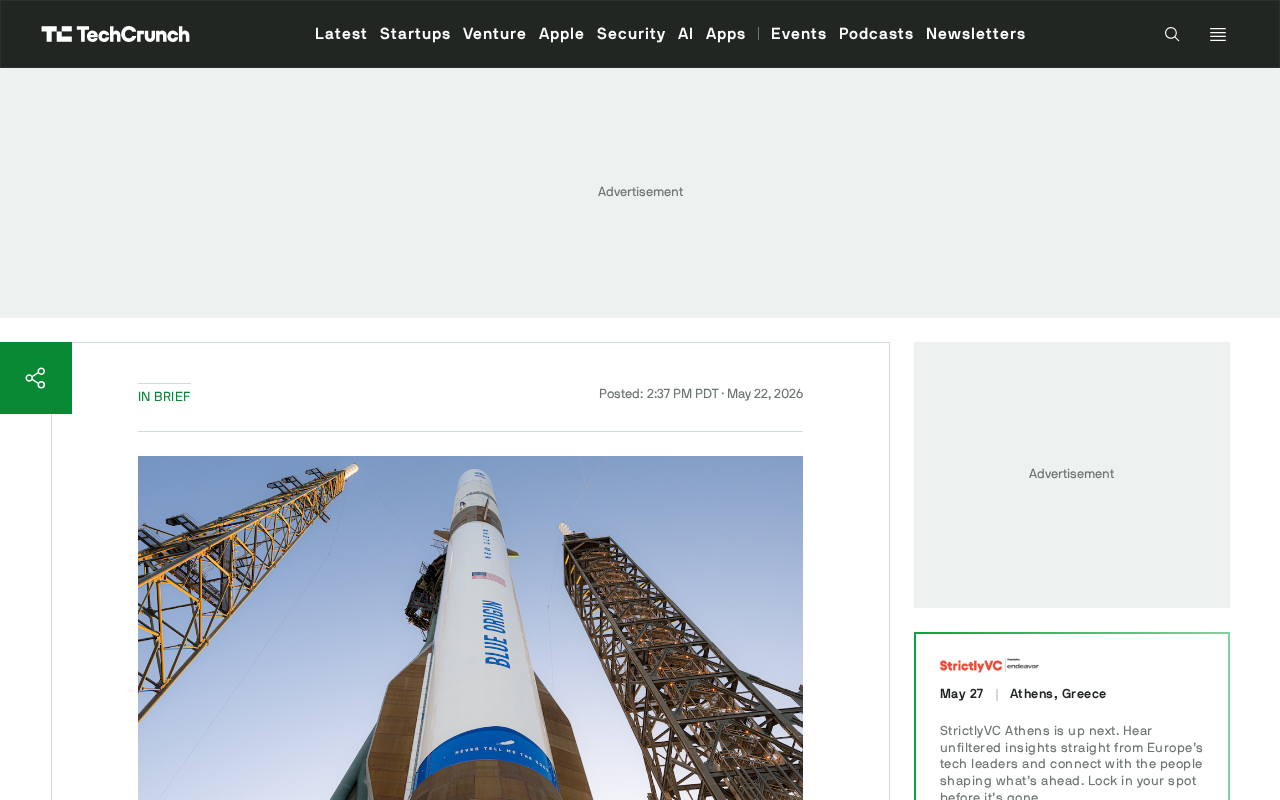
April Launch Failure Recap: The Engine Failure Sequence
How the AST SpaceMobile Satellite Was Lost
Blue Origin confirmed that the April launch failure originated from an engine malfunction. The incident directly prevented an AST SpaceMobile communications satellite from reaching orbit, resulting in significant commercial losses.
Founded in 2017 and headquartered in Texas, AST SpaceMobile's core technology approach involves deploying large flat-panel satellites in low Earth orbit (LEO) that connect directly to ordinary smartphones without requiring users to purchase specialized terminal equipment. This technical approach differs fundamentally from SpaceX's Starlink — Starlink primarily targets fixed broadband scenarios and requires dedicated antennas, while AST SpaceMobile aims to let existing phones connect directly to a satellite network, covering approximately 5.5 billion people worldwide who lack stable terrestrial cellular coverage. The company has signed partnership agreements with major carriers including AT&T, Verizon, and Vodafone, and completed deployment testing of its first batch of commercial satellites (the BlueBird series) in 2024. The lost satellite was part of its second-batch commercial constellation expansion plan, with each satellite estimated to cost tens of millions of dollars. The time-window losses for constellation deployment are equally difficult to quantify, significantly impacting the overall constellation deployment schedule.
Blue Origin disclosed limited technical details about the incident in its public statement, only confirming engine failure as the root cause without elaborating on which engine experienced the problem, the specific failure mode, or the timeline of when the fault occurred. This level of limited information transparency is not uncommon in the aerospace industry but has nonetheless sparked discussion among some industry observers.
Technical Background on New Glenn's BE-4 Engine
The BE-4 (Blue Engine 4) is a liquid oxygen/liquefied natural gas (LOX/LNG) engine independently developed by Blue Origin, producing approximately 2.4 million newtons (about 540,000 pounds-force) of sea-level thrust per unit. New Glenn's first stage uses seven BE-4 engines in parallel, generating a combined thrust exceeding 16.8 million newtons. Notably, the BE-4 also serves as the main engine for United Launch Alliance's (ULA) Vulcan Centaur rocket, meaning reliability concerns with this engine affect not only New Glenn but also the supply chain stability of the entire U.S. heavy-lift market. Compared to traditional kerosene (RP-1), liquefied natural gas as a propellant offers higher specific impulse and cleaner combustion characteristics, but the storage and plumbing system complexity for cryogenic propellants is correspondingly higher, somewhat increasing the number of potential failure points in the engine system and making root cause analysis of this failure more technically challenging.
FAA Investigation and Corrective Action Process
From the April incident to receiving flight clearance, Blue Origin went through approximately one month of investigation and corrective action. Under 14 CFR Part 431, once a launch mishap occurs, the operator must immediately notify the FAA's Office of Commercial Space Transportation (AST) and submit an accident investigation report within the prescribed timeframe, covering root cause analysis (RCA), corrective actions (CA), and preventive actions (PA). After reviewing the report, the FAA may require the operator to provide supplemental test data or third-party verification before issuing a new launch license.
Completing the entire investigation and approval cycle in approximately one month is considered relatively efficient by industry standards — by comparison, SpaceX took about four months to return to flight after the 2016 Falcon 9 launch pad explosion and about six months after the 2015 CRS-7 mission failure. This comparison to some extent reflects the relatively manageable nature of Blue Origin's failure. The clearance to return to flight indicates that the FAA has accepted Blue Origin's proposed corrective measures.
New Glenn's Strategic Position in the Commercial Space Market
Competitive Landscape Against SpaceX's Falcon Rockets
New Glenn is Blue Origin's flagship product for entering the heavy-lift rocket market, viewed as a direct competitor to SpaceX's Falcon 9 and Falcon Heavy. The rocket features a reusable first stage, is powered by its proprietary BE-4 LOX/LNG engines, and offers a low Earth orbit payload capacity of approximately 45 metric tons.
For Blue Origin, New Glenn's launch reliability is critically important. The company has signed multiple commercial launch contracts, the most strategically significant being launch services for Amazon's Kuiper satellite internet project. Amazon Kuiper plans to deploy 3,236 low-orbit satellites as a direct competitor to SpaceX's Starlink, and Amazon has procured up to 27 New Glenn launches from Blue Origin, with the total contract value estimated at over $1 billion. Since Jeff Bezos controls both Amazon and Blue Origin, this internal relationship serves as both a commercial guarantee for New Glenn and a source of potential conflict-of-interest controversy. Notably, the Kuiper project has also procured launch services from ULA's Vulcan, Ariane 6, and SpaceX's Falcon 9 to diversify risk — if New Glenn continues to experience reliability issues, Kuiper's launch schedule will face serious delays, which in turn would intensify commercial pressure on Blue Origin, creating a negative feedback loop. Any reliability concerns could shake customer confidence and subsequently affect future order acquisition.
The Significance of a Multi-Supplier Landscape for the Satellite Launch Market
Although this incident caused a short-term setback, Blue Origin's rapid completion of the investigation and clearance to fly again demonstrates the company's strong engineering response capabilities. For the broader commercial space market, having an additional proven heavy-lift rocket supplier means more robust market competition and more reasonable launch pricing — a positive signal for satellite operators and the long-term development of the space economy.
Outlook After New Glenn's Return to Flight
New Glenn's return to flight will be a critical milestone for Blue Origin to prove its technological maturity. The company needs to rebuild market confidence through consecutive successful launch missions. That said, the subsequent collaboration attitudes of affected customers like AST SpaceMobile will also serve as an important indicator of how well Blue Origin has restored its commercial credibility.
Against the backdrop of continuously growing global satellite launch demand, whether New Glenn can achieve a stable, high-cadence launch rhythm will largely determine Blue Origin's ultimate position in the commercial space competition.
Key Takeaways
- Blue Origin confirmed the April launch failure was caused by an engine malfunction, resulting in the loss of an AST SpaceMobile satellite
- The company disclosed limited technical details about the incident, only confirming engine failure as the root cause
- New Glenn has been cleared to resume flights, indicating regulators have accepted the corrective measures
- New Glenn is Blue Origin's core product for competing with SpaceX in the heavy-lift market
- The success of the return-to-flight mission will directly impact Blue Origin's commercial credibility and future orders
Related articles
 Tech Frontiers
A Rare Quiet Day in AI: Recursive Self-Improvement Stirs Beneath the Surface
A rare quiet day in AI sees multiple sources go silent simultaneously. Behind the calm, Recursive Self-Improvement (RSI) research continues. What this means for the industry.
 Tech Frontiers
Reve 2 vs. Ideogram 4: A Deep Dive into Layout Control in AI Image Generation
A deep comparison of Reve 2 and Ideogram 4's layout control capabilities, covering technical approaches, real-world use cases, and industry trends for designers and creators.
 Tech Frontiers
In the Weights: Check Your Influence Score in the AI World
In the Weights is an AI influence search engine that quantifies your presence in the AI world with a score. Explore how it evaluates practitioners and what it means for digital identity.