Build RAG and AI Agent Projects at Zero Cost: A Practical Guide to Open-Source Tools

A practical guide to building RAG and AI Agent projects using free open-source tools without paid APIs.
This guide shows AI learners how to build impressive RAG and multi-Agent projects at zero cost using open-source tools like Ollama, Groq, Chroma, and Langfuse. It covers local model deployment, vertical domain project ideas, engineering best practices for production-grade demos, and strategies for breaking into the industry through portfolios, open-source contributions, and freelancing.
The Real Dilemma Facing AI Learners
On Reddit, a developer new to AI engineering posted a plea for help: they had already learned and practiced building RAG (Retrieval-Augmented Generation) systems, and had designed Agentic AI workflows using frameworks like OpenAI Agents SDK, CrewAI, and LangGraph. But a problem followed — everything they'd built so far was "generic and basic" practice projects. Building a truly usable system for real-world scenarios typically requires paid APIs, which creates a real barrier for budget-constrained learners. Combined with scarce internship opportunities in their city, they found themselves stuck in the anxiety of "learned a lot, but can't put it into practice."
RAG (Retrieval-Augmented Generation) is an architectural paradigm proposed by Meta AI's research team in 2020. Its core idea is to retrieve relevant document fragments from an external knowledge base before the large language model generates an answer, injecting them as context into the prompt so the model can generate more accurate, traceable responses based on real data. This architecture effectively mitigates the "hallucination" problem of large models — where models fabricate plausible-sounding but factually incorrect content when lacking relevant training data. A typical RAG system consists of three core components: document chunking and vectorization (Embedding), vector similarity retrieval (Retrieval), and augmented generation based on retrieved results (Generation). As enterprise demand for AI deployment grows, RAG has become the most mainstream architecture for knowledge-intensive AI applications.
The three Agent frameworks mentioned represent different design philosophies in current Agentic AI development. OpenAI Agents SDK (formerly Swarm) employs lightweight Agent orchestration, emphasizing simple function calls and "handoff" mechanisms between Agents. CrewAI borrows the metaphor of human team collaboration, defining each Agent with "Role, Goal, and Backstory," making it more suitable for building multi-Agent systems with clear role divisions. LangGraph is a state machine framework from the LangChain team that uses directed graphs to define Agent execution flows, supporting conditional branching, loops, human intervention, and other complex control flows — better suited for production-grade workflow requirements. These three aren't mutually exclusive alternatives but rather have distinct advantages across different complexity levels and scenarios.
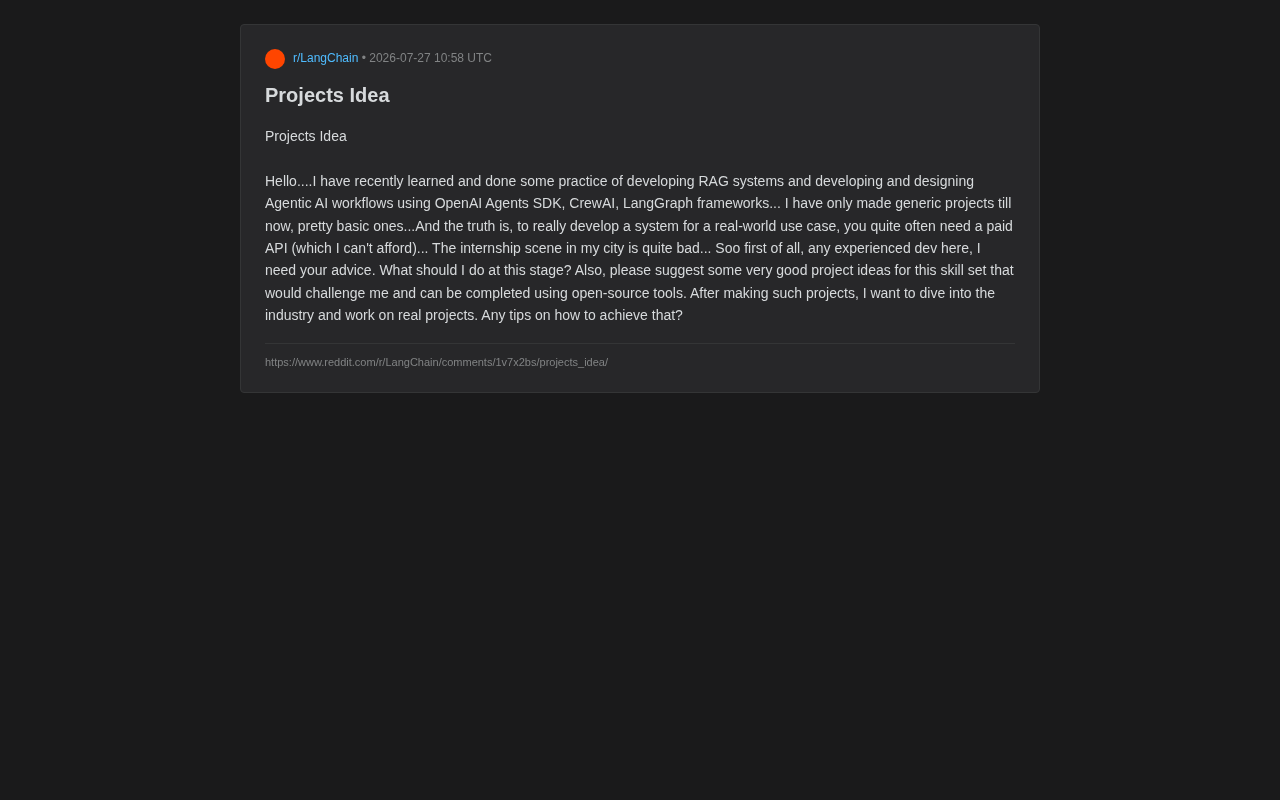
This question is highly representative. Many AI beginners hit the same bottleneck after mastering framework basics: How can you build meaningful, resume-worthy projects at zero or minimal cost, and successfully break into the industry? This article addresses this pain point with directly actionable strategies.
Breaking the "Must Use Paid APIs" Myth
Many beginners assume AI projects require calling paid LLM APIs like GPT-4 or Claude. That's simply not the case. Today's open-source ecosystem is mature enough to support the vast majority of practice projects and even near-production-grade applications.
Running Open-Source Models Locally: One-Click Deployment with Ollama
With Ollama, you can run mainstream open-source models like Llama 3, Mistral, Qwen, and Phi-3 on your personal computer with a single command. For machines with limited specs, choosing quantized versions below 7B parameters (such as Phi-3-mini or Qwen2.5-3B) can still handle conversation, summarization, structured output, and more. This means your RAG and Agent projects can achieve zero API call costs.
It's worth explaining what "quantization" means here. Quantization is a technique that converts model weights from high-precision floating point (e.g., FP16/FP32) to lower-precision formats (e.g., INT8, INT4), dramatically reducing memory usage and computational requirements so that large models originally requiring high-end GPUs can be deployed on consumer hardware. For example, a 7B parameter model requires approximately 14GB of VRAM at FP16 precision, but only about 4GB after 4-bit quantization — runnable on an ordinary laptop's integrated graphics. Current mainstream quantization formats include GGUF (llama.cpp ecosystem) and GPTQ/AWQ (GPU inference optimization). Ollama is built on the llama.cpp engine internally and uses GGUF-format quantized models by default, allowing users to pull and run models with a single command without understanding the underlying details.
Free Inference Quotas and Open-Source Hosting Options
If local compute isn't sufficient, here are free or low-cost alternatives:
- Groq: Offers extremely fast free inference quotas, particularly suited for Agent scenarios requiring multiple rounds of calls. Groq's core technology is its proprietary LPU (Language Processing Unit) chip, specifically optimized at the hardware level for LLM inference, achieving inference speeds several times faster than traditional GPU solutions — significantly reducing sequential call latency in multi-Agent workflows;
- Google Gemini / Mistral: Both have free-tier APIs, more than sufficient for development and demonstration needs;
- Hugging Face Inference API: Access to a massive library of open-source models with zero barrier to entry;
- Vector Databases: Chroma, Qdrant, and FAISS are all open-source and free, runnable locally with no additional costs. FAISS, open-sourced by Meta, excels at approximate nearest neighbor search on large-scale high-dimensional vectors; Chroma is designed specifically for AI applications with a clean, easy-to-use API; Qdrant offers more comprehensive filtering and distributed deployment capabilities.
Key insight: Paid APIs aren't a prerequisite for getting started — they're an option for the productionization stage when pursuing optimal performance and stability. During the learning phase, you can run through the entire workflow with open-source toolchains.
Build Deep Projects, Not Generic Ones
The developer mentioned they'd only built generic, basic projects — and that's precisely why resumes fail to stand out. Hiring managers don't care that "you know how to use LangGraph" — they want to see "what real problem did you solve with it." Here are several project directions that can be completed with open-source tools while offering sufficient challenge.
Vertical Domain Knowledge Assistant: Advanced RAG in Practice
Stop building "upload PDF and ask questions" demos that everyone has already seen. Pick a vertical domain and go deep:
- Legal Statute/Contract Analysis Assistant: Add clause citation tracing, conflicting clause detection;
- Medical Research Paper Assistant: Implement multi-document comparison, evidence strength grading;
- Enterprise Internal Documentation System: Add access control, hybrid search (keyword + semantic vector).
Technical highlights should include: Hybrid Search (BM25 + vector retrieval), Re-ranking, citation tracing, and retrieval quality evaluation (using the RAGAS framework). Being able to quantify and display "retrieval accuracy" is a clear differentiator.
Understanding these technical points is crucial. Hybrid Search combines two complementary search paradigms: BM25 is a classic sparse retrieval algorithm based on term frequency-inverse document frequency, excelling at precise keyword matching; vector retrieval captures semantic similarity between queries and documents through semantic embeddings, excelling at handling synonyms and semantic understanding. When combined, results are merged using strategies like Reciprocal Rank Fusion (RRF), significantly improving both retrieval precision and recall. Re-ranking is applied after initial retrieval, using a more powerful Cross-Encoder model to score and reorder candidate documents with finer granularity, further improving the quality of documents fed into the generation model. RAGAS is an open-source framework specifically designed for evaluating RAG systems, providing quantitative metrics like Faithfulness, Answer Relevancy, and Context Precision — upgrading your project from "feels okay" to "data proves it works."
Multi-Agent Collaboration Systems: Advanced Agentic AI
Use CrewAI or LangGraph to build multi-Agent systems that actually solve problems:
- Automated Research Report Generator: Search Agent + Analysis Agent + Writing Agent + Review Agent collaborating;
- Code Review Workflow: Read code repositories, perform static analysis, generate review comments, propose fixes;
- Data Analysis Assistant: Accept natural language questions, automatically generate and execute SQL or Pandas code, output visualization charts.
The key is designing reasonable Agent task division, state management, and error retry mechanisms — these are precisely LangGraph's core strengths. LangGraph models workflows as directed graphs where each node is a processing step (which can be an Agent call, tool execution, or conditional check), and edges define transition logic. It has built-in state persistence mechanisms supporting pause and resume at any node, making "Human-in-the-Loop" patterns possible — for example, in a code review workflow, an Agent can pause after generating a fix proposal to wait for developer confirmation before proceeding. This fine-grained process control capability is something simple chain-based calls cannot achieve.
Evaluable, Observable Production-Grade Demos
What truly makes a project look "like engineering" rather than "like a toy" are these engineering details:
- Use LangSmith or Langfuse (both have free tiers) for call chain tracing and performance evaluation;
- Add caching mechanisms, rate limiting strategies, and failure degradation logic;
- Wrap backend endpoints with FastAPI, build frontend interfaces with Streamlit or Next.js;
- Containerize deployment with Docker, and include clear README documentation and system architecture diagrams.
LLM Observability is an emerging practice that brings traditional software engineering monitoring and tracing concepts into large model applications. LangSmith is the commercial platform from the LangChain team, offering call chain tracing, prompt version management, A/B testing, and automated evaluation. Langfuse is its open-source alternative supporting self-hosted deployment with similar tracing and evaluation capabilities. Their core value lies in this: when an AI application involves multi-step chain calls (e.g., retrieval → re-ranking → generation → verification), developers need to inspect the input/output, latency, token consumption, and cost at each step to effectively identify issues and optimize performance. This engineering-grade observability is one of the key markers distinguishing "demo-level" from "production-level" AI applications. Demonstrating your understanding and application of these engineering practices in resumes and interviews will set you apart from the many candidates who only know how to call APIs.
The Practical Path from Projects to Industry
Once you have high-quality projects, how do you actually break into the industry? Here are several proven, pragmatic recommendations.
Build a Presentable Portfolio
Put 2-3 high-quality projects on GitHub with: clear READMEs, architecture diagrams, demo videos, or live experience links. One deployed, interactive project is worth more than ten scripts sitting idle in repositories. Free deployment platforms include Hugging Face Spaces, Render, Railway, and others.
Hugging Face Spaces deserves special attention — it supports direct deployment of Gradio and Streamlit applications, integrates seamlessly with Hugging Face's model and dataset ecosystem, and has high community traffic where excellent projects can gain natural exposure. Render and Railway are better suited for full application deployments requiring backend services (like FastAPI) and databases, with free tiers sufficient for demonstration purposes.
Contribute to Open-Source Communities to Build Industry Reputation
Submit PRs to popular open-source projects like LangChain, LlamaIndex, and CrewAI; improve documentation; answer issues. This builds technical reputation and gets you noticed by the community and potential employers. In regions where internship opportunities are scarce, this is an efficient path that transcends geographical limitations.
It's worth adding that open-source contributions don't have to start with "writing core code." What many high-quality open-source projects lack most is documentation improvements, example code additions, and bug reproduction reports. Documentation update speed for LlamaIndex and LangChain often can't keep up with feature iteration — if you find missing documentation or outdated examples during use, submitting fix PRs is a low-barrier but high-value contribution method. Maintainers of these projects typically welcome documentation PRs warmly and merge them quickly, allowing you to rapidly accumulate a visible contribution record.
Use Freelancing to Gain Real Client Experience
When internships are hard to find, take on small AI freelance projects on platforms like Upwork or Fiverr (such as building Q&A chatbots for businesses). This earns income to cover API costs while accumulating real-world client scenario experience — far more convincing in interviews than generic demos.
Conclusion: Run the Full Pipeline from Learning to Deployment with Open-Source Toolchains
The Reddit developer's dilemma is fundamentally a shared challenge for countless AI learners. The answer is actually clear: The open-source ecosystem has dramatically lowered technical barriers. The real differentiator lies in project depth, engineering maturity, and real-world scenario relevance.
Don't stop just because you can't afford APIs. Run open-source models locally with Ollama, get free inference from Groq, store vectors with Chroma, trace calls with Langfuse — this zero-cost toolchain can fully support you in creating impressive work. First, build one vertical, evaluable, deployable project thoroughly, and industry doors will naturally open for you.
Related articles

Greek Fire: The Ultimate Military Secret Guarded by the Byzantine Empire for a Millennium
Greek Fire was the Byzantine Empire's most closely guarded state secret — an ancient flamethrower that burned on water. Learn how it helped repel Arabs and Vikings and ensured the empire's survival.

7 Vibe Coding Agents Tested & Ranked: Which AI Coding Tool Should Beginners Choose?
Hands-on comparison of 7 Vibe Coding agents including Trae, Cursor, Claude Code, Codex, WorkBuddy & CoderWork, ranked by beginner-friendliness and performance.

AI-Generated Series 'Nido de Villanas': How AI Tells a Soap Opera Story
Deep analysis of AI-generated telenovela Nido de Villanas Episode 2: examining dialogue design, narrative tension, and AI's potential in dramatic storytelling.