Building an Intelligent Data Analysis Agent: A Complete Guide to Interface Alignment and SSE Streaming Response Integration
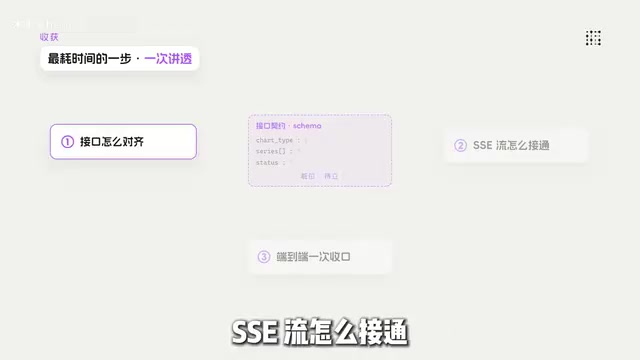
How to align interfaces, connect SSE streams, and close out E2E testing in enterprise AI Agent development.
Enterprise AI Agent projects often stall not on business logic, but on interface misalignment, broken SSE streams, and unreliable end-to-end testing. This guide covers how to establish an authoritative interface contract first, build the API and SSE layers around it, and close out testing systematically — replacing endless debugging cycles with a disciplined, repeatable delivery methodology.
Article
In enterprise-grade AI Agent development, the most time-consuming tasks are rarely writing business logic — they're aligning front-end and back-end interfaces, establishing SSE streaming responses, and closing out end-to-end testing. When these three areas are mishandled, the entire project falls into a trap where it looks like progress is being made but the wheels are actually spinning in place. This article, based on a hands-on walkthrough of an enterprise-level intelligent data analysis Agent project, systematically outlines the right approach for this critical delivery chain.
Interface Alignment: The First Hurdle in Agent Development
Many AI Agent projects fail not because the code can't be written, but because standards were never established from the start. When the front end renames fields to suit its own UI, the back end returns data in its own structure, and the LLM is stuck patching things together in the middle — everyone looks busy, but the team is drowning in pointless debugging.
As the original video put it: "If the interfaces don't align, everything that follows is wasted debugging." This cuts to the core pain point of Agent development. Without a front-end/back-end contract, every data exchange requires ad-hoc negotiation and patching — and the accumulated cost becomes a massive time sink.
An Interface Contract is essentially the legal document governing front-end/back-end collaboration. It's typically formalized as an OpenAPI/Swagger spec, Protocol Buffers definition, or GraphQL Schema. The API-First design philosophy advocates defining and freezing the interface spec — collaboratively agreed upon by product, front-end, and back-end — before writing any business code, so that all three parties can develop in parallel. This approach is widely adopted in microservices and front-end/back-end separated architectures, and can reduce integration costs by over 60%. For AI Agent projects, interface contracts must also specify streaming event types, data structure version numbers, and error event formats, to handle the added complexity introduced by non-deterministic LLM outputs.
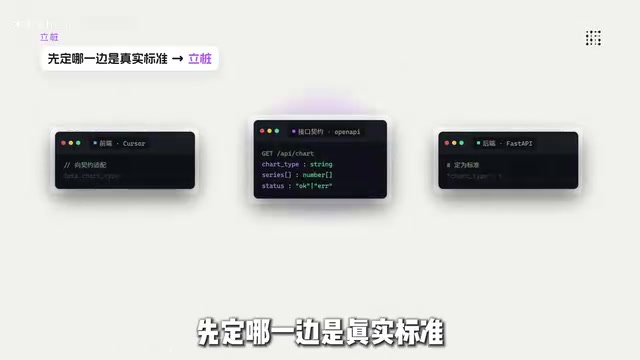
The solution is straightforward: decide which side is the authoritative source of truth, then have the other side adapt to it. Whether you anchor on the back-end response structure or the front-end's consumption requirements, the key is having a single, authoritative interface definition as the anchor point for the entire chain. Once the standard is established, the remaining work is adaptation — not a tug-of-war between two parties going in different directions.
Building an Interface Alignment Checklist
In practice, maintain an interface alignment checklist that verifies field names, data types, required vs. optional fields, and error code conventions one by one. Paired with a field mapping template, this allows front and back ends to collaborate on a shared "contract document," eliminating ambiguity at the source and avoiding rework. Tools like Swagger UI and Redoc can automatically render interface definitions as interactive documentation, enabling non-technical stakeholders to participate in API reviews and further reducing communication overhead.
Connecting the API Service Layer with SSE Streaming Responses
A defining characteristic of intelligent data analysis Agents is the need for streaming output — LLM inference results and intermediate states of chart generation all need to be pushed to the front end in real time. SSE (Server-Sent Events) is the widely adopted transport mechanism for this.
SSE is a standard protocol defined in the HTML5 spec for unidirectional server-to-client data push, implemented over persistent HTTP connections. Unlike WebSocket's full-duplex communication, SSE is designed specifically for "server-initiated push" scenarios. It has minimal protocol overhead, natively supports automatic reconnection (via the Last-Event-ID header), and every modern browser supports the EventSource API out of the box — no extra dependencies needed. In LLM streaming output scenarios, SSE has become the de facto standard. OpenAI, Anthropic, Google Gemini, and other major model APIs all use this protocol to return token streams, with each data: field carrying a JSON fragment that the client assembles incrementally to achieve a typewriter effect.

Compared to WebSocket, SSE is more lightweight for unidirectional streaming, cheaper to implement, and inherently HTTP-based for better compatibility. That said, getting SSE to work reliably isn't without its pitfalls. Common issues include:
- Chunk parsing errors: SSE transmits data as a
data:-prefixed text stream, and the client must correctly handle both packet concatenation and fragmentation. Due to TCP's segmentation behavior, data received in a singleonmessageevent may span multiple logical SSE events — requiring the client to maintain a buffer and perform boundary detection. - Connection drops and reconnection: When a stream is interrupted by network instability, graceful recovery is a scenario that must be handled. The
EventSourcespec has built-in auto-reconnect behavior, but reconnect intervals, retry limits, and resume-from-checkpoint logic still require explicit handling at the application layer. - Buffering issues: Some reverse proxies (like Nginx) buffer responses, breaking the streaming effect entirely. You need to explicitly disable buffering — either by setting the
X-Accel-Buffering: noresponse header or addingproxy_buffering offto thelocationblock in Nginx. Without this, the browser won't receive any data until the entire response completes, completely defeating the purpose of streaming.
Building the Service Chain Layer by Layer Around the Standard

The right approach is to close out the API service layer, SSE client, and chart binding one layer at a time. The service layer exposes interfaces according to the established contract; the SSE client reliably parses streaming data and triggers state updates; the chart binding consumes structured data to render visualizations. Every layer is grounded in the interface standard, with clear responsibilities and well-defined boundaries between layers.
The benefit of this approach: when something goes wrong, you can quickly pinpoint which layer deviated from the standard, rather than searching blindly across the entire chain. A companion SSE troubleshooting checklist provides a systematic diagnostic tool for exactly these kinds of issues.
End-to-End Testing: The Key to Closing Out in One Shot
A working pipeline is not the same as a reliable pipeline. What truly determines project quality is whether end-to-end testing can be closed out in a single pass.
End-to-end (E2E) testing sits at the top of the testing pyramid, validating the completeness of the entire business flow, complementing unit tests (which validate function-level logic) and integration tests (which validate cross-module interactions). In AI Agent projects, E2E testing faces a unique challenge: LLM outputs are non-deterministic, so the traditional "exact match" assertion strategy needs to shift to a "structure validation + semantic verification" approach — verifying that returned data conforms to the contract in terms of field structure, types, and value ranges, rather than doing literal string comparisons of model-generated content. Modern E2E frameworks like Playwright and Cypress already support intercepting and asserting on SSE streaming responses, enabling tests that simulate data arriving chunk by chunk.
The value of E2E testing lies in validating the complete user path — from the front end initiating a request, to the back end calling the LLM, to the SSE stream returning results, and finally the chart rendering correctly. Any hidden deviation in any single step will surface during E2E testing.
Four Dimensions of an E2E Testing Checklist
Build an E2E testing checklist around core user scenarios, covering these four dimensions:
- Happy path: Can a standard query complete the full flow and render correctly?
- Error paths: Are degradation handling and fallbacks in place for API errors, stream interruptions, and timeouts?
- Data consistency: Does the data displayed on the front end exactly match the raw data returned by the back end?
- Streaming experience: Is the SSE push real-time, ordered, and free of data loss?
Running these tests in a Docker environment ensures consistency between test and production environments, completely eliminating the classic "it works on my machine" failure mode. Docker Compose achieves environmental idempotency through container orchestration — no matter which machine you run docker compose up on, you get an identical runtime environment. This is the industry-standard solution to the "environment drift" problem.
The Truth About Efficiency: Standards Before Prompts
One counterintuitive but highly valuable insight from this walkthrough: what truly determines pipeline efficiency is not writing more rounds of prompts — it's establishing the interface standard first, then running the entire chain around that standard.
Prompt Engineering refers to the technique of guiding LLM outputs by carefully crafting input text, including methods like few-shot learning, chain-of-thought, and role prompting. During the LLM application development boom, many developers have over-invested in prompt engineering while neglecting the engineering infrastructure underneath. However, prompt optimization is fundamentally local fine-tuning within the model's capability ceiling — and its returns are limited by the stability of the underlying engineering chain. If interfaces are unstable, streaming drops packets, and test environments aren't reproducible, prompt optimizations cannot be objectively measured and will be completely masked by engineering noise. Industry consensus is increasingly clear: the maturity of an LLMOps (LLM Operations) system is a prerequisite for prompt engineering to deliver real value.
For enterprise-grade Agent projects, a stable interface contract, reliable streaming transport, and reproducible end-to-end tests are the fundamental factors that determine whether a project can actually ship. Prompt optimization only delivers real value when built on top of a solid engineering foundation.
Summary
Building an intelligent data analysis Agent is, at its core, a test of engineering discipline. Start with interface alignment — establish a single authoritative standard. Then build the API service layer and SSE client layer by layer around that standard. Finally, close out with end-to-end testing in a single pass. This pipeline is clear, reusable, and the essential path from "can be written" to "can run" to "can be trusted."
For teams actively developing similar projects, the recommendation is to map your work directly against the interface alignment checklist, field mapping template, SSE troubleshooting checklist, and E2E testing checklist — putting this methodology into practice in your own project to meaningfully reduce wasted debugging and improve overall delivery efficiency.
Key Takeaways
Related articles

The Truth Behind Codex 'Build a Website in 5 Minutes': AI Isn't Creating Sites—It's Helping You Copy Them
Exposing the truth behind viral Codex 5-minute website videos: creators aren't building original sites with AI—they're copying shared prompts or scraping others' work. Learn AI coding tools' real limits.

Getting Started with AI Agent Development: A Complete Guide from Concept to Practice
A comprehensive guide to AI Agent architecture and development, covering automated marketing, intelligent customer service, and investment analysis scenarios with single and multi-agent collaboration.

The Truth Behind Codex 'Build a Website in 5 Minutes': AI Isn't Creating Sites — It's Helping You Copy Them
Exposing the truth behind viral Codex 5-minute website videos: creators aren't building original sites with AI — they're copying shared prompts or scraping others' work.