Building LangGraph from Scratch in TypeScript: A Complete Agent Development Guide for Frontend Engineers

A four-stage TypeScript guide for frontend engineers to master AI Agent development, from API calls to building LangGraph from scratch.
This guide outlines how frontend engineers can leverage TypeScript and Zod to break into AI Agent development. It covers a four-stage progression: basic API calls, LangChain orchestration, LangGraph graph-based workflows, and ultimately building your own Agent framework from scratch — with clear architectural parallels to familiar frontend concepts like Redux and XState.
Why Frontend Developers Should Use TypeScript for Agent Development
When people think about AI development, Python is usually the first thing that comes to mind. But there's a growing trend worth paying attention to: TypeScript-based AI Agent development is becoming the fastest path forward for frontend engineers.
The logic is straightforward. Today's mainstream AI frameworks — including LangChain and LangGraph — offer complete TypeScript/JavaScript versions (such as langchain.js and langgraph.js). It's worth knowing that LangChain was originally released as a Python framework in late 2022 and quickly became a go-to tool for AI application development. As demand from the JavaScript/TypeScript ecosystem surged, the team released a fully equivalent LangChain.js version. LangGraph, the advanced framework launched by the LangChain team in 2024 and designed specifically for complex Agent workflows, maintains its TypeScript version langgraph.js in sync with the Python version, with a highly consistent API. This means frontend developers can build sophisticated agents within a familiar tech stack — no need to switch to an unfamiliar Python ecosystem.
Shifts in the job market are equally noteworthy. Analysis shows that positions at major companies advertising "full-stack AI development" are almost universally built around Node.js / TypeScript backend + AI integration. For frontend and full-stack developers, the return on investment of entering Agent development through TypeScript is arguably higher than transitioning from Python or Java backends.
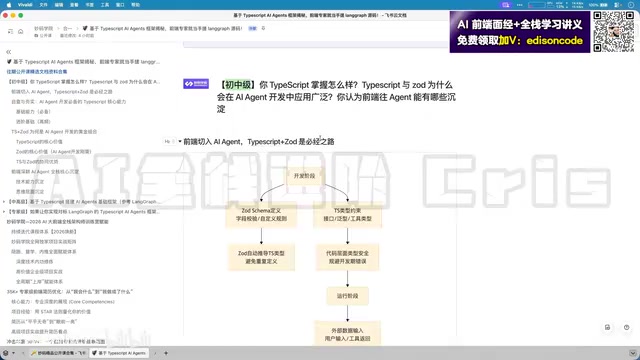
TypeScript and Zod: Two Cornerstones of AI Development
TypeScript has gone from "recommended" to nearly mandatory. A common benchmark in interviews: if a frontend developer has never used TypeScript, it often signals a lack of experience with large-scale or architecturally complex projects.
TypeScript, released by Microsoft in 2012, is a superset of JavaScript that catches errors at compile time through static type checking. In AI Agent development, its value far exceeds that of ordinary web development scenarios — LLM outputs are inherently probabilistic, non-deterministic text, and any model call may return an unexpected format. TypeScript's type system combined with Zod's runtime validation creates a "double safety net," significantly reducing the risk of cascading errors caused by inconsistent data structures in large-scale Agent systems.
In AI Agent scenarios, the value of TypeScript and Zod is amplified further. Zod is a TypeScript-first runtime data validation library that guarantees data structure correctness at both compile time and runtime. In AI development, LLM outputs are essentially unstructured text — Zod uses Schema definitions and parsing to coerce model outputs into type-safe, structured data, making it a natural fit for OpenAI's Structured Outputs feature. Specifically, its core value manifests in:
- Structured output: Zod is a natural validation tool for ensuring LLMs return data that conforms to an expected Schema
- Tool calling design: When building Function Calling parameter definitions, a tool's parameter Schema can be defined directly with Zod and automatically converted to JSON Schema, with the type system drastically reducing error costs. Function Calling, introduced by OpenAI in 2023, allows developers to describe callable tools to the model; the model then decides at inference time when to call which tool and returns the call parameters in structured JSON format
- Maintainability: Agent logic is complex — a strong type system makes team collaboration and code refactoring far more manageable
For frontend developers looking to move into AI, the first step isn't rushing to learn model invocation. It's building a solid foundation in TypeScript and Zod first.

A Four-Stage Progression from API Calls to Building Your Own Framework
The following capability progression path is worth referencing for any frontend developer looking to break into Agent development:
Stage 1: Basic API / SDK Calls
The most fundamental starting point is directly calling APIs from providers like OpenAI. But it's important to be clear-eyed: simply knowing how to call an API is nowhere near enough in today's job market — it's only the very beginning of an entry-level skill set.
Stage 2: Chain-Based Orchestration with LangChain
When a product requires chaining together multiple model calls, prompt templates, and external tools, you need a framework like LangChain to handle the "chain" orchestration and manage complexity that's difficult to handle with raw API calls alone. LangChain's core abstraction is LCEL (LangChain Expression Language), which uses pipe operators to connect Prompts, Models, OutputParsers, and other components into reusable chains — much like Unix pipe philosophy applied to AI development.
Stage 3: Graph-Based Orchestration with LangGraph
LangChain's linear chains struggle to express complex agent logic involving loops, branches, and state rollbacks. LangGraph draws from the design philosophy of directed graphs and state machines, organizing nodes and state transitions in a "graph" structure. The entire Agent execution process is modeled as a directed graph, where each node represents a processing unit and edges define the execution flow.
This design elegantly handles complex Agent patterns like ReAct (Reasoning + Acting), multi-agent collaboration, and Human-in-the-loop scenarios. ReAct was proposed by a Princeton University research team in 2022 — its core idea is having the language model perform explicit reasoning steps (Thought) before taking actions, forming a "Think → Act → Observe" loop that significantly improves reliability on complex tasks. Human-in-the-loop inserts human review nodes into an Agent's automated execution flow, pausing for manual confirmation when sensitive operations or uncertain decisions arise, balancing automation efficiency with safety and control. LangGraph natively supports both patterns through its graph structure's cyclic edges and Checkpoint mechanism, enabling control flows that more closely resemble real Agent decision-making.
Stage 4: Building Your Own Agent Framework from Scratch
The highest level of capability is implementing your own LangGraph-equivalent framework after truly understanding the underlying principles. A valuable mindset shift here: don't put these frameworks on a pedestal — treat them the same way you'd treat React or Vue, and the psychological pressure naturally disappears.

Core Design Principles for Building LangGraph from Scratch
Implementing an Agent framework in TypeScript that mirrors LangGraph comes down to a few key abstractions.
State Management
The operational core of LangGraph is a shared State object. Each node receives the current state, executes its logic, and returns a state update. When implementing in TypeScript, Zod can be used to define the State Schema, ensuring type consistency throughout the entire state flow. This design is highly aligned with Redux's Single Source of Truth principle — the global State object corresponds to Redux's Store, a node's state update function corresponds to a Reducer, and external event triggers correspond to Action dispatches.
Nodes and Edges
- Nodes: Essentially pure functions that receive State and return partial State updates
- Fixed edges: Define deterministic transitions between nodes
- Conditional edges: Dynamically determine which node to flow to next based on current state — the key to implementing branching decisions
Graph Compilation and Execution Engine
The framework needs an execution engine responsible for starting from the entry node, driving node execution step by step according to edge definitions, and handling state merging, loop termination conditions, and branching logic. This component is the "heart" of the entire framework and the most challenging part of the implementation.
From an architectural perspective, LangGraph's core abstractions — State, Node, and Condition — are philosophically very close to the Finite State Machine (FSM) model that frontend engineers are already familiar with. Take XState, the most mature state machine library in the frontend ecosystem: XState's state nodes correspond to LangGraph's Nodes, Guard-based conditional transitions correspond to Conditional Edges, and Context (extended state) corresponds to the global State object. Redux's Store corresponds to LangGraph's global State, Reducers correspond to Node state update functions, and Actions correspond to the events that trigger node execution. This cognitive transfer is precisely why frontend developers can quickly understand and work with Agent frameworks — and it's why "treat LangGraph like React/Vue" isn't just an empty reassurance, but a genuinely insightful observation grounded in solid architectural analogies.
Learning Recommendations for Frontend Developers Advancing into Agent Development
Beyond the technical roadmap, the following growth tips are equally valuable for developers who feel lost or uncertain.
Core principle: establish a clear plan first, then let time do the rest. For many people, anxiety stems from jumping back and forth between different directions, making no real progress after six months of study, and ultimately giving up because the knowledge feels scattered and disconnected.
For frontend developers, here's a relatively clear AI progression path:
- Strengthen foundations: TypeScript + Zod — clearing the first threshold for AI development
- Broaden scope: Extend from core frontend to broader frontend, micro-frontends, and server-side rendering
- Go full-stack: Node.js backend capabilities are a hard requirement for AI full-stack roles
- Go deep on Agents: Understand the design philosophy behind LangChain / LangGraph and be able to independently build complex agents
- Accumulate business experience: Fill in business knowledge gaps through real projects, and improve your ability to articulate and present "key challenges" convincingly
One High-Value Interview Preparation Technique
Before interviews, proactively organize and "frame" the key points, challenges, and highlights of your projects, and prepare the language to express them clearly. This way, when relevant questions come up, you can respond with confidence rather than freezing up and improvising on the spot.
Closing Thoughts
For frontend developers, AI Agent development is far from out of reach — it's a progression path you can walk entirely through TypeScript.
At its core, any framework is an engineering abstraction. Once you can break LangGraph down into the familiar concepts of state, nodes, edges, and an execution engine, "building a framework from scratch" stops being a myth. Starting from TypeScript and Zod, then understanding and reproducing the underlying logic of mainstream Agent frameworks — for frontend developers who want to stay competitive in the age of AI, this is undoubtedly a high-value technical investment.
Related articles

Disaster and Glory of the Apollo Program: The History We Must Revisit Before Returning to the Moon
From the fatal Apollo 1 fire to Apollo 8's daring lunar orbit to Apollo 11's successful landing—revisiting the disasters, fears, and compromises of the Apollo program and their lessons for today's return to the Moon.

Netflix Trust Exercise Turns Into Firing Trap: Where Are the Boundaries of Corporate Trust?
A Netflix employee was fired after sharing private info in a trust exercise. We analyze the risks of corporate trust exercises and how employees can protect themselves.

AMD CDNA5 Architecture Deep Dive: Technical Evolution and the AI Computing Competition Landscape
Deep analysis of AMD's CDNA5 architecture covering Chiplet packaging upgrades, HBM memory evolution, and low-precision compute optimization, examining how AMD challenges NVIDIA's AI chip dominance.