Chain of Thought (CoT) Explained: Teaching AI to Reason Step by Step

Chain of Thought (CoT) guides AI to reason step by step, dramatically improving accuracy on complex tasks.
Chain of Thought (CoT) is a prompt engineering technique that makes large language models show their reasoning process step by step instead of jumping to direct answers. Originally validated by Google researchers in 2022, CoT delivers over 40 percentage points of improvement on math benchmarks like GSM8K and enables transparent, traceable reasoning across domains from medical diagnosis to financial risk assessment.
From "Guessing Answers" to "Working Through Answers"
Imagine asking a large language model to solve a complex math reasoning problem. It will often spit out an answer directly — sometimes right, sometimes wrong — but more importantly, you have no idea how it got there. This "instant answer" pattern is the fundamental problem with traditional direct question-answering: there's no process, no logic.
Large language models perform well on simple problems, but often fall short on complex reasoning tasks like multi-step mathematical proofs or logical deductions. The reason is that direct question-answering is essentially "guessing" — the model matches the highest-probability response based on patterns in its training data, rather than performing genuine logical reasoning.
This is precisely where Chain of Thought (CoT) technology delivers its core value: instead of having the model guess an answer, it guides the model to think step by step — first analyzing the problem, then breaking it into steps, and finally reaching a conclusion. The shift from "guessing" to "thinking" sounds simple, but it's the key to improving reasoning capabilities in large language models.
What Is Chain of Thought (CoT)?
Chain of Thought is a prompt engineering technique that requires the model to show its reasoning process step by step when answering a question, rather than jumping directly to the answer.
Here's an intuitive example: if you ask an AI "how many more wheels does a tricycle have than a bicycle," a standard prompt might get a direct answer. But with Chain of Thought, the model would first say "a tricycle has three wheels, a bicycle has two wheels, so 3-2=1, a tricycle has one more wheel than a bicycle." The answer is embedded in the reasoning process — get the process right, and the answer follows naturally.
The core idea behind Chain of Thought is turning "implicit reasoning" into an "explicit reasoning chain." In the traditional approach, the model reasons internally in a way that's invisible to you — you only see the result. If it gets the answer wrong, you have no idea which step went astray. CoT makes this transparent: every intermediate step is laid out on the table, making it immediately clear where things went wrong.

This concept originated with a Google research team. In 2022, Jason Wei and colleagues formally introduced and systematically validated this technique in their paper "Chain-of-Thought Prompting Elicits Reasoning in Large Language Models." Their experiments on large-scale models like PaLM and GPT-3 showed that when models are guided to display reasoning steps, their ability to handle complex problems improves significantly. This research established the theoretical foundation for CoT technology by treating explicit reasoning steps as a scalable prompting strategy. CoT is especially well-suited for tasks requiring rigorous thinking — mathematical computation, logical inference, and multi-step decision-making. So CoT's value isn't just about producing more accurate answers; more importantly, it makes the AI's thought process traceable and interpretable.
The Three-Step CoT Workflow
At its core, Chain of Thought is a complete "think before answering" workflow, which can be broken down into three key steps.
Step 1: Prompt Construction
The user's question is assembled into a special prompt that includes not only the original question but also instructions that direct the model to show its reasoning process. For example, if you ask "Xiao Ming has five apples and gave two to Xiao Hong, how many are left," the prompt adds a line like "Please think through this step by step." This step activates the model's reasoning mode and sets the foundation for generating intermediate steps.
Step 2: Reasoning Chain Generation
The model generates reasoning steps one by one, with each step building on the output of the previous one. It might first calculate "gave away two, so 5-2=3," then confirm "the answer is three." The key is that each reasoning result feeds into the next step, creating a chain reaction that allows the model to handle multi-step derivations rather than jumping straight to an answer.
Step 3: Answer Integration
The model links all prior reasoning steps together into a complete chain of thought, then extracts the final answer from it. This answer doesn't appear out of thin air — it's backed by a complete reasoning process. The most elegant aspect of this entire workflow is that it mimics the human cognitive pattern of "thinking before acting," while also incorporating a dynamic error correction mechanism: when a step goes off track, subsequent steps can catch the deviation and adjust course.
Why CoT Works: Three Deep Mechanisms
Many people think Chain of Thought is just "writing out the answer in pieces" — an unnecessary extra step. But its effectiveness actually stems from three deeper mechanisms.
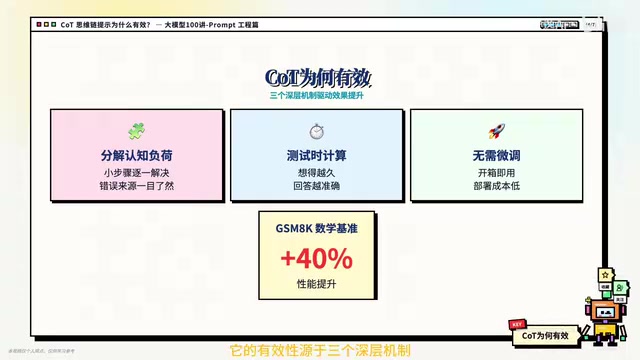
First, decomposition reduces cognitive load. Human working memory is limited, and trying to process a complex problem all at once leads to errors. Breaking reasoning into small steps — each tackling one sub-problem — dramatically improves the precision of error localization. The same applies to models: intermediate steps from decomposition make the source of any error immediately visible.
Second, it aligns with the Scaling Law for test-time compute. The Scaling Law was first proposed by OpenAI in 2020, describing the power-law relationship between model performance and parameter count, data volume, and compute. Test-Time Compute is an important extension of this idea — without changing model parameters, giving the model more computational resources to think during inference creates a positive correlation between thinking time and output quality. CoT is essentially a low-cost way to extend test-time compute: the more thoroughly the model reasons, the more accurate its response. This mechanism can even allow smaller models to approach the performance of larger ones by extending inference time.
Third, no fine-tuning is required — the cost is extremely low. Traditional methods for improving model capability often require large amounts of fine-tuning data and significant time investment. CoT changes the reasoning approach directly, with no additional training needed — it works right out of the box.
These mechanisms are well-supported by data: on the GSM8K math benchmark, CoT delivered a performance improvement of over 40 percentage points. GSM8K (Grade School Math 8K) is a math reasoning benchmark released by OpenAI, containing 8,500 word problems requiring 2 to 8 reasoning steps. It is one of the core standards for evaluating mathematical reasoning in large language models and one of the most compelling validation scenarios for CoT's effectiveness. This result clearly demonstrates the significant improvement in handling complex problems that step-by-step reasoning provides.
Four Key Application Scenarios
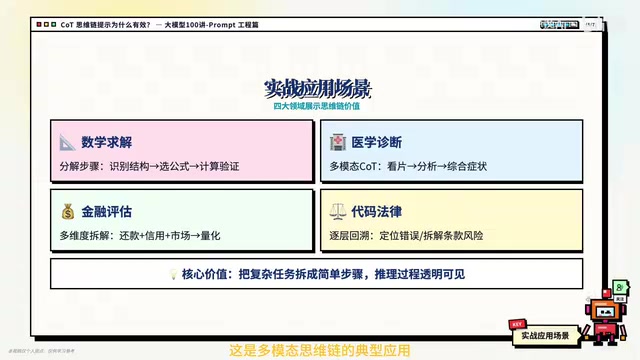
In real-world projects, Chain of Thought demonstrates its value most clearly in the following scenarios.
Mathematical Problem Solving
Given the equation x²+5x+6=0, CoT guides the model to first factor it as (x+2)(x+3)=0, then derive x=-2 or x=-3. Step-by-step reasoning dramatically reduces the chance of errors, and every step can be independently verified.
Medical Diagnostic Decision-Making
This is a classic application of multimodal Chain of Thought. When an AI analyzes an X-ray, it doesn't output a diagnosis directly. Instead, it first describes the imaging features it observes, then analyzes the potential pathological nature, and finally synthesizes a judgment based on the patient's other symptoms. This transparent reasoning logic makes it easier for physicians to understand the AI's rationale, allowing them to more effectively act on its recommendations.
Financial Risk Assessment
When evaluating a loan application or investment decision, CoT simultaneously considers multiple dimensions — repayment capacity, credit history, market conditions, and more — breaking down the vague question of "how risky is this" into quantifiable indicators that can be assessed in aggregate. The reasoning process is traceable and auditable, which is especially important in financial compliance contexts.
Code Debugging and Legal Document Analysis
In software development, when a program throws an error, CoT traces the path from the error message back to the specific lines of code. In legal contexts, when dealing with a contract dozens of pages long, CoT can break it down clause by clause following legal logic, precisely identifying potential risk points.
CoT vs. Few-shot: The Essential Difference
In practice, Chain of Thought and Few-shot prompting are often confused, but they differ fundamentally:
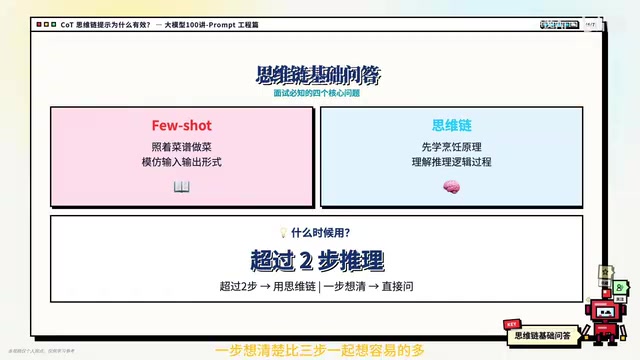
- Few-shot provides "input-output pair" examples, teaching the model to mimic a format — like following a recipe.
- Chain of Thought demonstrates the reasoning process itself, teaching the model to understand the logic — like learning the principles of cooking before trying to prepare a dish.
As a practical rule of thumb for when to use each: when a task requires more than two reasoning steps, prefer Chain of Thought; if one step is enough to reach a conclusion, a direct question works fine. CoT's impact on accuracy is most pronounced in multi-step reasoning tasks.
Clear-Eyed and Pragmatic: The Limits and Value of CoT
A deeper question is worth asking: is CoT genuinely reasoning, or is it performing "sophisticated pattern matching"?
The more precise framing in current academic discourse is "quasi-reasoning" or "behavioral reasoning" — the system exhibits the behavior and outcomes of reasoning, but whether its internal process truly resembles human reasoning remains an open question. Two main types of evidence support this view:
The first is counterfactual testing: presenting the model with a fictional scenario and observing whether its reasoning relies on genuine logic or similarity-matching with training data. The second is phrasing variation testing: rephrasing the same question differently can cause accuracy to fluctuate by 10% to 30% — if this were true logical reasoning, surface-level phrasing changes shouldn't have such a large effect.
But acknowledging limitations doesn't mean dismissing value. CoT delivers measurable improvements in reasoning capability, a phenomenon known as Emergent Reasoning — one of the central phenomena in large model research. It refers to capabilities that appear suddenly once a model's parameter count crosses a certain threshold, rather than scaling linearly with model size. This was systematically documented in Google's 2022 BIG-Bench research: CoT's effect is nearly zero on small models, but jumps dramatically on models exceeding 100 billion parameters — a textbook case of emergent reasoning. We shouldn't let uncertainty about the underlying mechanism lead us to deny its real-world effectiveness.
A mature technical judgment can be summed up in four words: clear-eyed and pragmatic. Acknowledge the limitations, recognize the value, and make full use of Chain of Thought's reasoning potential in the right contexts.
Key Takeaways
Related articles

The Truth Behind Codex 'Build a Website in 5 Minutes': AI Isn't Creating Sites—It's Helping You Copy Them
Exposing the truth behind viral Codex 5-minute website videos: creators aren't building original sites with AI—they're copying shared prompts or scraping others' work. Learn AI coding tools' real limits.

Getting Started with AI Agent Development: A Complete Guide from Concept to Practice
A comprehensive guide to AI Agent architecture and development, covering automated marketing, intelligent customer service, and investment analysis scenarios with single and multi-agent collaboration.

The Truth Behind Codex 'Build a Website in 5 Minutes': AI Isn't Creating Sites — It's Helping You Copy Them
Exposing the truth behind viral Codex 5-minute website videos: creators aren't building original sites with AI — they're copying shared prompts or scraping others' work.