ChatGPT Plus Subscription Guide: Third-Party Top-Up Explained, Risks Analyzed, and Compliant Alternatives

A full breakdown of ChatGPT Plus third-party top-up services, their risks, and safer alternatives for users in China.
This article examines why subscribing to ChatGPT Plus is difficult for mainland China users, walks through how third-party top-up services operate using a card-key model, and analyzes three core risks: account security from Session Token exposure, delayed account bans from OpenAI's risk controls, and unstable renewals. It concludes with safer alternatives including official subscriptions, API access, and domestic LLMs like DeepSeek and Kimi.
Why Subscribing to ChatGPT Plus Is So Difficult for Users in China
As OpenAI continues to advance its model capabilities, ChatGPT Plus and Pro subscriptions have become essential tools for many developers and content creators. Yet for users in mainland China, completing an official subscription is far from straightforward — OpenAI does not support Chinese payment methods, and users also need an overseas credit card, a stable network environment, and the correct regional account settings.
This barrier stems from multiple layers of compliance pressure. First, there's the U.S. Export Administration Regulations (EAR) — enforced by the Bureau of Industry and Security (BIS) under the Department of Commerce — which aims to prevent technologies with military or strategic value from reaching certain countries and entities. The algorithms, computing power, and data processing capabilities underlying large language models may fall under the "Dual-Use Technology" regulatory scope. EAR jurisdiction even extends to "Deemed Export" scenarios — providing controlled technology access to restricted-region users over the internet. Second, international payment networks (Visa/Mastercard) apply their own regional risk controls, and OpenAI has yet to formally establish compliant operations in mainland China. The situation resembles regional locking by platforms like Netflix or Spotify, but AI services face additional complexity due to data security and technology export regulations. Even users with a valid overseas credit card may find their payment rejected if their account IP or billing address is identified as mainland China.
This is precisely why numerous so-called "top-up" or "recharge" services have emerged online. This article is based on a walkthrough shared by a Bilibili content creator, organized and analyzed with a focus not just on "how it works" but on helping readers understand the underlying mechanics, potential risks, and safer alternatives.
Important Notice: The third-party top-up method described in this article is presented for informational purposes only. It carries no official endorsement regarding safety or reliability. Readers should assess the risks independently before making any decisions.
The Complete Third-Party Top-Up Process
According to the content creator's walkthrough, the method uses a "card key + self-service top-up URL" model, which they claim to have used continuously for over a year. The process breaks down into the following steps.
Placing an Order and Receiving Credentials
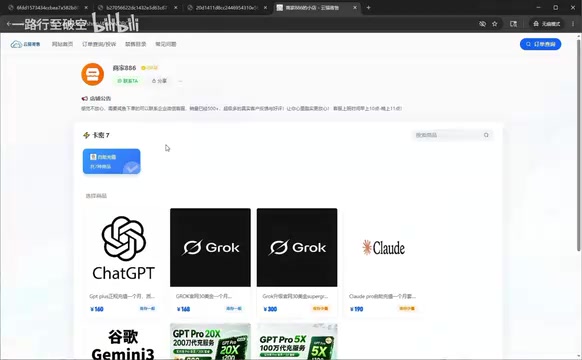
After placing an order on Xianyu (闲鱼) or the merchant's self-service delivery page, the user receives three things: a card key (卡密), a self-service top-up URL, and a dedicated customer service WeChat contact. ChatGPT Plus costs approximately ¥160 RMB per month, and merchants typically promise post-sale support.
Verifying the Account and Submitting Data
Open the self-service top-up URL (works in both mobile and desktop browsers), enter the card key, and click verify. The system then asks you to submit account information — at this point, you need to log into your own ChatGPT account in the same browser and follow the prompts to retrieve your account data.
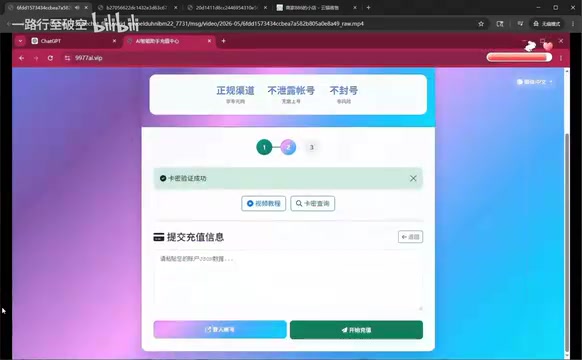
This step is the critical — and riskiest — part of the entire process. "Retrieving account data" typically involves submitting your account's session credentials (Session Token or Cookie) to a third-party platform, which then completes the payment on your behalf.
Understanding this risk requires some knowledge of web authentication: modern web applications widely use token-based stateless authentication. When you log into ChatGPT, the server generates an encrypted, signed Session Token and stores it in your browser via the Set-Cookie directive (OpenAI typically names it __Secure-next-auth.session-token), with HttpOnly and Secure flags set to prevent direct JavaScript access and non-HTTPS transmission. However, top-up platforms typically ask users to export Cookie values via specific scripts or manual methods — a process that fundamentally bypasses these security protections. A third party holding a valid Session Token can fully impersonate the user before the token expires (OpenAI tokens typically last anywhere from a few hours to 30 days), performing all actions including initiating subscription payments, modifying account settings, and accessing conversation history — permissions essentially equivalent to holding the account password directly. If you've already submitted your credentials, immediately go to the official site under "Settings → Security" and revoke all active sessions.
Confirming the Top-Up and Waiting for Activation
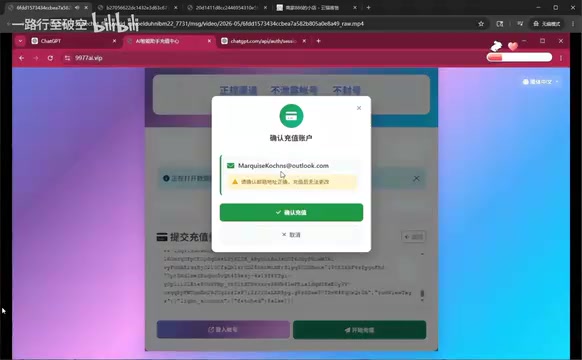
Paste the retrieved account data back into the top-up page, click "Start Top-Up," and the system will display a confirmation prompt to verify the account information. Confirm to complete the process.
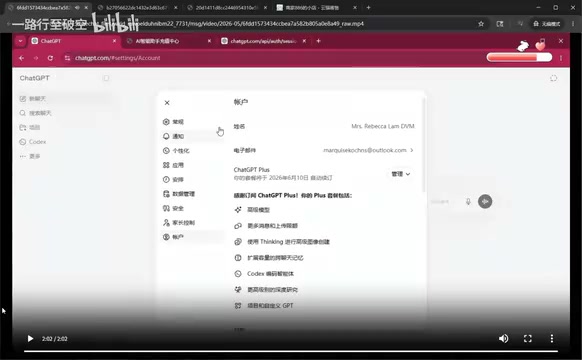
After a successful top-up, return to the ChatGPT website and refresh. If "Plus" appears in the lower-left corner, the subscription is active. You can also check the subscription expiration date under "Settings → Account" — it typically runs one month from the date of purchase.
Deep Dive: How Third-Party Top-Up Services Work and Their Three Major Risks
Why Can Third Parties Top Up on Your Behalf?
At its core, this type of service leverages bulk payment capabilities through overseas payment channels. The merchant's key advantage lies in controlling overseas payment channels that can bypass regional restrictions — common approaches include using virtual credit cards registered abroad (such as cards issued by Depay or Wise), completing payments through overseas proxy nodes, or using KYC-verified overseas accounts to operate in bulk.
Here's how virtual credit cards work: Cards issued by platforms like Depay, Wise, and Privacy.com are essentially single-use or multi-use card numbers generated on top of real bank accounts or prepaid card systems, typically registered in OpenAI-supported regions like the U.S. or U.K. The KYC verification threshold for such cards is relatively low — some platforms require only an email address and basic personal information. Merchants holding large numbers of these cards, combined with overseas proxy nodes to simulate local IP environments, can bypass OpenAI's regional payment restrictions. However, international card networks like Visa and Mastercard have automated fraud detection systems for abnormal transaction patterns (such as a single card number initiating many small payments to the same merchant in a short period). When triggered, the associated card number and linked accounts may be frozen — one of the root causes of instability in these top-up services.
Merchants typically acquire subscription entitlements at wholesale prices far below the official rate (for example, through educational discounts, team plans, or gift card channels), then resell them to domestic users at near-official prices, pocketing the margin. By obtaining a user's login session (i.e., Session Token), the merchant initiates the subscription payment from within the user's account. This may seem "painless" to the user, but control of the account has temporarily transferred to a third party. The fragility of this chain is that if any link in it is flagged by OpenAI's risk control system, all associated accounts could be impacted simultaneously.
Risk 1: Account Security Vulnerabilities
Submitting your session credentials means the third party can fully operate your account during that window — including viewing conversation history, modifying account settings, and potentially changing linked information. For users who handle sensitive work data through ChatGPT, this risk is especially significant.
Risk 2: Account Suspension
OpenAI employs a multi-dimensional risk control system targeting abnormal payment behavior and regional mismatches, using a combination of technical methods: at the network level, the system compares the IP geolocation at account registration, the IP of regular logins, and the IP from which payment was initiated — cross-regional payments (e.g., an account that's consistently active on Chinese IPs but whose payment originates from a U.S. IP) will trigger a high-risk flag; at the device level, browser fingerprinting technology can identify dozens of dimensions including operating system, screen resolution, font lists, and Canvas rendering characteristics, making it difficult to evade detection simply by switching IPs; at the account association level, the system tracks the number of accounts linked to the same payment method — when a single virtual credit card is used to subscribe for dozens or even hundreds of accounts, the probability of mass bans on the associated group rises sharply. OpenAI also analyzes behavioral patterns: anomalous action sequences within a short timeframe (login → immediately initiate payment → log out) may also trigger manual review. This system is similar in principle to anti-fraud systems used by major e-commerce platforms, but because OpenAI must simultaneously satisfy export compliance requirements, it is more sensitive to regional anomalies.
It's particularly worth noting that risk control enforcement often has a lag — an account may not be suspended until weeks or even months later. This explains why some users (including the content creator in question) report "no problems" in the short term, but these are individual experiences and cannot be generalized. If bulk payment activity is identified, associated accounts risk being suspended.
Risk 3: Unstable Renewals and Unreliable After-Sales Support
These services are entirely dependent on the merchant's continued operation. If a merchant shuts down or their payment channel fails, users who have already paid have little recourse and may face sudden subscription interruptions with no way to recover their funds.
Clarification on Claims Like "GPT-5.5, image-2, Codex"
Some top-up promotions mention version numbers like "GPT-5.5" or "image-2" — these should be viewed with skepticism. OpenAI's officially announced product lineup centers on the GPT-4 series, GPT-4o, and DALL·E image generation; Codex has long been integrated into broader coding capabilities. These version numbers read more like marketing language and should not be used as indicators of a service's legitimacy.
Activating Plus does grant access to stronger models, higher usage limits, image generation, and coding assistance — but what specific models are available depends on what OpenAI has officially unlocked in your account's region, and has nothing to do with the top-up channel itself.
Safer, Compliant Alternatives
For users who want reliable, long-term access to large language model capabilities, the following options carry significantly lower risk and are worth prioritizing:
- Official Direct Subscription: Users who have access to overseas payment methods should always prioritize subscribing directly through OpenAI. This offers the best account security and customer support.
- API Pay-As-You-Go: Developers can use the official API on a usage-based billing model with third-party clients. Costs are controllable and there's no need to hand over account control.
- Chinese Domestic LLMs: Products like DeepSeek, Tongyi Qianwen, Kimi, and Doubao perform excellently in Chinese-language contexts, offer compliant payment options, and are easily accessible — suitable for most everyday needs. It's worth noting that between 2023 and 2025, China's LLM ecosystem underwent rapid evolution from catching up to achieving partial leadership: DeepSeek, developed by DeepSeek AI, uses a Mixture of Experts (MoE) architecture in its V3 and R1 series models, achieving top-tier performance at extremely low training cost — matching OpenAI's o1 series on math reasoning and code generation benchmarks — with model weights fully open-sourced and supporting local deployment. Alibaba Cloud's Tongyi Qianwen (Qwen2.5) series spans multiple parameter scales from 0.5B to 72B, with strong performance on HumanEval code evaluation and multilingual understanding tasks. Moonshot AI's Kimi differentiates itself with a 2-million-token ultra-long context window, particularly suited for long-document analysis. All of these products operate within China's data compliance framework, support domestic payment methods like WeChat Pay and Alipay, and have been specifically optimized for Chinese-language contexts — often outperforming overseas models trained primarily on English data when it comes to Chinese ambiguity, internet slang, and local knowledge.
- Other Overseas Products: Google Gemini and xAI's Grok are also worth evaluating based on your specific needs.
Conclusion
Third-party top-up services do lower the barrier to subscribing to ChatGPT Plus for users in China, and the process is indeed as straightforward as the content creator described. But behind the convenience lies a temporary surrender of account control and a set of risks that should not be dismissed — from the account security vulnerabilities created by Session Token exposure, to the risk of delayed account suspension triggered by risk control mechanisms, to the subscription interruptions caused by merchants shutting down. This approach may be acceptable for casual personal use, but for situations involving important data or long-term reliance on the service, official channels or compliant domestic alternatives are strongly recommended. The true value of a technical tool lies in stable, long-term service — not in short-term savings at the cost of reliability.
Related articles

Network Doctor: An Open-Source Terminal Tool for Network Fault Diagnosis
Network Doctor is an open-source terminal network diagnostic tool that integrates ping, dig, curl, and traceroute, automatically detecting connectivity in stages and outputting fault conclusions in natural language.

LangChain Guardrails Explained: Building Safe and Controllable AI Agents
A detailed guide to LangChain Guardrails covering layered ecosystem architecture, middleware implementation, deterministic and model-driven protection for building production-grade secure AI Agents.

Deep Dive into Microsoft's AI Security Tools: Does Performance Really Surpass the Competition?
Microsoft launches enterprise AI security tools claiming superior performance. This deep analysis examines core capabilities, ecosystem advantages, and risks to guide enterprise security decisions.