Claude Code /cd Command: The Hidden Trick for Switching Directories Without Losing Context

Claude Code's /cd command switches directories while preserving full conversation context.
Claude Code's built-in /cd command lets developers switch working directories without restarting their session or losing conversation history. This is especially valuable in multi-repo, monorepo, and frontend-backend workflows where maintaining AI context across directories dramatically improves productivity. The article also explores the underlying LLM architecture that makes context preservation so critical.
An Easy-to-Overlook Practical Command
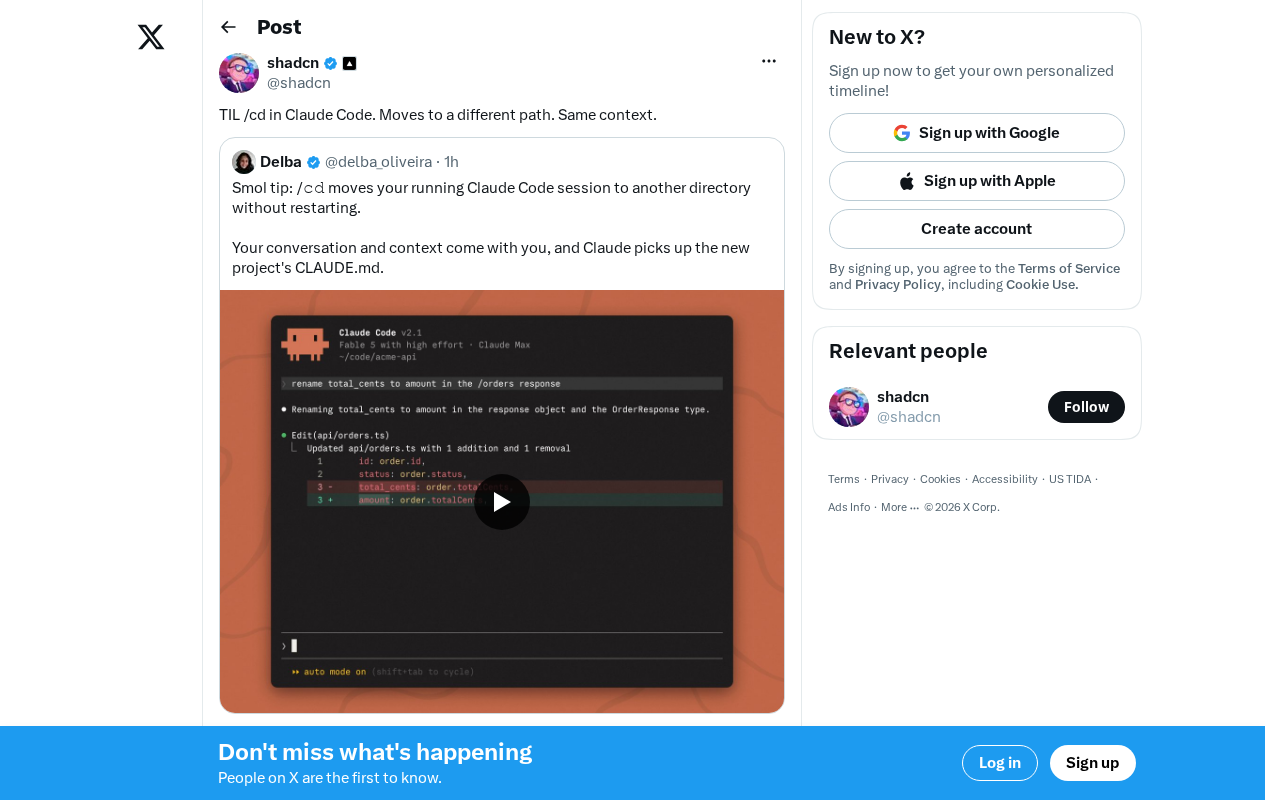
When using Claude Code for day-to-day development, many users may have never noticed a built-in command hiding in plain sight: /cd. It behaves similarly to the terminal cd command, but its real value lies in — switching the working directory while keeping the entire conversation context intact.
This means you don't have to start a new session just to switch to a different project path, and you don't need to worry about losing the accumulated conversation history, code understanding, and task context you've built up. For cross-project and cross-module development scenarios, this feature significantly improves workflow continuity.
Worth noting: Claude Code is Anthropic's terminal-native AI coding tool built for developers. Unlike IDE-integrated tools such as GitHub Copilot or Cursor, it uses the command line as its primary interface — closely aligned with the traditional Unix philosophy of doing one thing well and composing cleanly with other tools. This architectural choice makes it naturally suited for scripted and automated development workflows, and the slash command system is therefore one of its core interaction layers. /cd is an underappreciated member of that system.
Why Context Is So Critical
Context Is the Core Asset of an AI Coding Assistant
For AI coding tools like Claude Code, "context" essentially determines the ceiling of their capabilities. When you've had an in-depth conversation with the assistant — discussing architectural design, walking through business logic, agreeing on coding conventions — all of that information forms the foundation for the assistant's understanding of your intent.
It's worth understanding deeply: the "context" of a large language model is fundamentally the total amount of information the model can process in a single inference pass, typically measured in tokens. Tokens are not simply equivalent to characters or words; they are the basic units produced when a model's tokenizer splits text. In English, a common word usually corresponds to 1–2 tokens. In Chinese, each character often maps to 1–2 tokens due to higher character density; symbols like indentation and parentheses in code also consume token budget. This measurement method directly determines how much useful information a single conversation can accommodate.
Understanding how tokens are counted helps developers make smarter context management decisions in practice. For example, quoting entire file contents tends to burn through context budget quickly, while a concise architectural summary retains key information at a much lower token cost. This is fundamentally why some AI tools introduce "context compression" or "intelligent truncation" strategies — to maximize information density within a constrained token budget.
From GPT-3's early 4K token context window to the 200K token window supported by the Claude 3 series, expanding context capacity has been one of the most significant advances in LLM engineering in recent years. Behind this evolution lies fundamental improvements to positional encoding mechanisms. Traditional absolute positional encoding maps each token's position to a fixed vector, making it difficult for models to generalize to sequence lengths unseen during training. RoPE (Rotary Position Embedding) injects positional information into attention calculations via rotation matrices, allowing relative positional relationships to naturally hold at any sequence length. ALiBi (Attention with Linear Biases) takes a simpler approach with linear bias penalties, enabling models to elegantly extrapolate to longer contexts at inference time. The direct result of these breakthroughs is that modern LLMs possess context windows of tens of thousands to hundreds of thousands of tokens — code snippets, architecture discussions, and variable naming conventions accumulated over a continuous conversation all enter the model's "working memory" and participate in generating every subsequent response.
However, a larger context window doesn't mean the model can uniformly utilize everything within it. Researchers have identified a phenomenon called "Lost in the Middle": LLMs tend to assign stronger attention weights to information at the beginning and end of the context window, while content in the middle tends to be relatively overlooked. This is closely related to the computational characteristics of the attention mechanism in Transformer architectures — during autoregressive generation, models have a natural preference for "most recent" and "earliest" tokens, while long historical content in the middle can get "diluted" in attention allocation. This means that in very long conversations, architectural constraints or coding conventions established early on may "sink" to the middle of the context window as the conversation progresses, causing the model's reference weight for them to decrease. This is why some AI tools implement strategies like "context compression" or "pinning key information" to counteract this attention decay effect.
There is a key architectural fact here: LLMs are stateless inference engines. Each call is an independent forward-pass computation with no cross-call internal memory mechanism. What we call "conversation memory" is essentially the application layer concatenating historical messages into the prompt before submitting it to the model — state management is entirely the responsibility of the client or middleware layer. Claude Code's session management operates under this architectural constraint, simulating "memory" capability by persisting context window contents. Once a session is interrupted, that information cannot be automatically recovered. This is precisely why "switching directories without interrupting the session" is so valuable to developers: every forced session restart is equivalent to giving the AI assistant amnesia, requiring it to rebuild its understanding of the project background from scratch.
Under the traditional approach, if you need to jump between multiple codebases or directories, you either start a new session (at the cost of losing all context) or make do by handling cross-directory needs within the same directory. The /cd command exists precisely to fill this experience gap.
Typical Use Cases
The /cd command is especially handy in the following workflows:
- Microservices / multi-repo development: Freely switch between multiple service directories while maintaining a conversational understanding of the overall system architecture.
- Frontend-backend integration: Jump from a backend directory to a frontend directory while the assistant still remembers the API definitions agreed upon earlier.
- Code migration and refactoring: Move between source and target directories while retaining the overall refactoring plan and context.
- Monorepo projects: Navigate between different sub-packages in a large monorepo without repeatedly explaining the project structure to the assistant.
On that last point, some engineering background is worth adding: Monorepo (monolithic repository) is a code management strategy that stores multiple related projects or services in a single Git repository. It is widely adopted by large tech companies like Google, Meta, and Microsoft, with typical tooling including Nx, Turborepo, and Bazel. The contrasting Multi-repo strategy stores each service or module in its own independent repository. The core advantage of Monorepo lies in unified dependency management, atomic commits across projects, and smoother code sharing — but the tradeoff is rapid repository size growth. Google's internal monorepo reportedly contains over a billion files, and even typical engineering teams may face directory hierarchies with dozens or hundreds of sub-packages. Multi-repo, on the other hand, requires navigating between locally cloned repositories at different paths, with higher complexity in dependency version management. Notably, modern Monorepo tools like Nx and Turborepo introduce mechanisms such as "task orchestration" and "incremental build caching," enabling more precise cross-package dependency tracking — and this fine-grained directory topology is precisely what increases developers' need to frequently jump between different sub-package paths. Regardless of strategy, developers need to frequently navigate between different directory levels. The value of /cd in this context is especially pronounced: it lets the AI assistant follow the developer's perspective as they move freely through complex project topologies, rather than being locked into the local view of a single directory.
How to Use the /cd Command
Usage is straightforward. In Claude Code's interactive interface, type:
/cd /path/to/another/project
After executing, Claude Code's working directory switches to the specified path while all conversation history and context in the current session remains intact. You can immediately start working in the new directory while referencing anything discussed previously at any time.
What a Small Command Reveals About AI Tool Design Philosophy
A seemingly minor command like /cd reflects Claude Code's deep attention to developers' real-world workflows in its product design. A programmer's daily routine is not linear — it's not about staying in one directory but constantly moving between projects, modules, and dependencies.
A truly useful AI coding assistant shouldn't require users to adjust their work habits to accommodate the tool. Instead, it should proactively conform to those habits. Decoupling "switching directories" from "losing context" is a concrete expression of this design philosophy — it makes the AI assistant feel more like a collaborator who is always present, rather than a temporary helper who needs to "meet you all over again" with every operation.
More Slash Commands Worth Exploring
This tip also reminds us: AI coding tools often have a wealth of slash commands that haven't been fully explored.
Slash commands are a mature interaction design pattern in modern conversational tools. Their origins can be traced back to IRC (Internet Relay Chat) in the era of /join, /quit, and similar operation instructions. IRC emerged in 1988 as one of the primary real-time communication protocols on the early internet, and its slash-prefix command system became the design template for all subsequent conversational tools. This pattern was later systematically promoted and standardized in team collaboration tools like Slack — Slack's slash command system, launched in 2013, allowed third-party apps to register custom commands, seamlessly embedding external service capabilities into the chat interface through a unified / trigger mechanism. This greatly advanced the pattern's adoption in productivity tools and directly influenced the command interaction design of later platforms like Discord and Teams. The core idea is to embed structured command entry points within a natural language interface, triggered by a / prefix to distinguish them from ordinary conversation — balancing the low barrier of a natural language interface with the precision of structured commands.
In AI coding tools specifically, slash commands typically serve two roles: meta operations that control the tool's own behavior (such as switching working directory, clearing context, or switching model versions), and workflow shortcuts (such as /commit for auto-generating commit messages or /explain for explaining selected code). Notably, these commands often technically bypass the LLM's inference layer and are executed directly by the application layer — meaning they respond faster, behave more deterministically, and are unaffected by model randomness (temperature parameters, sampling strategies, etc.). They represent the most stable and reliable part of the tool's capability boundary.
The temperature parameter is the core hyperparameter that controls output randomness in LLM inference: as the value approaches 0, the model tends to produce the same highest-probability output each time, making behavior highly reproducible; as the value increases, the model samples from candidate vocabulary with a more uniform probability distribution, producing more creative but less predictable outputs. Working in concert with temperature are sampling strategies like Top-p (nucleus sampling) and Top-k — Top-p controls diversity by dynamically selecting the set of candidates whose cumulative probability exceeds a threshold, while Top-k simply limits each step to sampling from the top k most probable candidates. These parameters together form the control system for LLM output randomness. Slash commands completely bypass this probabilistic sampling process and directly trigger deterministic program logic — this is the fundamental difference in reliability between them and AI-generated content, and the engineering rationale for designing critical workflow operations as slash commands rather than natural language instructions.
The reason these commands are easy to overlook is that they don't directly participate in the main question-and-answer flow, yet they often play a decisive role at critical points in the workflow.
It's worth spending some time inputting / to trigger the command completion list, or consulting the official documentation, to systematically understand the full extent of the tool's capabilities. These details accumulate and often deliver quite substantial productivity gains.
Summary
While the /cd command is simple, it's a practical trick that significantly improves the Claude Code experience. Its core value lies in switching the working directory while fully preserving the conversation context, making it especially well-suited for multi-repo and multi-module development scenarios. Understanding the stateless nature of LLM context windows — that so-called "memory" is nothing more than the application layer continuously concatenating and passing historical messages, and that advances in positional encoding techniques like RoPE enable this "concatenation" to maintain semantic coherence over longer conversation spans — lets us appreciate the necessity of this design more deeply: every unnecessary session reset is a waste of accumulated "AI collaboration assets." For developers who rely heavily on AI coding assistants, mastering these detailed commands makes the entire workflow smoother and more efficient.
Key Takeaways
Related articles

Disaster and Glory of the Apollo Program: The History We Must Revisit Before Returning to the Moon
From the fatal Apollo 1 fire to Apollo 8's daring lunar orbit to Apollo 11's successful landing—revisiting the disasters, fears, and compromises of the Apollo program and their lessons for today's return to the Moon.
Netflix Trust Exercise Turns Into Firing Trap: Where Are the Boundaries of Corporate Trust?
A Netflix employee was fired after sharing private info in a trust exercise. We analyze the risks of corporate trust exercises and how employees can protect themselves.

AMD CDNA5 Architecture Deep Dive: Technical Evolution and the AI Computing Competition Landscape
Deep analysis of AMD's CDNA5 architecture covering Chiplet packaging upgrades, HBM memory evolution, and low-precision compute optimization, examining how AMD challenges NVIDIA's AI chip dominance.