Claude Sonnet 5 Deep Dive: Impressive Benchmarks, Questionable Value — Just Use Opus 4.8?
Claude Sonnet 5 benchmarks well but real-world testing reveals hidden costs and weak creative output — Opus 4.8 remains the better choice.
Claude Sonnet 5 posts strong benchmark scores (63.2% SWE-bench, 80.4% Terminal Bench) and nearly matches Opus 4.8, but a new tokenizer inflates actual token costs beyond the listed price. Real-world tests show it ranks 13th on CursorBench, struggles with SVG generation and frontend tasks, and loses its cost advantage when Max Effort mode is enabled. Verdict: use Opus 4.8 instead.
Sonnet's Biggest Upgrade Yet
Anthropic has officially launched Claude Sonnet 5, positioning it as the most significant iteration in the Sonnet series to date. Compared to its predecessor Sonnet 4.6, the new model delivers notable improvements across reasoning, tool use, code generation, and everyday knowledge work — with overall performance now approaching the higher-tier Opus 4.8.
Anthropic's model naming follows a three-tier architecture: Haiku → Sonnet → Opus, corresponding to lightweight/fast, balanced/workhorse, and flagship/premium respectively — inspired by the increasing complexity of poetic forms. The Sonnet line has historically played the "best value" role, typically accounting for the largest share of API call volume.
In terms of product positioning, Sonnet 5 is the most "agentic" Sonnet to date. Agentic capabilities refer to the model's ability to autonomously decompose goals, invoke external tools, execute iteratively, and verify results — rather than simply handling single-turn conversations. This requires stable tool-calling formats, low hallucination rates, and long-context consistency, all of which are core metrics for engineering usability in modern LLMs. Sonnet 5 hallucinates less, calls tools more reliably, can autonomously plan tasks, invoke external tools like browsers and terminals, and complete full workflows with greater independence. This kind of autonomous workflow capability typically required larger, more expensive models just a few months ago.
Claude Sonnet 5 is now available across all Claude plans and has become the default model for both free and Pro users. It can be accessed via API or directly through the Claude chat interface.
Benchmark Numbers Look Strong
Looking at publicly available benchmark data, Sonnet 5's scores are genuinely impressive:
- SWE-bench Verified (agentic coding): 63.2%, a significant jump over Sonnet 4.6, roughly 6 percentage points behind Opus 4.8
- Terminal Bench 2.1: 80.4%, very close to Opus 4.8
- HLE: Broadly competitive with Opus
- Computer Use: 81.2%
- GDPVal: 16.19, actually exceeding Opus
Each of these benchmarks tests different capabilities. SWE-bench Verified draws from real GitHub issue fix tasks, requiring the model to locate bugs and generate passing patches within a full codebase environment — scoring above 63% puts it in the top tier among current models. Terminal Bench evaluates a model's ability to autonomously complete system operations in a command-line environment, closely mirroring real DevOps scenarios. HLE (Humanity's Last Exam) is an extremely challenging comprehensive knowledge test designed by leading academic institutions, covering math, physics, law, medicine, and other specialized domains. GDPVal focuses on quantitative reasoning and structured output capabilities. The diversity of these benchmarks reflects the industry trend of shifting LLM evaluation from simple Q&A toward composite task performance.
On aggregate leaderboards, Sonnet 5 currently ranks fifth — though evaluations are ongoing and rankings may shift.
On paper alone, Sonnet 5 looks like an everyday workhorse model that "approaches Opus performance at a lower price." But real-world testing revealed a critical twist.
The Tokenizer Trap Hidden in the Pricing
Sonnet 5 currently offers an introductory price: $2 per million input tokens and $10 per million output tokens, valid through August 31, 2026. After that, it will increase to $3 per million input tokens and $15 per million output tokens. It also supports a 1 million token extended context window.
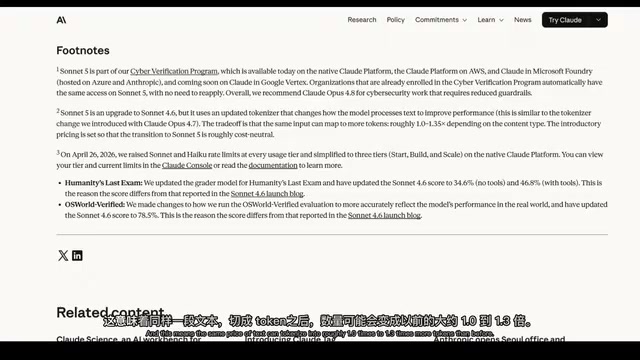
However, buried in the pricing footnotes is a critical detail: Sonnet 5 uses the same Tokenizer as Opus 4.7. To understand the impact of this change, it helps to know how tokenizers work. A tokenizer is the core preprocessing component that converts text into numerical sequences for large language models. Modern mainstream LLMs typically use BPE (Byte Pair Encoding) algorithms to build their vocabularies, determining merge rules by analyzing high-frequency byte combinations in training corpora. Vocabulary design directly affects how many tokens a given piece of text gets split into: a larger vocabulary covering more high-frequency phrases can represent the same content with fewer tokens, while a smaller one produces more tokens. Anthropic's Tokenizer for Opus 4.7 differs from the previous generation in how it handles Chinese text, code, and special symbols — meaning the same text could be tokenized into approximately 1.0 to 1.7 times as many tokens as before, depending on content type. In other words, the listed price may look lower, but certain prompts actually consume more tokens. Since APIs bill per token, this "hidden price increase" has a particularly significant impact on enterprise users with high call volumes.
The testing conclusion here is pointed: Anthropic's introductory pricing is, in a sense, offsetting the hidden cost increase caused by the tokenizer change. It's a clever strategy, but one that makes Sonnet 5's much-touted cost-efficiency look less stable than it appears.
Real-World Testing: The Advantages Are Fading
In more practical evaluations, Sonnet 5's performance is notably less impressive than the benchmark rankings suggest. On the CursorBench leaderboard, it comes in at just 13th place.
Users have historically favored Sonnet because it was "faster and cheaper than Opus while still being capable enough." With Sonnet 5, the cost advantage still exists, but it's no longer compelling — it's only about 72% cheaper than Opus 4.8 Max, while the performance gap remains.
One tester put it bluntly: "At this point, there's not much reason for me to stick with Sonnet, because switching directly to Opus 4.8 gives a much more noticeable performance boost." More awkwardly, when Max Effort mode is enabled, Sonnet 5's token consumption nearly matches Opus. Max Effort mode is an optional reasoning enhancement mechanism introduced by Anthropic — similar to OpenAI's o-series "slow thinking" path. When enabled, the model generates extensive internal reasoning steps (Thinking Tokens) before producing a final response, and these steps count toward token consumption. Enabling it essentially makes Sonnet temporarily match Opus-level reasoning depth, but at the cost of losing its original speed and cost advantages. For a model that's supposed to lead on speed and cost efficiency, the value proposition breaks down quickly.
Real Generation Capabilities: A Mixed Bag
macOS Clone: Decent Completion

In a test using the World of AI Benchmark tool to generate a macOS clone, Sonnet 5 delivered a passable result. It completed a login screen, notification system, and functional menu bar; supported light/dark mode switching and wallpaper changes; and produced a Dock with visually solid SVG icons. Apps including Launchpad, Safari, Messages, Mail, Calendar, Notes, and Maps mostly worked, and it even generated a playable FPS mini-game along with a terminal, calculator, and text editor.
The cost, however, was steep: the entire process took around 40 minutes in Max mode, consumed a large number of tokens, felt inefficient, and the final result fell short of what Opus had produced in previous tests.
Minecraft and Frontend: Clear Weaknesses
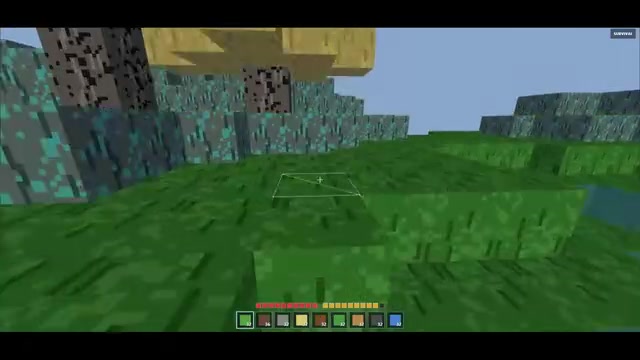
In the Minecraft test, Sonnet 5 used different-style texture packs, had working water dynamics, and generated mobs including villagers and Creepers. But the overall build was quite buggy: no block-breaking animations, no inventory system, no infinite terrain generation, and no cave system as requested — scoring roughly 6.5 out of 10.
For a SaaS landing page frontend test, scroll-triggered effects were very basic and components weren't generated completely or correctly. The tester noted that even GLM 5.2 produced better frontend output than Sonnet 5.
SVG Creative Tasks: The Most Disappointing Weakness
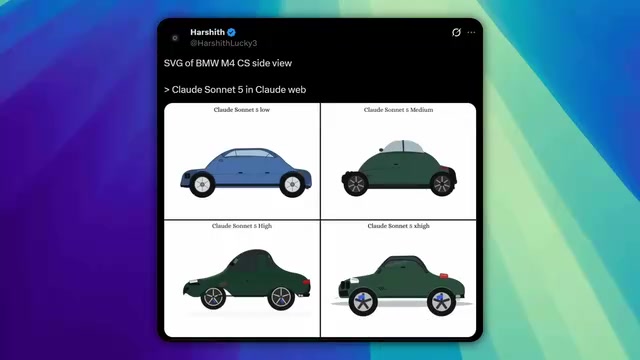
SVG generation is where Sonnet 5 disappointed most. SVG (Scalable Vector Graphics) generation is a classic task for evaluating spatial reasoning and visual abstraction in LLMs: unlike raster images, SVG uses XML tags to describe paths, shapes, and transformations, requiring the model to precisely map visual concepts to geometric instructions in a coordinate system. Generating complex objects like cars requires the model to project 3D forms onto 2D outlines, abstractly represent brand-specific features (such as BMW's kidney grille proportions), mathematically control Bézier curves in paths, and make aesthetic compositional judgments.
The tester asked Sonnet 5 to generate an SVG of a BMW M4 CS. Even with Effort set to High, the result was completely unsatisfactory — the expected proportions, stance, and visual identity of the BMW were essentially absent. In contrast, the same task given to Opus at least produced the main structural form with a recognizable BMW silhouette. The fundamental weakness of current LLMs on such tasks stems from their training objective — language models are trained on next-token prediction without dedicated visual geometry supervision signals. GLM's relative advantage on tasks like these may stem from its training data containing more structured visual description samples or targeted fine-tuning.
On these types of creative and visual tasks, Sonnet 5 clearly lags behind GLM, with design aesthetics that don't even meet GLM's standard. The tester consequently ranked Sonnet 5 below GLM 5.2.
Verdict: Stick with Opus 4.8 for Most Tasks
All things considered, the tester's assessment of Claude Sonnet 5 is blunt: it completely failed to meet expectations. Beyond the autonomous workflow improvements mentioned in Anthropic's official blog post, it showed no clear advantage over Opus in most real-world test scenarios. While it's slightly cheaper, the new tokenizer means actual token efficiency isn't as straightforward as the listed price suggests — and the all-in cost may not be as favorable as it looks.
The testing recommendation is clear: for almost all tasks, stick with Opus 4.8 rather than Sonnet 5 — you're more likely to get the results you want. The tester also expressed hope for future versions, such as a potential Sonnet 5.5.
It's worth noting that the views in this article primarily come from a single testing source and reflect a strongly personal evaluation perspective. Benchmark data does confirm that Sonnet 5 has real capability — but its cost and creative performance in real-world scenarios are still worth carefully evaluating against your own use cases.
Key Takeaways
Related articles

Disaster and Glory of the Apollo Program: The History We Must Revisit Before Returning to the Moon
From the fatal Apollo 1 fire to Apollo 8's daring lunar orbit to Apollo 11's successful landing—revisiting the disasters, fears, and compromises of the Apollo program and their lessons for today's return to the Moon.
Netflix Trust Exercise Turns Into Firing Trap: Where Are the Boundaries of Corporate Trust?
A Netflix employee was fired after sharing private info in a trust exercise. We analyze the risks of corporate trust exercises and how employees can protect themselves.

AMD CDNA5 Architecture Deep Dive: Technical Evolution and the AI Computing Competition Landscape
Deep analysis of AMD's CDNA5 architecture covering Chiplet packaging upgrades, HBM memory evolution, and low-precision compute optimization, examining how AMD challenges NVIDIA's AI chip dominance.