Codex /goal Command Tutorial: A Practical Guide from AI Q&A to Automated Task Execution

The /goal command marks AI programming's shift from Q&A mode to persistent automated task execution.
Codex CLI's /goal command transforms AI programming from stateless single-shot Q&A into stateful persistent task management. It provides a trackable goal anchor for long-running programming tasks, enabling AI to continuously progress toward objectives rather than waiting for step-by-step instructions. The article proposes a five-part template (Objective, Context, Scope, Acceptance, Deliverables), emphasizing that clearer goals yield more controllable execution, and high-risk tasks require explicit boundaries.
From Chat Window to Task Execution: The Fundamental Shift of /goal
If you're still treating AI programming as a chat window, asking it line by line how to write code, then Codex's /goal command might be a watershed moment. What truly matters isn't that there's a new command—it's that AI programming is shifting from "answering questions" to "driving tasks forward".
Technical Background of Codex CLI: Codex CLI is a command-line programming assistant tool released by OpenAI, built on the GPT-4 series of models. It allows developers to interact directly with AI in a terminal environment to complete programming tasks. Unlike the web-based ChatGPT, Codex CLI deeply integrates file system operations, code execution, and version control capabilities, enabling direct read/write access to local codebases. The introduction of the /goal command marks Codex's transition from stateless single-shot inference to stateful persistent task management, which technically relies on the Thread persistence mechanism provided by the App Server.
In the official documentation, /goal is listed as a built-in command for Codex CLI, supporting Set, Get, Pause, Resume, and Clear operations for a task goal. The key official description states:
Give Codex a persistent goal to keep tracking while it runs on larger tasks.
This statement carries significant weight. Previously, what you gave AI was mostly a single prompt—execute and done. Now you're giving it a goal state attached to a thread. In the App Server documentation, interfaces like Thread Goal Set, Get, and Clear already exist, indicating that tasks can run for hours or even longer.
Persistent Goal State and AI Agent Architecture: Traditional LLM calls are stateless—each request is independent, context is passed in via prompt, and everything is discarded after execution. The "persistent goal state" introduced by /goal is essentially one of the core components of AI Agent architecture. In Agent systems, the Goal serves as an anchor stored in the thread context, driving the model to continuously advance through multi-step execution loops (ReAct loop: Reasoning → Acting → Observing) rather than waiting for each user input. This aligns with the design philosophy of frameworks like AutoGPT and LangChain Agent, with the difference being that Codex natively integrates it into the developer toolchain, dramatically lowering the barrier to entry.
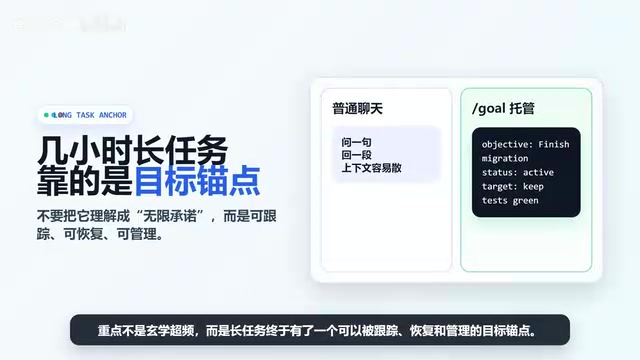
The key point isn't some mystical overclocking—it's that the workflow has changed. Long tasks finally have a goal anchor that can be tracked, resumed, and managed. AI no longer just responds with a code snippet; it continuously progresses around a goal.
The Evolution of AI Programming Tools: Understanding the significance of /goal requires placing it in the context of three generations of AI programming tool evolution. The first generation, represented by GitHub Copilot (2021), provided line-level/function-level code completion—essentially intelligent autocomplete. The second generation, represented by ChatGPT Code Interpreter and Cursor, supports multi-turn conversational programming where developers iterate on code through dialogue. The third generation, now represented by Devin, SWE-agent, and Codex CLI /goal, sees AI taking on complete engineering tasks with autonomous planning, execution, debugging, and reporting capabilities. This evolution path closely mirrors the development of the Robotic Process Automation (RPA) industry—from assistive tools to semi-automation to fully automated task execution, with the core driver being "reducing manual intervention points."
Writing /goal Correctly: From Wishful Thinking to Task Contracts
There's a common pitfall here. Many people write /goal as a wish, such as "help me optimize this project." This kind of statement essentially asks AI to play a guessing game.
An effective /goal should read like a task contract—objective, context, scope, acceptance criteria, and deliverables all need to be clearly specified.
Bad Example
Help me optimize the login page
Good Example
Convert the login page to a mobile-first layout, keeping backend APIs unchanged and not modifying auth logic.
After completion, verify: login, error messages, and logout—all three flows.
Finally, summarize changes, verification results, and remaining risks.

The difference is clear at a glance: the former lets AI freestyle, while the latter provides explicit boundaries and acceptance criteria. The clearer the goal, the more controllable AI's execution path becomes.
Which Tasks Are Suitable for /goal Automated Execution
Most Suitable Task Types
/goal works best for tasks that are clearly defined, procedurally tedious, and low-risk:
- Adding unit tests
- Fixing lint warnings
- Migrating API versions
- Organizing technical documentation
- Getting a specific feature working end-to-end
- Aligning startup procedures
These tasks aren't necessarily difficult, but they're patience-intensive—making them ideal scenarios for AI's long-running automated execution.
Tasks Least Suitable for Hands-Off Execution
- Payment logic
- Permission systems
- Production data operations
- Secret/key management
- Data deletion
- Large cross-repository refactoring
Engineering Principles Behind High-Risk Task Boundary Control: The high-risk task types listed above share a common characteristic in software engineering—they all involve "irreversible operations" or "high blast-radius operations." The risk of AI automatically executing such tasks comes not only from model hallucination but also from error accumulation effects in long tasks: small deviations at each step can be amplified into catastrophic errors through multi-step chain execution. In control theory, this is known as "Error Propagation." Therefore, setting explicit scope boundaries for /goal is essentially building "Guardrails" for AI Agents—a core research direction in the current AI safety field, with technologies like Constitutional AI and RLHF boundary constraints attempting to solve similar problems.
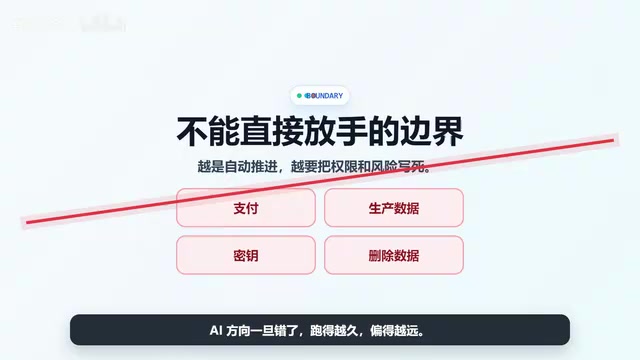
The core principle is: The longer the autonomous execution runs, the clearer the boundaries need to be. Once AI's direction is wrong, the longer it runs, the further it drifts.
The Five-Part /goal Template: Making AI Execute Like Receiving a Work Order
When writing /goal, it's recommended to include the following five sections by default:
| Section | Content | Example |
|---|---|---|
| Objective | What to accomplish | Convert the login page to mobile-first layout |
| Context | Why it's being done | Mobile users account for 70%, current experience is poor |
| Scope | What can be changed, what's off-limits | Only modify frontend components, don't touch backend APIs or auth |
| Acceptance | What tests must pass | Login, error messages, and logout—all three flows |
| Deliverables | What to output | Change summary, verification evidence, risk list |
The Paradigm Leap from Prompt Engineering to Task Engineering: This five-part template has deep methodological roots. Prompt Engineering emerged during 2020-2022, with its core focus on maximizing model output quality through carefully designed single inputs, using techniques like few-shot examples, Chain-of-Thought, and role-setting. Task Engineering is its evolved form, targeting multi-step, long-running AI task orchestration. The five-part template actually draws from User Stories and Acceptance Test-Driven Development (ATDD) in software engineering—"Objective + Context" corresponds to the User Story's As a / I want / So that structure, while "Acceptance + Deliverables" corresponds to ATDD's Given / When / Then acceptance conditions, migrating mature engineering management methodologies into the AI task design domain.

The value of this template lies in transforming AI from a "chatty code assistant" into a reliable task executor.
Related articles
 Tutorials
ChatGPT Plus Subscription Guide: Are GPT-5.5, image-2, and Codex Worth the Upgrade?
A detailed look at ChatGPT Plus features — GPT-5.5, image-2, and Codex — with a Plus vs Pro comparison and a complete step-by-step subscription guide for users outside the US.
 Tutorials
Harness AI Engineering in Practice: Using Claude Code to Master Enterprise-Level E-Commerce Development
Deep dive into Harness AI Engineering: master enterprise e-commerce development with Claude Code using the Rules, Skills, Wiki, and Changes framework.
 Tutorials
Cursor + Codex Dual-IDE Collaboration: A Practical Methodology for Open-Source Project Customization
A complete methodology for open-source project customization based on real-world experience, detailing the Cursor+Codex dual-IDE workflow, seven-stage process, MVP validation, and AI source code reading techniques.