Complete Guide to LangChain 1.3: From Models and Agents to DeepAgent Architecture

A layered breakdown of LangChain 1.3 from Models and Agents to DeepAgent and Harness architecture.
This guide systematically covers LangChain 1.3's three-layer architecture — Models, Agent, and DeepAgent — explaining how Tool Calling replaced ReAct, why LangGraph is the essential foundation for all Agents, what the Harness design philosophy entails (context management, tool orchestration, state tracking, context compression), and how DeepAgent sits at the top of the stack. Includes a recommended learning path and version selection advice.
Why LangChain 1.3 Matters
LangChain is an unavoidable core framework in AI application development. The reality, however, is that many developers are still learning from materials based on the 0.x era — severely out of sync with current engineering practice. This article, based on the latest LangChain 1.3 curriculum, systematically traces the technical evolution from Models to Agents to DeepAgent, helping you build a clear, modern understanding of Agent architecture.
The version issue deserves special emphasis: A large number of tutorials still cover early versions like LangChain 0.2, 0.6, and 0.8, while LangChain has already iterated to 1.3. Since Harrison Chase launched LangChain in October 2022, it has evolved at a remarkable pace. The 0.x era centered on the Chain abstraction and suffered from inconsistent interfaces, difficult debugging, and excessive coupling. Version 0.1, introduced in early 2024, began introducing LCEL (LangChain Expression Language). By the 1.0 release, the core modules had been fully refactored — splitting langchain into sub-packages such as langchain-core, langchain-community, and langchain-experimental — dramatically reducing dependency size and improving maintainability. Many APIs and design patterns from pre-1.0 are now deprecated, making further study of them largely unproductive. This article focuses on best practices in version 1.3.
Core Concepts: A Layered View from Models to Agents
Understanding the LangChain ecosystem starts with a clear mental model of its layered structure. The entire stack can be broken down into three core layers: Models → Agent → DeepAgent, each building on the one below through successive abstraction.
The Model Layer: Foundation of All Capability
Large language models form the lowest layer of the entire system. In LangChain 1.3, the Models module provides a unified interface for calling various LLMs — whether OpenAI, DeepSeek, or others — all accessible through a consistent abstraction layer. This layer addresses the fundamental question of "how to communicate with a model," covering core capabilities such as prompt construction, message formatting, and streaming output.
The Agent Layer: Giving Models the Ability to Act
If a large language model is "a thinking brain," then an Agent is the mechanism that gives it "hands and feet." Built on top of LLMs, Agents add Tool Calling, reasoning and decision-making, and multi-step execution — enabling the model to autonomously determine when to call a tool and how to combine multiple tools to complete complex tasks.
Tool Calling is a native capability of modern LLMs, first standardized by OpenAI with Function Calling in 2023. The core mechanism works like this: developers pass a JSON Schema description of available tools to the model; during inference, the model decides whether a tool is needed, and if so, returns a structured invocation instruction (rather than natural language); the application layer executes the call and returns the result to the model for continued reasoning. This mechanism has effectively replaced the earlier prompt-parsing-based ReAct (Reasoning + Acting) pattern, delivering significant gains in stability and accuracy. LangChain 1.3 uses Tool Calling as the standard underlying implementation for Agents.
There is one important underlying relationship worth highlighting: Agent implementation depends on LangGraph. Strictly speaking, an Agent is itself a graph-based execution structure. LangGraph is an independent library released by the LangChain team in 2024 that models the Agent's execution process as a directed graph. Each node in the graph represents an execution step (such as calling an LLM or executing a tool), and edges define the flow logic between nodes, with support for conditional edges to enable dynamic routing. The key innovation is a persistent State mechanism — the entire graph execution revolves around a shared State object that any node can read or write, natively solving the context propagation problem in multi-step Agents. This design makes cyclic execution, human-in-the-loop intervention, and checkpoint-based resumption possible — all things traditional linear Chains cannot achieve. This is also why LangGraph is so important: even if you never directly use LangGraph's workflow features, it remains the foundational underpinning of every Agent.
The Harness Architecture and DeepAgent
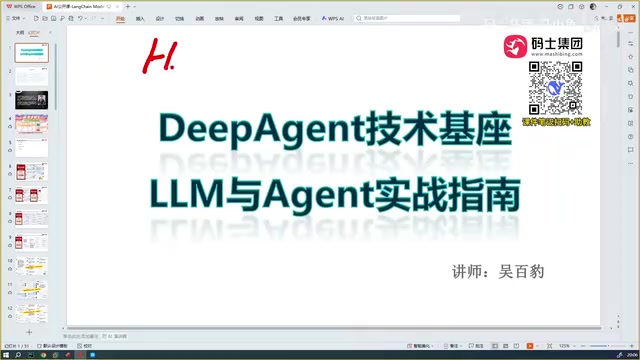
Recently, "Harness architecture" has appeared frequently in job listings across major recruitment platforms, becoming a key evaluation criterion for LLM application development roles. So what exactly is Harness?
Harness: An Architectural Design Philosophy
Harness is not a specific product or framework — it is an architectural design philosophy for building complex Agent systems, encompassing the following key capabilities:
- Context management: How to organize and maintain context across conversations and tasks
- Tool management: How to register, schedule, and orchestrate multiple external tools
- State management: How to track various intermediate states throughout multi-step execution
- Context compression: How to effectively compress context when it grows too long, avoiding exceeding the model's context window limit
Context compression deserves a deeper look. The context window is the maximum number of tokens an LLM can process in a single call. GPT-4o supports 128K tokens, and Claude 3.5 supports 200K tokens — yet even these limits can be hit in long conversations or complex multi-step tasks. Context compression strategies in Harness architecture typically fall into three categories: summarization, which generates rolling summaries of conversation history to replace raw content; memory retrieval, which stores historical information as vector embeddings and retrieves relevant segments on demand; and structured state extraction, which retains only the key variables needed for task execution rather than the full conversation. LangChain 1.3's Memory module and LangGraph's State mechanism provide native support for all three approaches.
The core goal of this philosophy is to enable Agents to reliably and consistently handle complex, long-horizon, multi-turn task scenarios.
DeepAgent: Harness Philosophy in Practice
DeepAgent is the concrete framework implementation of the Harness architecture philosophy. Released by the LangChain team, it is a highly abstracted layer built on top of both LangChain and LangGraph.
The encapsulation relationship between the three can be summarized in one sentence:
DeepAgent = Agent + LangGraph, further encapsulated — while Agent itself is built on top of the LLM.
DeepAgent sits at the very top of the entire stack. To truly master it, you must first understand the underlying LLM invocation and Agent execution mechanisms — which is exactly why this article builds up from Models layer by layer.
Recommended Learning Path for LangChain 1.3
Based on the current state of the LangChain 1.3 ecosystem, here is a validated learning path:
Step 1: Build a Solid Foundation in Models
Start with the basics of calling large language models — understand core concepts like the message mechanism, prompt engineering, and output parsing. Even beginners without a Python background are encouraged to start here, reading and understanding each line of code rather than simply copying and pasting.
Step 2: Master Agents and Tool Calling
Once comfortable with model invocation, move into the Agent layer. Focus on understanding the mechanics of Tool Calling and the Agent's decision-making loop. This step is the critical leap from "being able to call a model" to "building an intelligent agent."
Step 3: Develop a Deep Understanding of LangGraph
Many people mistakenly believe that "LangGraph is no longer important" — this is a common misconception. In reality, LangGraph's importance has only grown as the foundational layer for both Agents and DeepAgent. Systematically learning LangGraph's graph structure, state transition mechanism, and RAG integration is an essential step on the path to mastery.
RAG (Retrieval-Augmented Generation) is the mainstream approach for addressing LLMs' knowledge cutoff dates and private-domain knowledge limitations, formally introduced in a 2020 paper from Meta AI. The basic workflow is as follows: external documents are chunked and vectorized using an embedding model, then stored in a vector database (such as Chroma, Pinecone, or Milvus); when a user asks a question, the most relevant document chunks are retrieved first, then combined with the question into a prompt sent to the LLM to generate an answer. Within the LangChain 1.3 + LangGraph ecosystem, RAG can be integrated as a tool node within an Agent, enabling the Agent to autonomously decide when to query the knowledge base — achieving a far more flexible knowledge-augmentation strategy than traditional fixed RAG pipelines.
Step 4: DeepAgent in Practice
With a solid foundation from the first three steps, dive into how DeepAgent concretely implements the Harness architecture philosophy, and proceed to build production-grade, complex Agent applications.
Version Selection: A Critical Decision That Affects Learning Efficiency
AI frameworks evolve rapidly. The journey from LangChain 0.x to 1.3 represents not just a version number change, but a deep restructuring of API design and architectural philosophy.
When learning AI application development, always choose the latest version aligned with current production environments. Most pre-1.0 versions are now deprecated, and the return on investing time in learning them is extremely low. When selecting learning materials, prioritize confirming whether the version covered is the latest stable 1.x release, and stay current with the framework's ongoing updates.
Summary
This article has traced the core technical thread of LangChain 1.3: large language models serve as the foundation; Agents are built on top of them with the ability to act (driven underneath by LangGraph's graph structure and persistent State); and DeepAgent is realized based on the Harness architectural philosophy (encompassing context management, tool scheduling, state tracking, and context compression). The three layers build progressively on one another, with LangGraph serving as the indispensable underlying foundation throughout. RAG — as the primary means of knowledge augmentation — is deeply integrated with this entire system, together forming a complete technical map for modern AI application development.
For engineers looking to enter the field of AI application development, understanding this layered architecture and systematically learning from the latest version is the right path to building solid technical competence.
Key Takeaways
Related articles

The Truth Behind Codex 'Build a Website in 5 Minutes': AI Isn't Creating Sites—It's Helping You Copy Them
Exposing the truth behind viral Codex 5-minute website videos: creators aren't building original sites with AI—they're copying shared prompts or scraping others' work. Learn AI coding tools' real limits.

Getting Started with AI Agent Development: A Complete Guide from Concept to Practice
A comprehensive guide to AI Agent architecture and development, covering automated marketing, intelligent customer service, and investment analysis scenarios with single and multi-agent collaboration.

The Truth Behind Codex 'Build a Website in 5 Minutes': AI Isn't Creating Sites — It's Helping You Copy Them
Exposing the truth behind viral Codex 5-minute website videos: creators aren't building original sites with AI — they're copying shared prompts or scraping others' work.