Coze Beginner's Guide: A Complete Guide to Building AI Agents Without Code

Coze is ByteDance's no-code platform for building AI agents and apps powered by large language models.
Coze (扣子) is ByteDance's visual, no-code AI development platform that lets anyone build AI agents and applications using drag-and-drop and natural language. It supports multiple LLMs, a rich plugin ecosystem, and RAG-based knowledge bases. Available in both a domestic (coze.cn) and international (coze.com) version, it's ideal for quickly automating everyday workflows without programming knowledge.
What Is Coze
Coze is a one-stop AI application development platform launched by ByteDance. As a product under the parent company of TikTok, it is backed by the Doubao large language model, with a clear core goal — lowering the barrier to AI application development.
Background on the Doubao LLM: Doubao is a series of large language models introduced by ByteDance in 2023, built on its proprietary Skylark model architecture. ByteDance has made massive investments in AI infrastructure, and Doubao excels at Chinese language understanding, multi-turn dialogue, and code generation. It's worth noting that "Doubao" is also the name of ByteDance's consumer-facing AI assistant product, while as an underlying capability, the Doubao LLM provides the core inference engine for the Coze platform. This vertical integration strategy of "model + platform + application" closely mirrors OpenAI's GPT + API + ChatGPT ecosystem logic, reflecting how major tech companies are pursuing full-stack AI development.
Unlike traditional AI development, Coze adopts a visual drag-and-drop development paradigm. This paradigm is rooted in the Low-Code and No-Code movement — replacing hand-written code with graphical interfaces, lowering the development barrier from "must know a programming language" to "just understand the business logic." Salesforce Lightning and Microsoft Power Apps are early representatives of this approach in enterprise software, and Coze brings that same philosophy to AI application development. Business users can directly embed large language models into their own workflows without any programming background. The entire development process requires virtually no coding, and where it does, Coze supports automatic code generation from natural language (Chinese or English).
Interestingly, Coze is not designed for large-scale AI projects. For professional developers, its use cases are actually more limited — large applications tend to require custom low-level development. Coze's true value lies in rapidly building small AI tools for everyday life and work, enabling ordinary users to meaningfully boost their productivity with the help of LLMs.

A Concrete Example
Imagine you work as a customer service agent at a travel company, and every day you hand-write itinerary recommendations for inquiring customers. A single itinerary might take anywhere from 10 minutes to half an hour. But if you build an itinerary planning agent with Coze, you simply pass in the destination, number of travel days, and other requirements — and the agent generates a complete plan in just seconds. This kind of efficiency leap is exactly what makes Coze so appealing to everyday users.
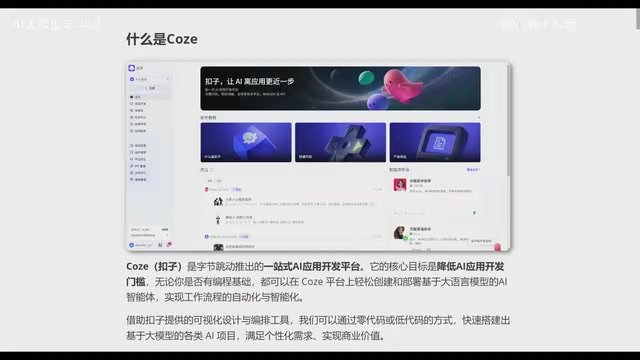
Three Core Advantages of Coze
Extremely Low Development Barrier
This is Coze's most defining characteristic. The combination of visual drag-and-drop and natural language development means users with no programming background can quickly build AI applications. "Natural language development" means that when code is truly needed, you simply describe what you want in everyday language and the platform generates the code automatically. This not only lowers the entry barrier but also dramatically improves overall development efficiency. Firms like Gartner predict this democratization of development will become one of the mainstream directions in software development.
Rich Ecosystem and Integration Capabilities
Coze includes a robust plugin system that makes it easy to connect with external APIs. Whether it's Feishu's collaboration features or Amap's location services, they can all be seamlessly integrated into your AI Agent. The platform also supports multiple mainstream large language models and provides a knowledge base feature, allowing agents to give accurate answers based on private data.
The knowledge base feature technically corresponds to RAG (Retrieval-Augmented Generation). LLMs have a training data cutoff date and cannot directly "remember" a user's private materials (such as internal company documents or product manuals). RAG solves this by splitting private documents into chunks and storing them as vectors. When a user asks a question, the system retrieves the most relevant text segments from the knowledge base and injects them into the prompt, guiding the model to answer based on real source material — effectively suppressing hallucinations. Coze wraps this technology into a visual knowledge base, so users can enjoy private-data Q&A without needing to set up their own vector databases (like Pinecone or Weaviate).
Enterprise-Grade Collaboration Support
Coze supports team collaboration, permission management, and version control, and provides end-to-end services covering development, testing, deployment, and monitoring — making it suitable for enterprise-scale adoption. That said, it's worth noting objectively that large AI projects often involve complex customization requirements, and Coze still has limitations in heavy enterprise scenarios. Its core strength remains rapid development and delivery of small-to-medium AI projects.
Domestic vs. International Version
Coze comes in two separate versions, and many users are only aware of the domestic version while overlooking the international one. The key differences lie in interface language and available models.
| Dimension | Domestic Version (coze.cn) | International Version (coze.com) |
|---|---|---|
| Interface Language | Chinese | English |
| Available Models | Doubao, DeepSeek, Kimi, StepFun, etc. | GPT series, Gemini, DeepSeek, etc. |
| Access | Direct access | Requires VPN |
In terms of capability, a straightforward conclusion is: the international version is generally more powerful than the domestic version, primarily due to model differences. To understand this, it helps to know the current landscape of mainstream LLMs: GPT-4o is OpenAI's flagship multimodal model released in 2024, consistently ranking at the top of comprehensive benchmarks for reasoning, coding, and English writing; Gemini is Google's LLM series, excelling in multimodal processing and long context windows; DeepSeek, developed by the Chinese startup DeepSeek, is known for its highly competitive price-to-performance ratio — its R1 reasoning model attracted global attention in early 2025, matching or even surpassing some top closed-source models on math and coding tasks; Kimi (Moonshot AI) and StepFun, available in the domestic version, are also strong representatives of Chinese-made models. Overall, DeepSeek performs impressively, though it still lags behind GPT-4o in some scenarios. For users in China, however, the domestic version eliminates the network barrier and offers a more user-friendly Chinese interface, making it the better choice for beginners.
Agents and Apps: Two Product Formats
Coze supports creating two types of products, and understanding the difference between them is key to using the platform effectively.
Agent (Bot)
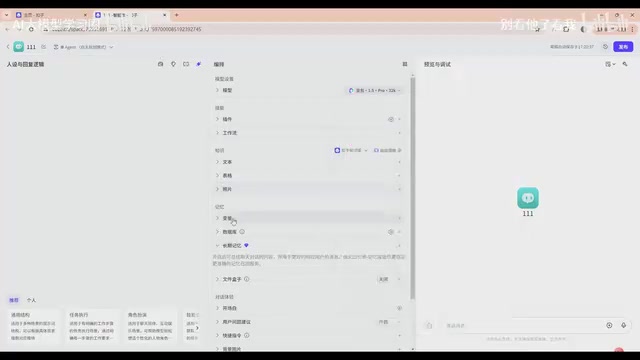
An agent is a conversation-based AI project — essentially a chat interface. It receives user input through dialogue, and the LLM automatically invokes plugins or workflows to execute the corresponding business logic, then outputs a final response. This one-question-one-answer interaction format is well-suited for handling all kinds of lightweight tasks.
From a technical perspective, AI Agents represent one of the most cutting-edge paradigms in LLM applications today. Unlike traditional single-call interactions of "input question → output answer," agents have the ability to plan autonomously, call tools, and perform multi-step reasoning. The core architecture typically consists of four modules: a perception layer (receiving user input), a planning layer (the LLM deciding execution steps), a tool layer (calling external APIs, databases, or plugins), and a memory layer (maintaining context and history). OpenAI's Function Calling mechanism is currently the mainstream technical implementation for agent tool use, and Coze's plugin system is essentially a visual abstraction of this mechanism — allowing users to equip their agents with the ability to call external services without needing to understand the underlying protocols.
Importantly, within the Coze platform, AI agents are called Bots. A Bot is an AI Agent — it's simply the platform's internal terminology. These Bots can perform a wide range of tasks including automated services and intelligent Q&A.

Application (App)
An application is a complete application program built using LLM technology, with both a frontend interface and backend logic. Unlike conversational agents, applications have a visual user interface with clearly defined inputs and outputs, capable of completing a series of tasks according to established business logic.
For example, a translation tool is a classic application format — the user enters text, clicks translate, and the backend calls an LLM to return the result, with no dialogue interaction required. Coze's app creation feature is currently in Beta, but the actual experience is already quite polished.
How to Choose the Right Format
- For building small productivity tools, an agent (Bot) will typically meet your needs;
- If you need a clear input/output interface and want to invoke an LLM in the background to complete a full business workflow, choose the application format.
Summary
At its core, Coze is a visual development platform provided by ByteDance that makes cutting-edge AI capabilities accessible and practical for everyone. It integrates a vast array of plugins and multiple mainstream large language models, making AI application development no longer the exclusive domain of programmers.
Whether you want to explore the boundaries of AI or genuinely use AI to eliminate repetitive work, Coze offers a sufficiently low-barrier starting point. For everyday professionals, mastering Coze means being able to rapidly automate daily workflows — which may be precisely why it is regarded as "a platform that every industry will eventually use."
Key Takeaways
Related articles

Claude Paid Subscription Down for Over a Week with No Response: The Pain Points of AI Service Support
Claude AI paid subscription down for over a week with no support response, exposing systemic gaps in AI service customer support. Analysis of impact, industry shortcomings, and user strategies.

Older Google Home Gets Gemini Live Upgrade: Conditions and Experience Fully Explained
Google is rolling out Gemini Live conversational AI to older Google Home speakers, but subscription or plan requirements may apply. Here's what you need to know.

Older Google Home Gets Gemini Live Upgrade: Complete Breakdown of Requirements and Experience
Google is rolling out Gemini Live conversational AI to older Google Home speakers, but subscription or plan restrictions may apply. Full breakdown of the upgrade details and impact.