Cozy AI Kitchen Wraps Up: Microsoft's Heartfelt AI Education Experiment and What It Teaches Us About Content Creation

Microsoft's Cozy AI Kitchen finale reflects on using warmth and practicality to make AI approachable.
Microsoft's AI education show Cozy AI Kitchen has aired its final episode. This article reflects on how the show used a 'cozy' aesthetic, everyday practical props like cereal boxes, and a human-centered perspective to help ordinary people understand AI — offering meaningful lessons for science communication in the age of artificial intelligence.
When AI Meets "Cozy" Content
In an era where AI content is dominated by grand narratives of "efficiency," "disruption," and "the future," Microsoft's AI education show Cozy AI Kitchen took a deliberate detour — wrapping cold technology in a layer of warmth. The show recently announced its finale ("Hanging up the Aprons"), with the creative team using the final episode to reflect on the show's original vision and the journey that followed.
Even the show's name reflects this philosophy. The creators admitted they deliberated at length before collectively landing on the word "Cozy." "Because at the time, AI wasn't 'cozy' for anyone," one creator recalled. That contrast between technology and emotion became the show's central tension — using a relaxed, welcoming atmosphere to dissolve the public's sense of alienation and anxiety around artificial intelligence.
This creative direction has deep roots in social psychology. AI Anxiety has become a recurring concept in psychology and sociology research in recent years. Stanford's AI Index reports show the public's emotional relationship with AI is sharply polarized: optimism about its potential on one side, and growing fear of job loss, privacy erosion, and loss of control on the other. The rise of "cozy content" as a format is, at its core, a corrective in communication strategy — one that borrows from the psychological mechanisms of "Cozy Games" (like Stardew Valley) and ASMR content, reducing cognitive load and fostering a sense of safety so audiences can absorb complex information in a relaxed state. Neuroscience research shows that when people are in a calm, pleasant emotional state, the prefrontal cortex integrates information more effectively and learning efficiency improves — a scientific foundation that Cozy AI Kitchen's content strategy happened to align with perfectly.
Explaining AI with Cereal Boxes: A Pragmatist's Creative Philosophy
What stands out most about the show is how its creators chose to make it. Early on, the team planned to rely heavily on green screen effects to visualize AI concepts, chasing visual spectacle. But they quickly realized: "We were making this way more complicated than it needed to be."
So they pivoted to Practical Effects — using everyday objects like cereal boxes as visual metaphors. In film and TV production, "Practical Effects" refers to visual techniques achieved on set through physical props, mechanical rigs, or chemical means, without relying on post-production digital processing — the opposite of CGI. This approach dominated Hollywood for decades; the early Star Wars films leaned on it heavily, giving those movies a distinctive tactile weight. As CGI became ubiquitous in the digital age, visual effects grew increasingly homogeneous, and the handcrafted feel of practical effects made a comeback — evident in recent films like Mad Max: Fury Road and Oppenheimer.
In science communication, practical effects have an even clearer advantage: they are inherently perceivable. Audiences intuitively understand the physical properties of real objects without needing to decode abstract representations. Using a cereal box to analogize an AI concept draws on the principle of Embodied Cognition from cognitive science — the idea that humans understand abstract concepts by mapping them onto concrete physical experiences. This shift made the content far more accessible, and came with an unexpected bonus: "It's also very good for cost control."
This choice to move from high-tech effects back to a handmade aesthetic perfectly mirrored the show's core intent. When trying to help ordinary people understand AI, flashy technical demonstrations can actually widen the psychological distance. Familiar everyday scenes and handcrafted props, it turns out, are the real bridges.

"Old Fashioned Code": The Wit Behind Episode One
According to the creators, the first episode was titled Old Fashioned Code — a deliberate double meaning. It refers both to traditional programming approaches and to the classic cocktail (an Old Fashioned), a vintage concoction with a retro charm.
Even within the practical effects framework, the team preserved a few digital effects at key moments to illustrate abstract concepts like "Semantic Code." One creator fondly recalled a surprise shot in the opening: "When we opened it, there was an 'oh—' kind of moment." The team considers this one of the show's most memorable scenes.
"Semantic Code" is a core concept in modern AI systems, especially within the technical stack of large language models (LLMs). Unlike traditional "Syntactic Code" — program instructions that follow rigid rules and execute line by line — Semantic Code operates at the layer of meaning: it describes what to do rather than how to do it, relying on a model's understanding of context, intent, and semantic relationships to generate or execute actions. This concept is essential for understanding AI coding tools like GitHub Copilot and ChatGPT Code Interpreter, which fundamentally perform semantic-level code reasoning rather than traditional symbol matching. By using a well-placed visual effect rather than lengthy explanation to convey this idea, Cozy AI Kitchen embodied the classic principle of science storytelling: Show, don't tell.
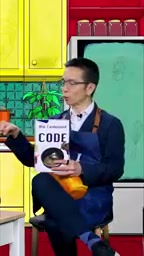
From a narrative structure standpoint, the combination of "mostly practical effects + strategic digital moments" is remarkably smart: it keeps production costs in check while delivering memorable beats at just the right moments, making abstract AI concepts both tangible and memorable.
The People Behind the Camera: Human Creativity in a Tech-Driven Age
In the finale retrospective, the creators heaped praise on their editing team: "Our editors are second to none." They even described the team's overall output as "Pixar level."
One remark from the creators is worth sitting with: "I'm in awe of that creativity, and that drive to just want to try hard as a human being." This captures Cozy AI Kitchen's unique position in the AI wave — in an era when everyone is talking about AI replacing humans, this show consistently placed people at the center of creation. Technology is just an ingredient. Human creativity, passion, and collaboration are the soul of the dish.
The show was never an isolated effort — it fits into Microsoft's broader content strategy. Since 2023, when Microsoft poured billions more into OpenAI and deeply integrated GPT-4 into Bing and Office 365 (Microsoft 365 Copilot), a central challenge has been lowering the adoption barrier for enterprise users and everyday consumers alike. The Technology Adoption Lifecycle theory identifies the key obstacle to crossing from "early adopters" to the "early majority" as not technical capability, but psychological perception and trust-building. Cozy AI Kitchen, as a "cozy" educational entry point, meaningfully echoes Microsoft's commercial goal of driving AI Copilot adoption in enterprise markets — by reducing psychological resistance among general consumers, it indirectly creates a more receptive environment for business decision-makers.

A Show's Finale, and the Continuation of an Idea
The conclusion of Cozy AI Kitchen marks the end of one chapter in a content experiment. It never chased viral traffic or indulged in technical showmanship. Instead, it steadily explored a central question: How can ordinary people genuinely understand and embrace AI — in a relaxed, comfortable setting?
The lessons this show leaves behind may be more valuable than the content itself:
- Technology communication doesn't have to be cold and serious — a "cozy" approach can carry substantive, complex knowledge;
- A pragmatist's creative philosophy (like using practical effects) can control costs while dramatically improving approachability;
- In an age of AI moving at breakneck speed, emphasizing human creativity and warmth is more important than ever;
- Embodied cognition and emotional safety are the key levers for bridging the "last mile" in science communication.
As the creators hang up their aprons, this warm experiment in AI education has come to a close — but the ethos of "making technology cozy" it championed will continue to influence content creators far beyond its runtime. In a landscape where so much AI content is caught in a cycle of anxiety and hype, this measured, human-centered approach is, if anything, more valuable now than ever.
Related articles

AI Art Prompt Structure Breakdown: Creating a Desert Crystal Pyramid Scene
Breaking down a popular Reddit AI artwork to reveal the five core elements of structured prompts: subject, material, lighting, environment, and atmosphere for AI art scene creation.

$100 Million Deal: AI Gives 50,000 Ukrainian Kamikaze Drones Autonomous Target Lock
A U.S. company struck a $100M deal with Ukraine to deploy AI visual lock-on capabilities on 50,000 cheap kamikaze drones, enabling terminal autonomous guidance to defeat electronic warfare jamming.

The Privacy Boundaries of AI Data Collection: Your Bedroom Is Becoming a Model Training Ground
A humorous tweet about clothes entering AI training data reveals the privacy dilemma of AI data collection. We explore machine unlearning challenges, consent issues, and how users can balance convenience with privacy.