Critical Security Flaw in Linux 6.9: LUKS Suspend No Longer Clears Encryption Keys

Linux 6.9 broke LUKS suspend's key-clearing behavior, silently defeating cold boot attack protections.
Since Linux kernel 6.9, the LUKS suspend feature no longer clears disk encryption keys from memory as intended, silently disabling protection against cold boot attacks. This regression likely stems from a dm-crypt refactor and affects users who rely on luksSuspend for full disk encryption security. Until a fix is released, high-risk users should prefer full shutdown over suspend.
A Security Threat Lurking in the Shadows
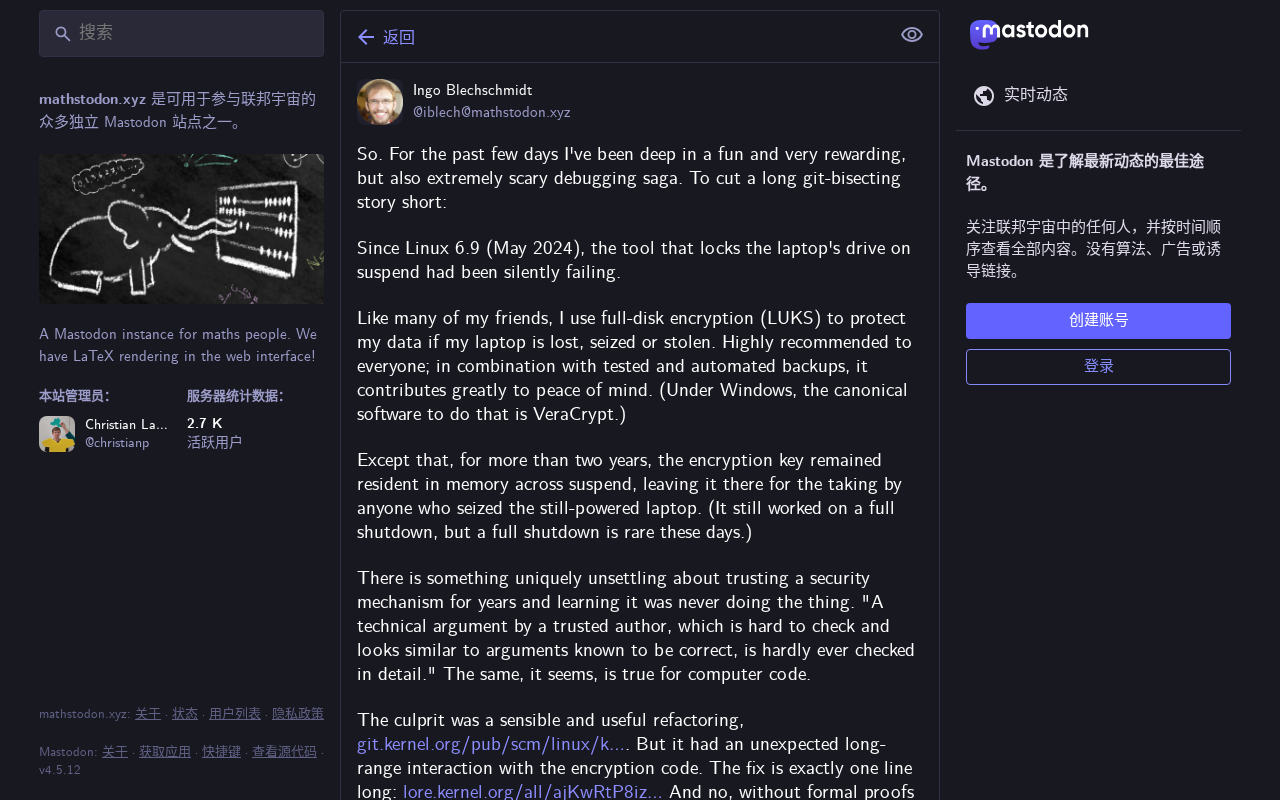
The security community has recently flagged a serious concern: since Linux kernel version 6.9, the LUKS (Linux Unified Key Setup) suspend function has stopped clearing disk encryption keys from memory. This change sparked heated discussion on Hacker News, with the related post earning 436 points and nearly 200 comments — a clear sign of the community's alarm over this potential vulnerability.
For users who rely on Full Disk Encryption (FDE) to protect sensitive data, this is not a problem to be taken lightly. By design, the cryptsetup luksSuspend command should completely wipe encryption keys from memory when the system enters a suspended or locked state, guarding against physical threats like cold boot attacks. The silent failure of this protection means keys may still reside in RAM, vulnerable to extraction at any time.
How LUKS Suspend Works
The Technical Foundation of LUKS
LUKS (Linux Unified Key Setup) is a disk encryption specification proposed by Clemens Fruhwirth in 2004. It has since become the de facto standard encryption solution on Linux, adopted as the default by major distributions including Ubuntu, Fedora, and Debian. Built on the dm-crypt kernel module, it uses a layered key architecture: actual data is encrypted with a Master Key, which is itself protected by the user's passphrase via key derivation functions like PBKDF2 or Argon2. This design allows users to change their passphrase without re-encrypting the entire disk, balancing security with usability. LUKS2 (the second-generation spec) further introduces integrity protection and more flexible key slot management.
The Design Intent
The core value of the suspend feature is this: when a user steps away from their device or the system enters sleep, the decryption keys are actively cleared from RAM, ensuring that even if the device is physically seized, an attacker cannot extract keys directly from a memory dump.
This design specifically addresses the Cold Boot Attack — a technique first publicly demonstrated by Princeton University researchers in 2008. It exploits a physical property of DRAM: data does not disappear immediately after power loss, but degrades exponentially. At room temperature, residual data can persist for seconds to minutes; freeze the memory module to -50°C, and that window can extend to hours. An attacker can quickly reboot into a controlled system, directly read the memory module, or use specialized hardware to dump memory before data degrades — and from that dump, extract the encryption keys. Once keys are fully cleared, a complete memory dump yields nothing useful.
What Went Wrong
According to reports, changes introduced in Linux 6.9 caused luksSuspend to no longer actually clear keys from memory during execution. This change likely stemmed from a refactoring of the dm-crypt subsystem or memory management layer — a performance improvement or bug fix that inadvertently altered the key-clearing semantics. This is precisely the kind of regression that's difficult to avoid entirely in large-scale kernel evolution.
The result: the system appears to enter a protected suspended state, while the underlying encryption keys remain fully intact in memory. Users are left with a false sense of security, believing their data is protected when the defense has already quietly collapsed.
This is what makes such issues so insidious: the command returns normally, no errors are reported, the UI shows nothing unusual — the only difference lies in the actual state of memory, which is invisible to ordinary users.
Scope and Risk Assessment
Who Is Affected
The primary affected group is users running Linux kernel 6.9 or later who actively rely on LUKS suspend for security protection. This typically includes:
- Journalists, activists, and others handling highly sensitive data
- Organizations and enterprises dealing with confidential information
- Security-conscious technical users
Ironically, it's precisely those who proactively use luksSuspend — an advanced security feature — who are most likely to be impacted. A deliberate security measure has been silently rendered ineffective by an underlying implementation flaw.
Real-World Attack Threshold
Objectively, exploiting this vulnerability requires a non-trivial set of conditions. A cold boot attack demands physical access to the target device, along with the technical expertise and specialized hardware to rapidly dump memory. For most ordinary users, the actual probability of such an attack is relatively low.
However, the core principle of security is Defense in Depth — a concept borrowed from military strategy and introduced to information security by the NSA. The idea is to build layered, independent security controls so that the failure of any single layer doesn't cause the entire defense to collapse. In the context of disk encryption, LUKS suspend was meant to be one critical layer in this multi-layered defense, working alongside BIOS/UEFI passwords, physical device security, Secure Boot, and other mechanisms. When a security feature claims to offer a specific protection but fails to deliver, it damages not just a concrete technical defense — it erodes user trust in the entire system's security. That is the deeper reason this issue has resonated so strongly in the community.
A Deeper Look: Silent Failure of Security Features
Regression Testing Is Non-Negotiable
This incident once again highlights the critical importance of rigorous regression testing for security-related features. While the Linux kernel has testing frameworks like kselftest and LTP (Linux Test Project), security properties like "are keys truly cleared from memory?" are notoriously difficult to verify through conventional functional testing — because from the user's perspective, the feature appears to work normally. Test coverage for memory residue state is quite limited, representing a structural gap in the kernel's security testing infrastructure, and a key reason this regression was able to go undetected for so long.
For foundational software like the Linux kernel, any code change touching security semantics demands extreme caution. A seemingly harmless refactor can silently break carefully designed security guarantees.
Recommendations for Affected Users
Until an official fix is released, affected users can consider the following mitigations:
- Stop relying on luksSuspend: For high-security scenarios, prefer a full shutdown over suspend
- Monitor kernel updates: Track relevant security patches and keep your kernel up to date
- Reassess your threat model: Evaluate whether you are realistically within the threat range of cold boot attacks
- Strengthen other layers: Consider enabling memory encryption technologies like AMD SME/SEV as supplementary protection
Conclusion
This issue lays bare a harsh reality of software security: the most dangerous failures are often not obvious vulnerabilities, but security mechanisms that fail silently — leaving users convinced they are still protected. The LUKS suspend regression in Linux 6.9, while requiring a high bar to actually exploit, represents a betrayal of a security promise that the entire open source community should take seriously.
With continued community attention and discussion, kernel developers will hopefully deliver a fix soon. For every user who cares about data security, this is also an important reminder: security features cannot be trusted simply because they "look like they're working." Truly understanding the underlying behavior — from the physical properties of DRAM to kernel key management mechanisms — is itself a critical part of staying secure.
Key Takeaways
Related articles

The Truth Behind Codex 'Build a Website in 5 Minutes': AI Isn't Creating Sites—It's Helping You Copy Them
Exposing the truth behind viral Codex 5-minute website videos: creators aren't building original sites with AI—they're copying shared prompts or scraping others' work. Learn AI coding tools' real limits.

Getting Started with AI Agent Development: A Complete Guide from Concept to Practice
A comprehensive guide to AI Agent architecture and development, covering automated marketing, intelligent customer service, and investment analysis scenarios with single and multi-agent collaboration.

The Truth Behind Codex 'Build a Website in 5 Minutes': AI Isn't Creating Sites — It's Helping You Copy Them
Exposing the truth behind viral Codex 5-minute website videos: creators aren't building original sites with AI — they're copying shared prompts or scraping others' work.