Cube Studio: A Deep Dive into Tencent's Open-Source Cloud-Native AI Platform

Cube Studio is Tencent Music's open-source, cloud-native, one-stop AI platform covering the full MLOps lifecycle.
Cube Studio is a Kubernetes-based, one-stop AI platform open-sourced by Tencent Music, covering the full MLOps lifecycle from data labeling and model training to inference deployment. It supports major distributed training frameworks and large model training paradigms (SFT, RLHF), integrates inference engines like vLLM, and offers VGPU virtualization, domestic hardware support (Huawei Ascend), and edge computing — making it ideal for enterprise AI teams and domestic hardware substitution scenarios.
Overview
As AI engineering moves into mainstream adoption, efficiently managing the full pipeline — from data labeling and model training to inference deployment — remains a core challenge for enterprises. Cube Studio, open-sourced by Tencent Music, was built precisely to address this pain point. It is a one-stop machine learning / deep learning / large model AI platform built on a cloud-native architecture, covering the entire MLOps lifecycle. The project has already earned nearly 5,000 stars on GitHub.
This article provides a comprehensive breakdown of Cube Studio across its architectural design, core features, technical highlights, and applicable use cases.
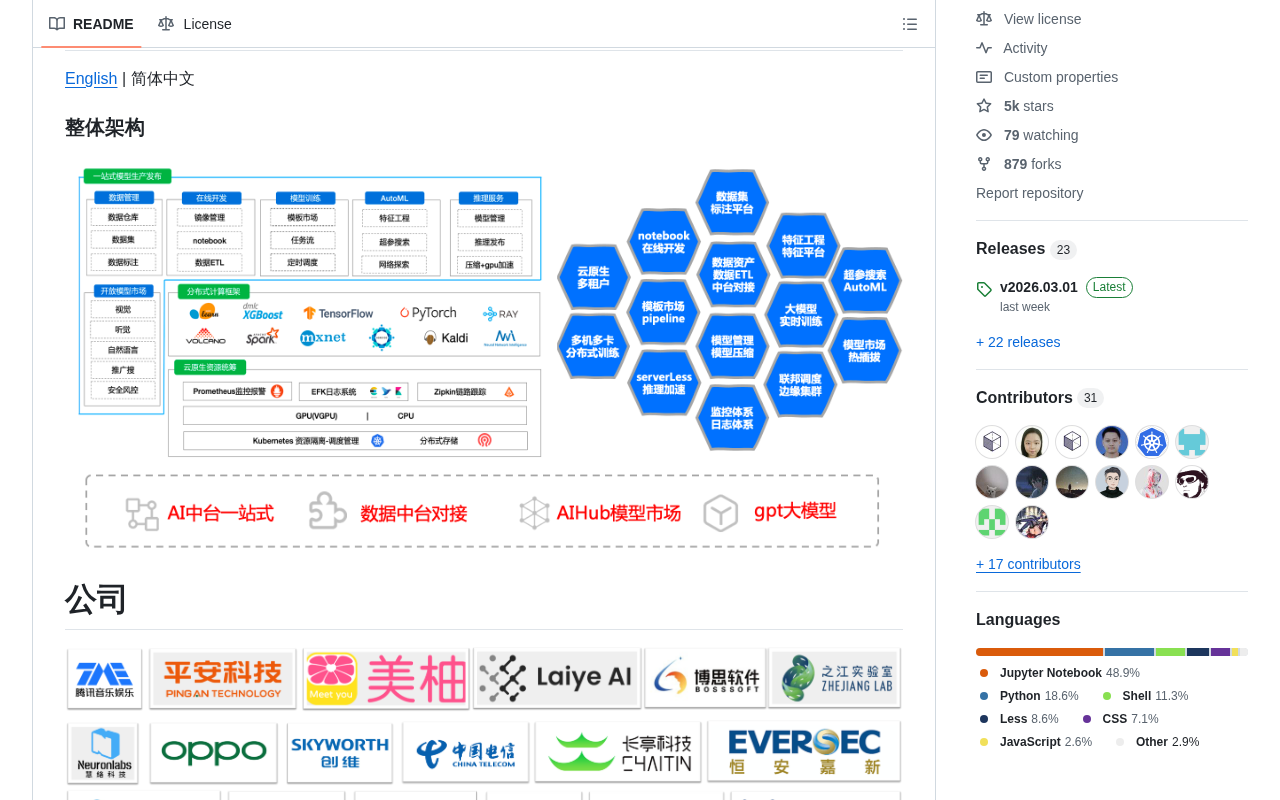
Cube Studio: A Full-Spectrum Feature Overview
End-to-End MLOps Coverage
Cube Studio's defining characteristic is its complete coverage of the AI development lifecycle. From upstream data labeling, to mid-stream model development and training, to downstream inference service deployment, the platform delivers a fully integrated solution:
- Data Labeling Platform: Built-in automated labeling capabilities that significantly reduce manual annotation costs
- Online Notebook Development: Write and debug code directly in the browser — no local environment setup required
- Pipeline Orchestration: A drag-and-drop workflow builder that lowers the barrier to constructing complex task pipelines
- Model Training: Supports multi-node, multi-GPU distributed training and hyperparameter search
- Inference Services: Supports VGPU virtualization and edge computing deployment
- AI Model Marketplace: Facilitates model sharing and reuse across teams
This end-to-end design philosophy allows teams to complete everything from experimentation to production within a single platform, eliminating the efficiency losses that come with switching between multiple toolchains.
Large Model Training and Inference Capabilities
In the era of large language models, Cube Studio demonstrates strong adaptability. The platform supports the most widely used large model training paradigms:
- SFT Fine-Tuning: Supports supervised fine-tuning of leading models such as DeepSeek
- Reward Model Training: Provides training support for reward models as part of the RLHF pipeline
- Reinforcement Learning Training: Full support for Reinforcement Learning from Human Feedback (RLHF) training workflows
On the inference side, the platform integrates vLLM, Ollama, and MindIE — all mainstream inference engines — and supports multi-node distributed inference for large models. It also provides a private knowledge base capability, making it easy for enterprises to build RAG (Retrieval-Augmented Generation) applications.
Comprehensive Distributed Training Framework Support
Cube Studio's support for distributed training frameworks is remarkably thorough, covering virtually every major solution in the industry:
- Deep Learning Frameworks: PyTorch, TensorFlow, MXNet, PaddlePaddle
- Distributed Training Libraries: DeepSpeed, ColossalAI, Horovod
- Compute Scheduling Frameworks: Ray, Volcano
This broad compatibility means teams with different technology stacks can integrate seamlessly into the platform without having to change their existing technical choices to accommodate it.
Technical Highlights
Cloud-Native Architecture Built on Kubernetes
Cube Studio is built on Kubernetes, inheriting its native capabilities for elastic scaling, resource isolation, and high availability. The platform also offers compute leasing functionality, enabling enterprises to flexibly manage and allocate heterogeneous compute resources such as GPUs and NPUs — supporting fine-grained resource operations.
Domestic Hardware Ecosystem Support
Notably, Cube Studio explicitly supports domestic Chinese CPUs, GPUs, and NPUs — with particular emphasis on the Huawei Ascend ecosystem. Given the current push for domestic technology substitution in China, this is a critical feature for local enterprises, especially government and state-owned clients. The platform also supports RDMA high-speed networking, ensuring excellent distributed training performance even on domestic hardware.
VGPU Virtualization and Edge Computing
Through VGPU virtualization technology, Cube Studio can partition a single physical GPU into multiple virtual GPUs, improving GPU utilization and reducing the cost of deploying inference services. At the same time, the platform's edge computing support enables model deployment to edge devices, addressing use cases that require low latency or offline inference.
Use Case Analysis
Cube Studio is well-suited for the following types of users and scenarios:
- Mid-to-Large Enterprise AI Teams: Organizations that need unified management of the full pipeline from data to model, improving team collaboration efficiency
- Compute Resource Operators: Leveraging the platform's compute leasing and VGPU virtualization capabilities to build GPU compute sharing platforms
- Large Model Application Teams: Teams that need to fine-tune open-source large models, deploy them, and build private knowledge bases
- Domestic Hardware Substitution Scenarios: Building AI training and inference platforms on domestic hardware such as Huawei Ascend
Community and Ecosystem
As an open-source project from Tencent Music, Cube Studio is developed in Python and currently has nearly 5,000 stars and 877 forks, reflecting a reasonably active community. The project's continuous updates also demonstrate that it is keeping pace with the rapid evolution of the large model era — for example, quickly adding support for new capabilities like DeepSeek fine-tuning and vLLM inference.
Conclusion
Cube Studio represents an important direction for enterprise-grade AI platforms in China: full-lifecycle coverage, cloud-native architecture, and domestic hardware compatibility. It is not merely a training platform or an inference platform — it aims to build a unified infrastructure that spans the entire AI development lifecycle. For teams looking for an open-source MLOps solution, Cube Studio is undoubtedly a strong candidate worth evaluating in depth.
That said, all-in-one platforms typically come with higher deployment and operational complexity. Teams are advised to carefully assess their own technical capabilities and actual requirements, and to conduct thorough POC validation before committing to adoption.
Related articles
 Product Reviews
The Programmer's Desk Setup Guide: Building a Workspace That Feels Like Home
Discover how programmers build productive, comfortable workspaces. From multi-monitor setups to ergonomic design, explore the desk philosophy that drives focus and flow.
 Product Reviews
Qoder vs Cursor Real-World Comparison: Which $20/Month AI IDE Is Better?
Hands-on comparison of Qoder vs Cursor AI IDEs: Agent autonomy, human interaction count, and architecture decisions. Qoder needed only 2 interactions vs Cursor's 8.
 Product Reviews
Cursor Cloud Agent Demo: Eliminating Bottlenecks Across the Entire Software Development Lifecycle
Deep analysis of Cursor's Cloud Agent demo showing how cloud VMs, automated test artifacts, and a full-chain control plane systematically eliminate human bottlenecks across the software development lifecycle.