Deep Dive into Agent Skills Architecture: How to Extend AI Agent Capabilities

A deep dive into how Agent Skills use plug-and-play packages to extend AI agent capabilities.
Agent Skills are a lightweight open-source format that extends AI agents via plug-and-play skill packages defined in SKILL.md files. This article explains the architecture, the progressive disclosure mechanism for saving context resources, and the key differences between Skills Agent and Multi-Agent designs.
What Are Agent Skills
As large model technology continues to evolve, Agent Skills are becoming a game-changing core technology. The central problem they solve is: how can a single-responsibility Agent break through its capability boundaries and gain nearly "unlimited" extensibility?
To understand where Agent Skills fit, it's worth reviewing the evolution of Agent technology. The rise of the Agent concept is closely tied to the maturation of large language models' reasoning and tool-calling capabilities. Early AI applications were mostly single-turn Q&A systems, whereas Agents use a "perceive—plan—execute—reflect" loop that allows models to autonomously break down tasks, call external tools, and iterate based on execution results. Since 2023, with the emergence of frameworks like ReAct, AutoGPT, and LangChain, Agents have moved from concept to engineering practice. However, single Agents quickly hit a capability ceiling: their knowledge is baked into system prompts or a limited set of tools, making them unable to flexibly handle the ever-changing landscape of specialized tasks. It's against this backdrop that Agent Skills emerged as a standardized, pluggable capability-extension solution—becoming another important capability-expansion paradigm following Function Calling.
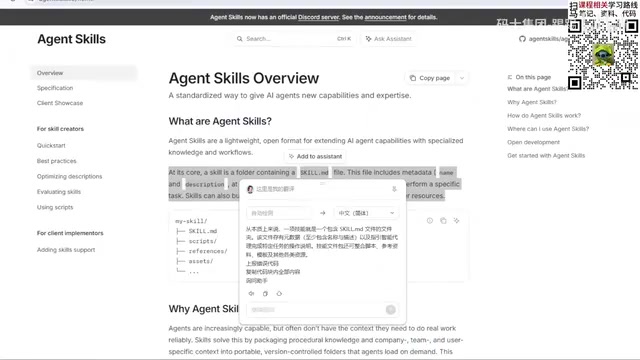
According to the official definition, Agent Skills are a lightweight open-source format that extends an AI agent's functionality with specialized knowledge and workflows. In plainer terms, a skill is essentially a folder containing a SKILL.md file, which stores metadata, strategy instructions guiding the agent to complete specific tasks, along with various resources such as scripts, reference materials, and templates.
The SKILL.md file uses Markdown as the core carrier for skill definitions, and this design choice is quite deliberate. Markdown is both a human-readable plain text format and naturally understood by large models, requiring no additional parser or complex Schema. A SKILL.md file typically contains a YAML-format metadata header (name, description, etc.) along with natural-language instructions in the body. This "human-writable, AI-readable, version-controllable" quality means that skill packages can be shared, forked, and iterated on GitHub just like open-source code. Another layer of value in the open format is avoiding vendor lock-in—skill packages aren't tied to a specific model or platform, and can theoretically be loaded into any Agent runtime that supports the format, laying the foundation for building a cross-platform skill ecosystem.
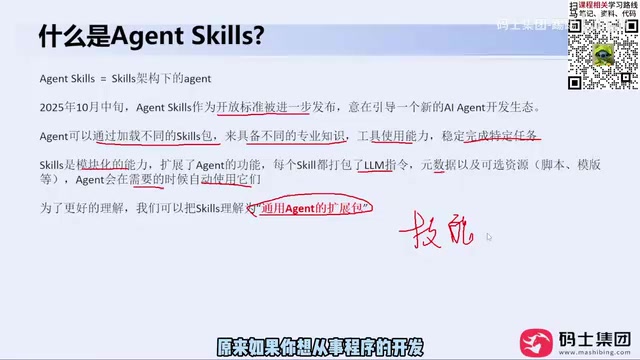
Here's a simple formula: Agent Skills = an Agent built on a Skills architecture. When developing Agent and intelligent agent projects, you can choose different architectural designs—single-agent architecture, multi-agent architecture, or an agent-plus-Skills architecture. When an Agent needs a certain specialized capability, it can achieve it by loading different skill packages.
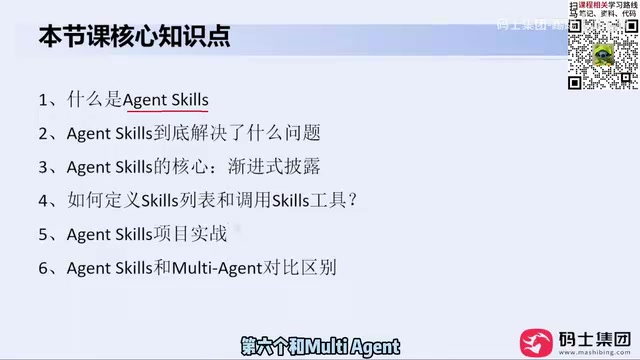
Interestingly, after Agent Skills were officially released as an open standard, they have further steered a brand-new Agent development ecosystem. Each Skill packages instructions, metadata, and optional resources, and the Agent automatically invokes them when needed.
What Problem Do Agent Skills Actually Solve
To understand the value of Skills, let's use a real-life analogy.
An Analogy About a "Secretary"
Suppose you're the boss of a company with a very capable secretary. This secretary has solid general knowledge, but reveals shortcomings when handling specialized tasks:
- Ask them to write legal documents, and they may not understand law
- Ask them to make a poster, and they may not know how to use Photoshop
- Ask them to book flights, and they may be unfamiliar with the operating system
Faced with these shortcomings, you traditionally have two solutions:
Option 1: Train the existing secretary. Spend several months sending them to professional institutions to learn—say, law school or Photoshop courses. This approach consumes a great deal of time and energy.
Option 2: Recruit specialized talent. Hire a dedicated lawyer when you need legal documents written. This approach incurs additional labor costs.
The "Third Way" Offered by Skills
Agent Skills offer a revolutionary "third way": neither training people nor hiring specialists, but packaging various specialized capabilities into plug-and-play plugins.
- When you need to fight a lawsuit, load a "legal expert" skill package
- When you need to make a poster, mount a "Photoshop design" skill package
- When you need to arrange business travel, mount a "ticket booking" skill package
After completing a task, you can also promptly uninstall these skills to free up the corresponding resources. This is the core design essence of the modularity, low cost, and high flexibility that Agent Skills bring.
Understanding the Value of Skills Through a Programmer's Growth
Comparing Skills to a programmer's career growth makes their disruptive nature easier to grasp.
In the past, to become a programmer capable of independently developing projects, you had to follow a long learning path:
- Start with the most basic programming syntax
- Learn databases
- Learn development frameworks
- Finally, be able to carry out complete project development
Under the Skills architecture, this process is radically simplified. The Agent doesn't need to "learn from scratch"—as long as ready-made skill packages exist on the market, or you can customize a Skill, the Agent can immediately acquire the corresponding capability.
This "load whatever you need, uninstall when done" model essentially makes extending an AI agent's capabilities as flexible as building with LEGO blocks.
What Is Progressive Disclosure
Progressive Disclosure is a key design concept in the Agent Skills architecture.
Its core idea is: an Agent doesn't need to load all the details of every skill at startup, but instead loads information in layers on demand. It first loads a skill's metadata (name, description), and only when it determines that a skill is relevant to the current task does it further load the complete instructions and resources.
Progressive disclosure matters because a large model's context window is a limited and expensive resource. The context window refers to the total number of tokens a model can process at once, and even advanced models supporting hundreds of thousands or even millions of tokens see their inference costs grow linearly—or even super-linearly—with context length. If you inject the full descriptions of all potentially useful skills into the context at once, you not only crowd out valuable window space but also risk interfering with the model's judgment due to too much irrelevant information—a phenomenon known in the industry as "context pollution" or "lost in the middle." Through layered loading, progressive disclosure first lets the model see a lightweight metadata index, then pulls detailed content on demand. It is essentially an optimization strategy for token economics, sharing a similar approach with Retrieval-Augmented Generation (RAG).
The benefits of this design are obvious:
- Saves context resources: Avoids cramming massive amounts of skill information into the context window all at once
- Improves invocation efficiency: The Agent can more precisely determine when to invoke which skill
- Reduces cost: Consumes computing resources only when necessary
Progressive disclosure complements the modular design of Skills, together forming an efficient and scalable Agent capability system.
Architectural Differences Between Multi-Agent and Skills Agent
In Agent development, the multi-agent architecture and the Skills Agent architecture represent two different approaches, and understanding the difference is crucial.
Multi-Agent Architecture
The Multi-Agent architecture is akin to the "hire another secretary" approach—completing complex tasks through the collaboration of multiple independent Agents. Each Agent has its own responsibilities, and they coordinate their work through communication. The cost of this architecture is the need to maintain multiple Agent instances and manage the collaborative relationships between them, which is relatively high.
Skills Agent Architecture
The Skills Agent architecture, on the other hand, follows the "give one secretary a skill package to mount" approach. It keeps the main body of a single Agent unchanged and extends capabilities by dynamically loading and unloading skills. This approach is more lightweight and hassle-free, avoiding the complexity of multi-agent coordination.
In short:
- Multi-Agent: Horizontal scaling, collaboration among multiple specialists
- Skills Agent: Vertical enhancement, a single generalist equipping skills on demand
It's worth adding that these two architectures are not mutually exclusive. In complex production systems, a hybrid model is often adopted: multiple dedicated Agents divide the work and collaborate, while each Agent itself is equipped with several Skills to enhance its specialized capabilities. Which architecture to choose depends on the task's complexity, concurrency requirements, and the trade-off between cost and maintainability.
Conclusion: Why Skills Are a Game-Changing Design
The reason Agent Skills are considered a game-changing technology fundamentally lies in the way they redefine how AI agents extend their capabilities. They liberate "specialized capability" from human training and cost investment, turning it into reusable, composable, plug-and-play modules.
Whether you work in product, technology, or operations, understanding large models and Agent Skills has become an unavoidable trend. As this session emphasized: understanding large models is not scaremongering, but an objective reality faced by today's IT professionals.
Mastering the principles and hands-on practice of the Skills architecture can help you avoid detours amid the wave of AI Agent development and build more flexible, more powerful intelligent systems.
Key Takeaways
Related articles

Transformer²: Achieving Co-Design of Robot Morphology and Control with a Unified Architecture
Deep dive into how Transformer² uses a unified Transformer architecture to integrate robot morphology design and motion control into one model, enabling task-driven end-to-end co-design for embodied AI.

Tutorial: Installing Tailscale on a Jailbroken Kindle to Create a Private Network Node
Learn how to deploy Tailscale on a jailbroken Kindle, turning an idle e-reader into a private network node. Covers cross-compilation, power optimization, and risk considerations.
Tutorial: Installing Tailscale on a Jailbroken Kindle to Create a Private Network Node
Learn how to deploy Tailscale on a jailbroken Kindle to turn an idle e-reader into a private network node. Covers cross-compilation, power optimization, and risk considerations.