Deep Dive into Alibaba's AgentScope 2.0: Six Core Upgrades and Agent Design Patterns Explained

Deep dive into Alibaba's AgentScope 2.0: six production-grade upgrades and two key agent design patterns.
Alibaba's Tongyi Lab released AgentScope 2.0, a production-grade multi-agent framework featuring six major upgrades: event-driven tracing, security interception against LLM hallucinations, human-in-the-loop support, improved execution efficiency, a workspace system for seamless local-to-cloud deployment, and agent-as-a-service via REST API. The article also compares the ReAct and Plan-and-Execute agent design patterns that underpin the framework.
Why AgentScope 2.0 Deserves Your Attention
Alibaba's Tongyi Lab has officially released AgentScope 2.0, their multi-agent development framework. As an open-source multi-agent framework, AgentScope has undergone a complete "breaking change" from version 1.0 to 2.0—code written for 1.0 is entirely incompatible with 2.0, and the API has been fundamentally restructured. This means 2.0 isn't a simple incremental upgrade but a comprehensive overhaul from the underlying architecture to the developer experience.
If AgentScope 1.0 was still a "toy-grade" product, version 2.0 is now ready for real production environments. It's worth noting that AgentScope 2.0 operates in an increasingly competitive multi-agent framework landscape. Internationally, LangChain/LangGraph, CrewAI, AutoGen (Microsoft), and Swarm (OpenAI) each have their own focus areas. Domestically in China, open-source projects like MetaGPT and CAMEL are also active players. AgentScope's differentiating advantage lies in its production-grade engineering capabilities—workspace systems, service-oriented deployment, and security interception features that lean toward enterprise application needs rather than staying at the research prototype stage. This reflects an industry-wide trend of multi-agent frameworks transitioning from "capability demonstration" to "engineering deployment."
This article provides a deep dive into AgentScope 2.0 across three dimensions: framework architecture, core improvements, and agent design patterns.
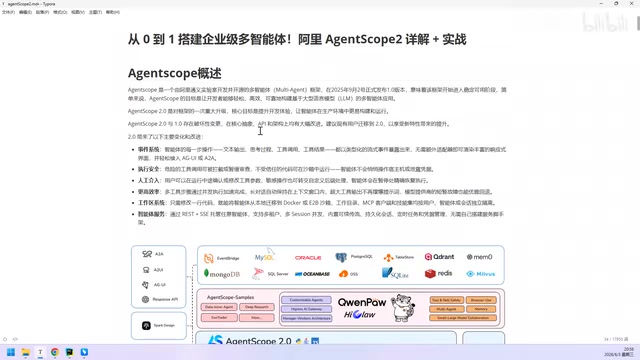
Six Core Upgrades: From Usable to Production-Ready
AgentScope 2.0 introduces major improvements over version 1.0 in six key areas, each addressing real pain points in production environments.
Event System: Making Every Operation Traceable
Version 2.0 introduces a brand-new event system that exposes every step of an agent's execution—including text output, reasoning processes, tool calls, and tool return results—as typed events. This is critical for debugging, monitoring, and auditing. In complex multi-agent collaboration scenarios, precisely tracking each node's behavior is a fundamental requirement for stable system operation.
Event-Driven Architecture (EDA) is a classic design pattern in distributed systems, widely used in microservices, message queues, and real-time data processing. Introducing an event system into an agent framework essentially abstracts every internal state change of an agent (such as LLM inference, tool invocation, and result returns) into a subscribable, replayable event object. The advantage of this design lies in achieving separation of concerns—core business logic is completely decoupled from cross-cutting concerns like monitoring, logging, and auditing. Developers can subscribe to specific event types to build custom monitoring dashboards, debugging tools, or compliance audit systems without touching the agent's core code.
Security Interception: Preventing LLM "Disasters"
Large language models are fundamentally probabilistic models and cannot guarantee 100% accuracy. When a model hallucinates, it may generate dangerous instructions—such as commands to delete system files. If an agent blindly executes these without judgment, the consequences could be catastrophic.
LLM hallucination refers to the model generating content that appears plausible but is actually incorrect or fabricated. This problem stems from the fundamental nature of large language models—they are probabilistic prediction models trained on massive text datasets that generate text by predicting the next most likely token, rather than reasoning from facts. In agent scenarios, the hallucination problem is further amplified: once a model has the ability to call tools and execute operations, a single erroneous "hallucination" can directly translate into destructive system operations. The industry refers to this class of risk as "Tool Misuse," which is one of the key focus areas in current AI safety research.
AgentScope 2.0 includes built-in security interception mechanisms that automatically block dangerous operations, ensuring the system remains robust even when the model makes mistakes. This is the critical step from "it runs" to "we dare to use it."
Human-in-the-Loop
For sensitive operations involving payments, transfers, and similar actions, relying entirely on AI autonomous decision-making is clearly unrealistic. AgentScope 2.0 supports user confirmation or modification of tool parameters during runtime, with sensitive operations delegable to custom backend processing. The system precisely pauses at critical nodes, waiting for human review before continuing execution.
Human-in-the-Loop (HITL) is not a new concept in the AI agent domain—it has long been standard practice in high-risk fields such as autonomous driving, medical AI, and financial risk management. Its core principle is to set up human review checkpoints in the AI system's decision chain, ensuring that critical decisions don't rely entirely on machine autonomous judgment. Implementing HITL in agent frameworks presents unique engineering challenges: the system needs to gracefully pause at any execution node, fully serialize and save the current context, resume execution after human review, and do all this without losing any state information. This requires the framework to have comprehensive state management and session persistence capabilities—which is precisely what AgentScope 2.0 focused on solving in its underlying architecture redesign.
Higher Execution Efficiency
Version 2.0 includes multiple performance optimizations:
- Concurrent Execution: Multi-tool steps support concurrent execution, significantly accelerating task completion
- Context Management: Long conversations are automatically kept within the context window
- Output Control: Oversized tool outputs no longer blow up the prompt
- Fault Tolerance: The system gracefully falls back when model services experience brief outages, rather than crashing outright
Among these, context window management is a technical point worth understanding in depth. The context window is the maximum number of tokens a large language model can process at once. Although the latest models have expanded context windows to 128K tokens or even longer, context overflow remains a common issue in multi-turn conversations and complex tool-calling scenarios. When conversation history plus tool return results exceed the context window limit, the model either throws an error or loses critical early information. Common management strategies include sliding window truncation, summary compression, and importance-based selective retention. AgentScope 2.0's automatic context management means developers don't need to manually handle these complex truncation and compression logistics—the framework intelligently balances preserving key information with controlling token consumption.
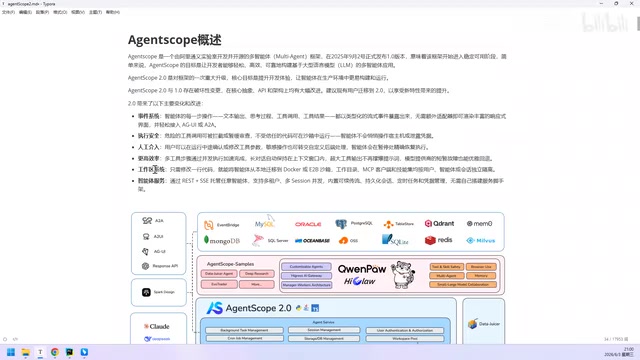
Workspace System: One-Click Local-to-Cloud Deployment
This is one of AgentScope 2.0's most practically valuable improvements. Developers can seamlessly deploy agents from local environments to the cloud or containerized environments without modifying a single line of code.
Many developers have experienced this frustration: an agent runs perfectly locally but breaks when deployed to the cloud. The workspace system is designed precisely to solve this environment consistency problem, dramatically reducing the friction cost from development to production. This design philosophy is aligned with the core idea behind containerization technologies (like Docker)—eliminating the classic "it works on my machine" problem through standardized runtime environments.
Agent-as-a-Service
AgentScope 2.0 hosts any agent via REST API, supporting multi-tenant, multi-session concurrency, with built-in pausable and resumable streaming sessions, scheduled tasks, and rate management. Developers no longer need to build their own concurrent service scaffolding—the framework has all this infrastructure ready to go.
REST API (Representational State Transfer) is the most widely adopted interface design style in the web services domain, operating on resources through standard HTTP methods (GET, POST, PUT, DELETE). Exposing agents as services through REST APIs means that any client capable of sending HTTP requests—whether a web frontend, mobile application, or other backend service—can seamlessly invoke the agent's capabilities, greatly expanding the application boundaries of agents.
Architecture Overview: AgentScope 2.0's Ecosystem Positioning
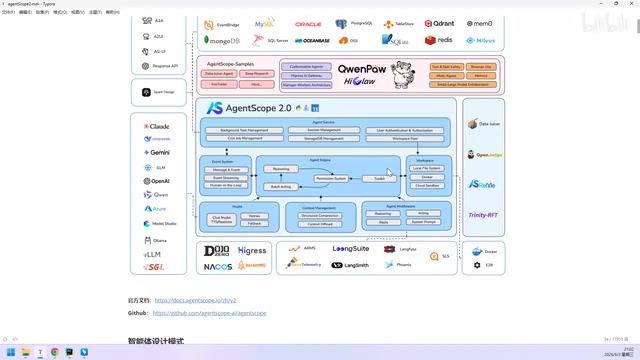
AgentScope 2.0's architecture can be divided into the following layers:
| Layer | Description |
|---|---|
| Core Framework Layer | AgentScope itself, developed and maintained by Alibaba's Tongyi Lab |
| Model Access Layer | Supports mainstream LLMs including GPT, DeepSeek, Gemini, Zhipu, Doubao, Qwen, and more |
| Application Layer | Various upper-level applications built on the framework |
| Tool Layer | Accompanying development tools |
| Environment Layer | Runtime environment support |
| Middleware Layer | Underlying infrastructure |
Interestingly, AgentScope is not a closed, all-in-one solution. Alibaba's Tongyi Lab is only responsible for the core framework, while other components form the complete development experience through integration with the external ecosystem. This open architecture design allows developers to flexibly choose the technology stack best suited to their scenarios. The multi-model support in the model access layer is particularly critical—in production, different tasks may call for different models (e.g., using a strong reasoning model for planning and a lightweight model for simple classification), and the framework's model-agnostic design makes this kind of hybrid deployment possible.
Agent Design Patterns: ReAct and Plan-and-Execute Explained
To truly leverage AgentScope 2.0 effectively, understanding the agent design paradigms behind it is essential.
ReAct Pattern: Alternating Between Thinking and Acting
ReAct stands for "Reasoning and Acting" (not to be confused with the frontend framework React) and is currently the most mainstream paradigm for building AI agents. Its core idea mimics how humans solve problems: think first, then act, observe the results, and adjust the next round of thinking and acting based on those results.
The ReAct paradigm was first proposed by researchers from Princeton University and Google Brain in their 2022 paper ReAct: Synergizing Reasoning and Acting in Language Models. The paper's key finding was that reasoning alone (Chain-of-Thought) or acting alone (tool calling) each has significant limitations, but interleaving the two produces remarkable synergistic effects. The reasoning process helps the model formulate action plans, track progress, and handle exceptions, while action results provide new information inputs for reasoning, creating a positive feedback loop. This paradigm quickly became the de facto standard for building AI Agents and has been widely adopted by major AI companies including OpenAI, Anthropic, and Google.
Using "searching for the latest AI news" as an example, the ReAct workflow looks like this:
- Reasoning: The LLM analyzes the task and determines "I need to search for recent AI news first"
- Acting: The agent calls a search tool to execute the search
- Observation: It checks whether the search results meet expectations
- Reflection and Adjustment: If some news items are irrelevant, it refines the search keywords and searches again
- Iterative Loop: Repeats the above process until the results are satisfactory
- Output: Organizes and delivers the final results
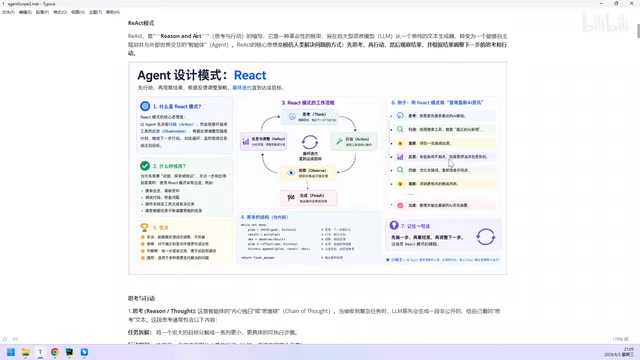
This "take a step, check the results, then adjust" pattern is essentially identical to how humans handle complex problems—every step has an opportunity for verification and error correction. AgentScope 2.0 is built on the ReAct paradigm.
Plan-and-Execute Pattern: Plan First, Execute Later
Plan-and-Execute (PE) is another important paradigm for building agents. Unlike ReAct's "interleaved execution," the PE pattern explicitly divides tasks into two phases:
- Planning Phase: Upon receiving a task, a powerful LLM is called to perform comprehensive analysis and generate a detailed multi-step action plan. This plan is fully formulated before execution begins—it's static planning.
- Execution Phase: Steps are executed strictly according to the pre-made plan, calling search engines, code interpreters, APIs, and other tools to complete each specific step. The planning process is only re-triggered when the entire plan has been executed or a major obstacle is encountered.
The PE pattern draws inspiration from classical AI planning (such as STRIPS, HTN, and other planning algorithms). Its core advantage lies in global optimality—by conducting comprehensive planning before execution, it avoids the "local optimum trap" common in ReAct, where the agent makes seemingly reasonable decisions at each step but the overall path is suboptimal. The PE pattern is particularly well-suited for scenarios where the task structure is relatively well-defined and there are clear dependencies between steps, such as data processing pipelines, multi-step report generation, and complex API orchestration. Frameworks like LangGraph also provide native support for the PE pattern, indicating broad industry recognition of this paradigm.
Comparing the Two Patterns
| Dimension | ReAct Pattern | Plan-and-Execute Pattern |
|---|---|---|
| Execution Style | Alternating thinking and acting | Complete planning first, then step-by-step execution |
| Flexibility | High, strategies can be adjusted at any time | Lower, depends on initial plan quality |
| Best For | Open-ended tasks with high uncertainty | Multi-step tasks with clear structure |
| Efficiency | Moderate, reasoning required at each step | Higher, lower overhead during execution phase |
| Industry Adoption | Current mainstream approach | Complementary approach for specific scenarios |
The industry currently favors the ReAct pattern as the mainstream approach, and AgentScope 2.0's default design follows this paradigm. In practice, the two patterns are not mutually exclusive—some advanced agent systems adopt a hybrid strategy: using the PE pattern to generate high-level plans, then employing the ReAct pattern for flexible execution within each subtask, combining global planning capability with local adaptability.
Summary and Outlook
The release of AgentScope 2.0 marks a milestone where a domestically developed multi-agent framework has officially reached production-grade quality. From the event system, security interception, and human-in-the-loop to the workspace system and service-oriented capabilities, every improvement addresses real pain points in production environments.
For developers, now is the perfect time to get started with AgentScope—it's recommended to begin directly with version 2.0 without worrying about 1.0. As multi-agent application scenarios continue to expand, mastering frameworks like this will become an indispensable core competency for AI engineers.
Key Takeaways
Related articles

Disaster and Glory of the Apollo Program: The History We Must Revisit Before Returning to the Moon
From the fatal Apollo 1 fire to Apollo 8's daring lunar orbit to Apollo 11's successful landing—revisiting the disasters, fears, and compromises of the Apollo program and their lessons for today's return to the Moon.

Netflix Trust Exercise Turns Into Firing Trap: Where Are the Boundaries of Corporate Trust?
A Netflix employee was fired after sharing private info in a trust exercise. We analyze the risks of corporate trust exercises and how employees can protect themselves.

AMD CDNA5 Architecture Deep Dive: Technical Evolution and the AI Computing Competition Landscape
Deep analysis of AMD's CDNA5 architecture covering Chiplet packaging upgrades, HBM memory evolution, and low-precision compute optimization, examining how AMD challenges NVIDIA's AI chip dominance.