Deep Dive into Inkling: The First Frontier Open-Source Multimodal LLM from the West
Inkling is the West's first frontier open-source natively multimodal LLM with near-trillion MoE parameters.
Thinking Machines has released Inkling, a near-trillion parameter MoE model under Apache 2.0 license — the first frontier-level, natively multimodal open-weight model from a Western lab. With 256 experts, 41B active parameters per token, and a 1M token context window trained on 45T tokens, Inkling excels in multimodal benchmarks while offering fast inference and interleaved tool calling. Though not SOTA across all metrics, its open-source nature and Tinker fine-tuning platform make it a significant milestone for the open-source AI ecosystem.
Inkling Launch: Filling the Gap in Western Frontier Open-Source Multimodal Models
Thinking Machines recently released their first open-weight model, Inkling — a significant event in the open-source LLM landscape. Why does it matter? Because it's released under the Apache 2.0 license, trained from scratch (without reusing any existing architecture beyond NVIDIA hardware), and designed from the ground up as a natively multimodal model.
Apache 2.0 is one of the most permissive open-source licenses available. It allows users to freely use, modify, and distribute software — even for commercial purposes — without requiring disclosure of modified source code. By contrast, many so-called "open-source" models actually use restrictive licenses (such as Meta's Llama series, which uses a community license with additional restrictions for products exceeding 700 million monthly active users). The Apache 2.0 license means any enterprise, research institution, or individual developer can unconditionally use Inkling in commercial products — a fundamentally important factor for driving widespread adoption in industry.
For a long time, the LLM release landscape has been clearly divided into two camps: Western labs primarily release frontier-level closed-source models, while open-source models are mainly driven by Chinese companies — but the latter are mostly text-first models. Truly frontier-level open-weight models from Western labs were virtually nonexistent. Inkling's arrival is changing this dynamic.
What makes it even more remarkable is that its multimodal capabilities are built from the ground up — training data simultaneously includes text, image, and audio inputs, rather than modules bolted on after the fact. Most current multimodal models use a "stitching" architecture: first train a powerful text LLM, then map image features into the text model's embedding space through a vision encoder (like CLIP or SigLIP), and align them with a projection layer or adapter. While this approach is engineering-efficient, the model's understanding of visual information essentially works by "translating to text," limiting deep cross-modal semantic fusion. Native multimodality means the model receives text, image, and audio data simultaneously from the pre-training stage, with modalities interacting directly in the Transformer's attention layers, enabling deeper cross-modal associations. Google's Gemini series also employs a similar native multimodal training strategy.
Inkling Architecture Analysis: A Near-Trillion Parameter Sparse MoE Model
From a technical specification standpoint, Inkling is a substantial model:
- Parameter count: Nearly one trillion parameters
- Context window: 1 million tokens (Playground actual limit is 256K)
- Training data: 45 trillion tokens of multimodal mixed data
- Architecture type: Mixture of Experts (MoE), with 256 routed experts + 2 shared experts
- Active parameters: Each token is routed to 6 experts, activating approximately 41 billion parameters
This means Inkling is a relatively sparse model — while total parameters approach one trillion, only about 41B parameters are activated per inference pass, maintaining model capacity while controlling inference costs.
Mixture of Experts (MoE) is a conditional computation technique whose core idea is: the model has a large number of expert sub-networks (256 routed experts + 2 shared experts in Inkling's case), but only a small fraction are activated during each inference pass. Specifically, each layer has a gating network (router) responsible for deciding which experts should process the current token. Inkling routes each token to 6 experts, meaning the routing sparsity is approximately 6/256 ≈ 2.3%. Shared experts are those that all tokens pass through, responsible for processing general features. This design was first validated at scale by Google in the Switch Transformer and later widely adopted by models like Mixtral and DeepSeek-V3. The core advantage of MoE is that the model's knowledge capacity is determined by total parameters (nearly one trillion), but computational cost is determined by active parameters (only 41B), achieving a balance between capacity and efficiency. However, MoE also faces engineering challenges like load balancing (some experts being overused while others sit idle) and communication overhead (experts distributed across different GPUs in multi-machine deployments).
Inkling uses a decoder-only architecture. Decoder-only means the model uses only the decoder portion of the Transformer, employing a causal attention mask so each token can only attend to preceding tokens. Since the GPT series demonstrated decoder-only's powerful generation capabilities, virtually all mainstream LLMs (including GPT-4, Claude, Llama, Qwen, etc.) have adopted this architecture. Its advantages include unified training and inference pipelines, naturally fluent autoregressive generation, and efficient incremental decoding through KV cache mechanisms.
One important detail: Inkling is a reasoning model, so "thinking effort" plays a critical role in performance. Reasoning models have been a major trend in the LLM field since 2024, represented by OpenAI's o1/o3 series and DeepSeek-R1. Unlike traditional "intuitive" responses, reasoning models perform an explicit thinking process (chain-of-thought) before generating the final answer, typically wrapped in special tokens that users can choose to view or hide. Thinking effort adjustment allows users to make trade-offs between speed and quality: at low thinking effort, the model quickly provides intuitive answers suitable for simple tasks; at high thinking effort, the model performs longer reasoning chains suitable for complex tasks requiring deep thinking like math and coding. This mechanism essentially regulates model performance by controlling inference-time compute, representing a major breakthrough from the traditional "single forward pass produces results" paradigm.
Benchmark Performance: Multimodal Capabilities Lead Among Open-Source Models
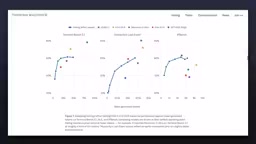
Looking at various benchmarks, Inkling is not currently the best (SOTA) on most metrics, but it is a very comprehensive and well-balanced model. Considering this is Thinking Machines' first open-weight model, these results are commendable.
Its real highlight is multimodal capability — Inkling beats most other open-weight models on several key multimodal benchmarks. It's speculated that this model powers the "interaction models" Thinking Machines previously demonstrated.
Additionally, its design capabilities are quite impressive. According to the Design Arena leaderboard, Inkling ranks just behind frontier closed-source models and GLM 5.2 — no small achievement for a first open-source release.
Tinker Platform and Product Ecosystem: A Complete Solution for Fine-Tuning Inkling
Inkling is Thinking Machines' third product release:
- Tinker: An API product for post-training models
- Interaction models: Recently demonstrated but not yet publicly available
- Inkling: The open-weight model released today
Post-training refers to a series of training steps performed after base model pre-training is complete, typically including supervised fine-tuning (SFT), reinforcement learning from human feedback (RLHF), or direct preference optimization (DPO). Tinker as a post-training API product represents an emerging business model: provide free or low-cost open-source base models, then monetize through post-training services. This model lowers the barrier for enterprises to use LLMs — users don't need to build their own training infrastructure, they just prepare domain data and submit training tasks via API. Similar products include OpenAI's fine-tuning API and Together AI's training platform. This model is especially valuable for enterprises with unique multimodal data (such as medical imaging, industrial quality inspection images, etc.).
The most critical synergy is that you can use Tinker to fine-tune Inkling. Users simply bring their own data, rent Thinking Machines' compute, and perform further post-training and fine-tuning on the free base model — particularly suitable for scenarios with multimodal data.
Furthermore, something even more exciting to look forward to is Inkling Small — a smaller version with 276 billion parameters and 12 billion active parameters, theoretically more suitable for running on consumer hardware, though specific availability timelines remain to be seen.
Interestingly, in the self-evolution research direction, the team even had the model fine-tune itself using the Tinker framework and open-source code harness — a rather cutting-edge exploration.
Hands-On Experience: Fast Generation Speed but Limited Design Diversity
In the Playground, the left panel allows setting reasoning effort (from none to maximum), the system prompt is relatively simple, and the training cutoff date is April 26 — quite impressive data freshness for a model of this scale.
Generation Speed and Tool-Calling Capabilities
In testing, the model response was extremely fast. When asked to "search the web for information about Inkling and generate a minimalist but beautiful website," it demonstrated complete capabilities: providing reasoning traces, executing interleaved tool calling, generating search queries, and returning results.
Interleaved tool calling is an advanced Agent capability pattern where the model can invoke external tools (such as search engines, code executors, APIs, etc.) multiple times interspersed throughout the response generation process, rather than planning all tool calls at once. The specific flow is: the model first thinks and initiates the first tool call, receives results, continues reasoning, decides whether further tool calls are needed based on new information, and repeats until sufficient information is gathered to generate the final answer. This is much closer to how humans solve problems than simple single-shot tool calling (like traditional function calling) — we typically research and think iteratively, rather than listing everything we need to look up at the start. This capability is crucial for building complex AI Agents.
The entire thinking process was coherent and thorough, with generation speed that's impressive for a trillion-parameter model.
Limitations in Design Capabilities
However, an obvious issue emerged: the websites it generates are highly similar. Different runs with the same prompt produce web pages with strikingly similar design styles. Even when asked to "freestyle and redesign," it ultimately reverts to the same default template. This indicates that Inkling still has significant room for improvement at the "taste" level. This phenomenon is not uncommon in LLMs, typically related to insufficient diversity of design styles in training data, or overly concentrated preference data during the reinforcement learning phase — the model may have converged to a "safe but monotonous" design pattern during optimization.

Code Generation Capabilities
For coding tasks, Inkling is similarly not SOTA, but serviceable. For example, when asked to create a real-time tracker (providing an API endpoint), it can generate runnable code directly in the conversation. Results are slightly off in positioning but largely correct.
Inkling Pricing Strategy: Mid-to-High Range but Open Source Is the Core Advantage
When used through the Tinker platform, Inkling pricing has two tiers (depending on token usage). For the 64K token tier as an example, input costs approximately $0.018 and output nearly $4.70 per million tokens — overall leaning toward the mid-to-high price range and not exactly cheap.
But don't forget its core advantage: this is an open-weight model. If you have sufficient compute, you can download the weights and run them on your own hardware; if you use Tinker, you can fine-tune and train at relatively manageable costs.

Conclusion: Inkling Opens a New Chapter for Western Open-Source Multimodal Models
Inkling's significance far exceeds its current benchmark scores. It marks the first step by a Western lab into the previously vacant territory of "frontier-level + open-source + natively multimodal," providing developers with another open-source option not dependent on Chinese labs.
As a first-generation model, it already demonstrates speed, comprehensiveness, and strong multimodal capabilities, despite still having distance to cover in design aesthetics and top-tier coding performance. Looking ahead, as subsequent iterations continue to strengthen (especially in the multimodal direction), Thinking Machines has the potential to release even more powerful versions. For practitioners following the open-source ecosystem, this is undoubtedly a direction worth continued attention.
Related articles

Maple-Preview: 20B Ternary MoE Model Achieves 120 tok/s On-Device Inference on iPhone
Maple-Preview achieves 120 tok/s inference of a 20B ternary MoE model on iPhone. We analyze ternary quantization, MoE sparse activation, and on-device inference challenges.

AI Powers Over Half of African Cybercrime: An In-Depth Warning from Interpol
Interpol reports AI now powers over half of Africa's cybercrime, with deepfakes and phishing surging. Analysis of AI as a crime accelerator, Africa's unique challenges, and global response strategies.

DiacTag: The Engineering Wisdom of Transforming Diacritic Restoration into a Constrained Classification Task
DiacTag redefines diacritic restoration as constrained classification rather than generation, providing structural guarantees that output never deviates from input through architectural design.