Deep Dive into MCP: How Large Language Models Connect to the Outside World

MCP is the universal standard that lets AI models connect to external tools and data sources.
MCP (Model Context Protocol), open-sourced by Anthropic in 2024, is a standardized protocol for connecting large language models with external tools and data sources. This article traces the evolution from ChatGPT's limitations through Function Calling, RAG, and AI Agents, explaining why a universal standard like MCP became essential for unlocking the commercial potential of LLMs.
Starting with the ChatGPT Explosion: The Commercialization Challenge for LLMs
In late 2022, ChatGPT burst onto the scene and ignited an AI revolution. The remarkable capabilities demonstrated by generative AI gave countless businesses and developers a clear sense of enormous market potential. In the two years that followed, major players raced to train their own models and turn them into real-world commercial applications.
It's worth noting that AIGC (AI Generated Content) didn't come out of nowhere. The GPT architecture underlying ChatGPT is fundamentally an autoregressive language model built on the Transformer, trained through unsupervised pre-training on massive amounts of internet text and then fine-tuned with RLHF (Reinforcement Learning from Human Feedback) to follow instructions and generate high-quality dialogue. This training paradigm gave large models their impressive language abilities — but it also planted the seeds of the commercialization challenges that followed.
As one experienced AI developer put it: whether a technology creates real value ultimately comes down to whether it solves actual human problems and meets genuine human needs. And it's precisely here that the inherent limitations of large models become a critical obstacle for commercial applications.
Two Fundamental Weaknesses of Large Models
First, reasoning is constrained by static training data. A model's capabilities are locked to the knowledge boundaries of its training data — it cannot access real-time information or interact with external systems. This creates a range of practical issues: the model has no awareness of a user's historical context, cannot invoke external tools to execute tasks, and cannot update its knowledge dynamically.
Second, knowledge staleness and hallucination. The knowledge cutoff refers to the temporal boundary of a model's training dataset — GPT-3.5, for example, has a training cutoff of September 2021. Hallucination is an even deeper flaw: rather than "querying" facts from a database, a model predicts the next token based on statistical probabilities. When a particular fact appears infrequently or inconsistently in training data, the model will confidently fabricate a plausible-sounding but incorrect answer. Research shows that even top-tier models can exhibit hallucination rates of 15–20% in specialized domains — a fatal flaw for industries like finance, healthcare, and law where accuracy is non-negotiable. These issues have significantly slowed the commercial adoption of large models.

Two Technical Approaches: Improve the Model vs. Augment from Outside
In response to these pain points, the industry converged on two main directions.
Approach 1: Optimize the Model from the Inside
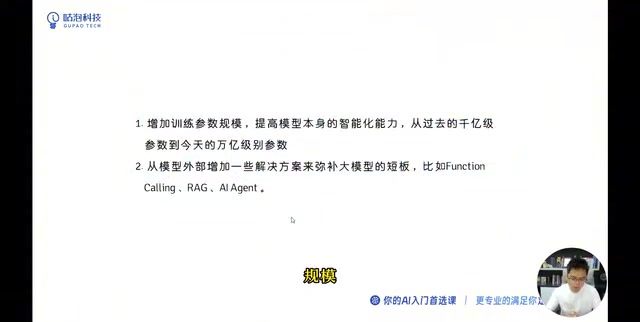
The first path is to keep scaling model parameters and refining training methods to improve intelligence from the ground up. But the ceiling here is obvious.
On one hand, models trained on static data can't fully escape the staleness problem. On the other hand, most training data comes from the public internet — for enterprise-specific use cases like intelligent customer service or financial data analysis, simply throwing more parameters and compute at the problem doesn't help. The model simply never "sees" the company's private data.
Approach 2: "Wire In" External Capabilities
Since improving models from within has clear limits, developers turned their attention outward. They began experimenting with custom APIs and plugins to connect model capabilities with external data sources, enabling models to access real-time information and compensate for their inherent weaknesses.
This approach gave rise to a series of key technologies:
- Function Calling: Enables models to recognize and invoke external functions.
- RAG (Retrieval-Augmented Generation): Connects models to external knowledge bases. The core RAG pipeline works by chunking external documents → embedding them as vectors → storing them in a vector database. When a user asks a question, a similarity search retrieves relevant content, which is then injected into the prompt to guide the model toward a grounded response. This approach effectively mitigates both knowledge cutoff and hallucination issues without the cost of fine-tuning, and has become the dominant solution for enterprise knowledge base Q&A.
- AI Agent: Gives models the ability to plan and act autonomously. Agents follow a ReAct loop of "think → act → observe," transforming large models from passive "answerers" into active "executors" capable of breaking down tasks, calling tools, and iterating toward a goal.

Function Calling: The Starting Point for External Augmentation
Among the various solutions, Function Calling — introduced by OpenAI in its API — stands out as particularly significant. It essentially opens a standard interface, allowing models to call external functions to retrieve information and execute actions.
In simple terms, Function Calling lets a large model "perceive" and invoke external tools, enabling programs to interact with external APIs for more complex tasks, such as:
- Automatically sending emails
- Querying real-time weather data
- Searching an enterprise knowledge base
This capability marked a turning point: large models began evolving from "closed conversational engines" into "action hubs" capable of connecting with the real world.
The Bottleneck of Function Calling
However, Function Calling was not the final answer. Different vendors and tools lacked a unified standard, and developers often had to write custom integration code from scratch for every new tool or data source they wanted to connect. As the number of tools grew into the hundreds or thousands, this "point-to-point" integration approach became bloated, difficult to maintain, and hard to scale.
This is the context in which the industry urgently needed a standardized protocol — a unified way to connect large models with external tools and data sources. That need is precisely what motivated the creation of MCP (Model Context Protocol).
MCP: Why It's Worth Understanding Deeply
The significance of MCP can be compared to the "USB-C port" of the AI era. Before MCP, connecting each tool to a model was like dealing with a different proprietary plug every time. MCP aims to define a universal standard, allowing any model to connect to any tool or data source in a consistent way.
On the technical side, MCP was officially open-sourced by Anthropic in November 2024 and is built on the JSON-RPC 2.0 communication protocol. In the MCP architecture, AI applications act as MCP Clients, while tools and data sources are packaged as MCP Servers. The two interact via a standardized message format and support three core capability types: tool invocation (Tools), resource access (Resources), and prompt templates (Prompts). In principle, an MCP plugin written for one model can be used by any other MCP-compatible model without modification — fundamentally addressing the fragmentation of tool ecosystems across vendors.
For developers, understanding MCP starts with recognizing the core problem it addresses: a large model's capability boundary is ultimately defined by what it can connect to. No matter how intelligent a model is, if it can't reach real-time data, internal enterprise systems, or external tools, its commercial value is severely limited.
From ChatGPT sparking a revolution, to the rise of Function Calling, RAG, and Agents, to MCP's attempt at standardization — a clear technical trajectory emerges: moving large models from closed to open, from static to dynamic, from conversation to action.
For developers looking to get started with MCP, the recommended path is to first build a solid understanding of Function Calling and Agent mechanics, then dive into the MCP protocol specification and hands-on projects. Only by truly understanding where it came from and why it exists can you fully grasp the core value of this protocol.
Related articles

The Truth Behind Codex 'Build a Website in 5 Minutes': AI Isn't Creating Sites—It's Helping You Copy Them
Exposing the truth behind viral Codex 5-minute website videos: creators aren't building original sites with AI—they're copying shared prompts or scraping others' work. Learn AI coding tools' real limits.

Getting Started with AI Agent Development: A Complete Guide from Concept to Practice
A comprehensive guide to AI Agent architecture and development, covering automated marketing, intelligent customer service, and investment analysis scenarios with single and multi-agent collaboration.

The Truth Behind Codex 'Build a Website in 5 Minutes': AI Isn't Creating Sites — It's Helping You Copy Them
Exposing the truth behind viral Codex 5-minute website videos: creators aren't building original sites with AI — they're copying shared prompts or scraping others' work.