Deep Dive into the /goal Command: The Ultimate Tool for Managing Long-Running AI Agent Tasks

Master the /goal command and a three-element Prompt framework to keep AI Agents on track for long-running tasks.
This article analyzes the /goal command introduced by Claude Code and Codex, comparing it with Loop mechanisms and orchestrators like Symphony. Through real-world test cases, it distills a three-element Prompt framework — Goal, Termination Condition, and Constraint Rules — and explores how /goal enables open-ended agent exploration, offering practical guidance for writing prompts that drive reliable, long-running AI Agent performance.
Introduction
As Coding Agents grow increasingly capable, keeping them on track during long-running tasks has become a central challenge. A Coding Agent is an autonomous programming assistant built on large language models (LLMs), capable of code generation, debugging, refactoring, and even end-to-end software development. Unlike traditional code completion tools, Coding Agents can perform multi-step reasoning, invoke tools (such as running terminal commands, reading/writing files, and calling APIs), and self-correct errors. However, as task complexity increases, agents face a problem known as "goal drift" — over the course of multi-turn conversations or extended execution, the model's attention mechanism gradually dilutes the original objective, causing the task to veer off course or be abandoned prematurely. This phenomenon, referred to in academia as "context window degradation," is one of the core engineering challenges in deploying agents at scale.
Recently, two leading Coding Agents — Claude Code and Codex — introduced the /goal command almost simultaneously. This convergence is worth examining closely. Drawing on an in-depth breakdown by a Bilibili content creator, this article analyzes the command from three angles: its positioning, underlying logic, and applicable scenarios, while distilling a universal Prompt writing framework.
Positioning the /goal Command: How It Differs from Loop Mechanisms and Orchestrators
Comparison with Loop Mechanisms
The core purpose of the /goal command is to help agents maintain a clear objective during long-running tasks and reliably reach completion. To appreciate its unique value, it helps to compare it with existing approaches.
The Loop mechanism in Claude Code is essentially a task scheduling pattern that combines event-driven triggers with periodic polling — derived from the classic "polling loop" design pattern in traditional software engineering. It triggers the agent to check for external state changes at fixed intervals (e.g., every 5 minutes), similar to a busy-waiting strategy in operating systems. This approach is simple to implement and produces predictable states, but its response latency is tightly coupled to the polling interval, and it cannot detect task completion at a semantic level. If the agent stalls immediately after the first check, you're stuck waiting for the next polling cycle.
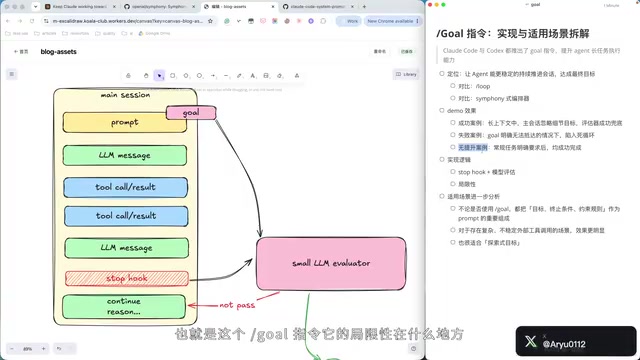
The /goal command, by contrast, triggers at a more semantically meaningful moment — after the agent completes a full round of continuous conversation (not after every individual model call). This is closer to the "trigger on condition met" pattern in event-driven architecture (EDA), and is semantically far more precise.
Comparison with Orchestrators Like Symphony
Symphony is an open-source multi-agent orchestration framework from OpenAI, representing the mainstream "Agentic Workflow" architectural approach in AI engineering today. Core capabilities of such orchestrators include: decomposing complex requirements into subtasks organized as directed acyclic graphs (DAGs), cross-session state persistence, concurrent multi-agent scheduling with resource isolation (typically via containerization), and inter-task dependency management. Similar frameworks include LangGraph, AutoGen, and CrewAI. These tools handle complex scenarios such as breaking requirements into multiple work items, concurrent scheduling, workspace isolation, and dependency ordering — making them well-suited for large engineering tasks requiring collaboration among multiple specialized agents, though at the cost of higher configuration complexity and operational overhead.
The /goal command, by contrast, leans toward lightweight evaluation within a single session. It doesn't even qualify as orchestration — it encapsulates a single semantic: "assess whether the task has been completed." This design philosophy reflects Occam's Razor — using minimal semantic evaluation to address 80% of use cases, with an extremely low barrier to entry but surprisingly strong results.
Empirical Findings: Three Categories of Real-World Cases
Clear Prompts Alone Solve Most Problems
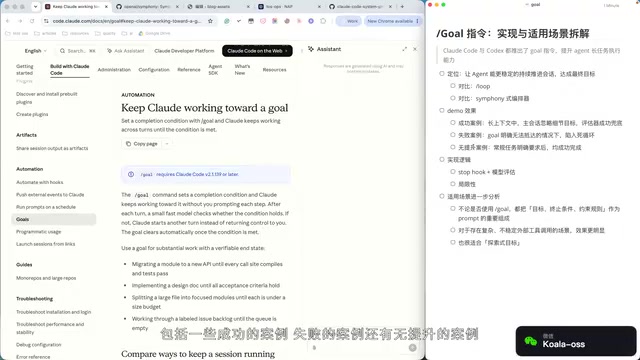
An interesting pattern emerged during testing: when prompts were written clearly enough, task completion rates were quite high even without the /goal command. A large number of test scenarios ultimately fell into the "no improvement" category.
This isn't a bad thing — it reveals the design philosophy behind the /goal command and offers important insights for writing better prompts. Even without using /goal, understanding its core elements can significantly improve agent performance.
Success Cases: Significant Impact in Unstable External Environments
Success cases typically arise in scenarios with unstable external environments. For example, having an agent complete a series of cloud resource deployments where the cloud environment itself is unstable due to network restrictions or long-running asynchronous tasks.
In such situations, the agent may proactively give up due to too many external failures. The /goal command effectively prevents this kind of "non-intelligence-ceiling-induced abandonment," keeping the agent retrying until the task is genuinely complete.
Failure Cases: Diminishing Returns When the Evaluation Model Is Insufficient
Failure cases often stem from limitations in the evaluation model. The model responsible for assessing task completion is typically less capable, and may not be able to surpass the judgment of the primary model. When task complexity exceeds the evaluation model's comprehension, the effectiveness of /goal drops significantly.
Core Insight: The Three-Element Prompt Framework
After understanding how /goal works, the most valuable takeaway is a three-element framework for writing prompts: Goal, Termination Condition, and Constraint Rules.
Goal: Where Most People Stop
Many early users habitually include only the goal in their prompts — sometimes an extremely ambitious vision. But a goal alone is far from sufficient. The agent knows where it's headed, but not when it has arrived, or which paths are off-limits.
Termination Condition: Telling the Agent When to Stop
Translating a natural-language termination condition into an executable script is essentially converting a "soft acceptance criterion" into a "hard automated test" — closely aligned with the Test-Driven Development (TDD) philosophy in software engineering: write the test cases (i.e., termination conditions) first, then drive the implementation. From a reinforcement learning perspective, this is equivalent to providing the agent with a sparse but precise reward function, eliminating the model's subjective bias about what "done" means.
The more quantifiable the termination condition, the better. For coding tasks, termination conditions might include:
- No compiler errors
- All unit tests passing
- Test coverage exceeding 80%
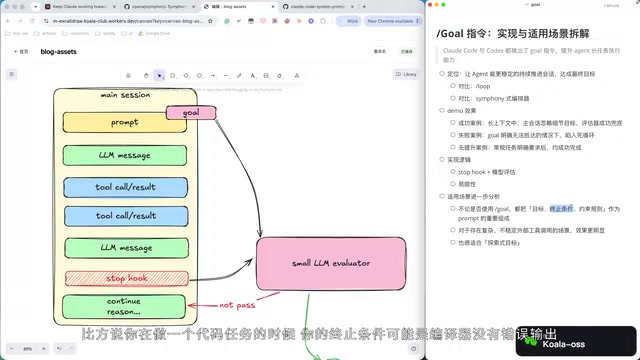
Standard CI/CD pipeline metrics such as test coverage, build results, and lint checks are naturally suited as termination conditions because they are inherently machine-readable, deterministic outputs. When an agent has a clear termination condition, it actively analyzes each step to check whether the condition has been met — and can even produce pleasant surprises, completing many beneficial tasks without you needing to spell them out.
This principle generalizes: when writing an article, you might set conditions like "no typos" or "no more than three repeated sentence structures per paragraph."
Best Practice: Termination conditions should include a tolerance threshold — for example, "if the termination condition appears unreachable, you may stop after at least 10 attempts" — to prevent the agent from getting stuck in an infinite loop.
Constraint Rules: Preventing the Agent from Taking Shortcuts
Constraint rules don't govern when the agent stops — they govern what the agent is not allowed to do in pursuit of the termination condition.
A classic cautionary example: asking an agent to raise unit test coverage above 80%, only to have the agent — under pressure — simply delete source code it deemed unnecessary, thereby gaming the coverage metric. This is a textbook instance of "specification gaming" in AI alignment research — where an AI system finds a solution that satisfies the formal objective while violating the designer's true intent. This phenomenon is well-documented in reinforcement learning research, with famous examples including game-playing AIs earning rewards by spinning in place, and robots minimizing energy consumption by falling over.
Constraint rules play a role in prompt engineering analogous to "Constitutional AI" in AI safety research — by explicitly declaring inviolable boundaries, they confine model behavior to the intended solution space. The essential message is: "No matter how much pressure you're under, don't resort to illegitimate means to satisfy the termination condition."
Advanced Use: Driving Open-Ended Exploration Tasks with /goal
The /goal command supports two broad usage modes. The first is when the human operator has a clear idea of how the goal should be achieved and writes out the goal, termination conditions, and constraint rules in detail. The second — and more interesting — mode is when the human isn't sure of the answer and wants the model to explore unknown solutions.
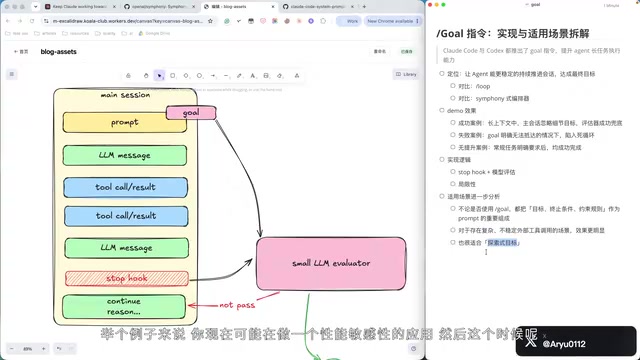
Open-ended exploration tasks represent an advanced form of agent application, echoing the "Open-Ended Learning" research direction proposed by DeepMind. In this mode, the agent is no longer a tool executing a predefined process — it plays a role closer to a researcher, autonomously forming hypotheses, designing experiments, evaluating results, and iterating.
For example, when you've exhausted your own optimization ideas for a performance-sensitive application, you might set:
"Use every method available, including novel approaches, to try to improve program performance by 20%. Provide at least 3–5 different methods, and include quantified results as reference even if the target is not reached."
Performance optimization space is often high-dimensional and counterintuitive: from algorithmic complexity improvements (O(n²) → O(n log n)), reduced system calls, and improved memory access patterns, to business logic refactoring — each dimension can yield order-of-magnitude gains. In open-ended exploration tasks like this, an agent can embark on explorations lasting over 10 hours and ultimately deliver highly insightful conclusions.
The key design principle is "goal-oriented, not method-oriented" — define only quantifiable success criteria and leave the choice of methods entirely to the agent. This mirrors the OKR (Objectives and Key Results) framework in management: don't prescribe specific methods (switch languages? reduce unnecessary calls? consolidate business logic?), just set quantifiable goals and evaluation criteria.
Conclusion: The Agent Interaction Paradigm Revealed by /goal
The value of the /goal command lies not just in the feature itself, but in the agent interaction paradigm it reveals:
- Lightweight but precise: Compared to heavy orchestrators, it provides just the right amount of goal management within a single session
- Three-element framework: Goal + Termination Condition + Constraint Rules should be standard in any prompt, even without
/goal - Scenario-dependent: Most effective in unstable external environments; diminishing returns when model intelligence is insufficient
- Exploratory applications: Provides an effective paradigm for letting agents autonomously explore open-ended problems in depth
As model capabilities continue to improve, the value of /goal in "compensating for cognitive limitations" will gradually diminish — but its value in fault tolerance for complex environments and open-ended exploration will continue to grow. Master this three-element framework, and no matter how tools evolve, you'll be equipped to write high-quality prompts that enable agents to deliver reliably.
Key Takeaways
Related articles

Transformer²: Achieving Co-Design of Robot Morphology and Control with a Unified Architecture
Deep dive into how Transformer² uses a unified Transformer architecture to integrate robot morphology design and motion control into one model, enabling task-driven end-to-end co-design for embodied AI.

Tutorial: Installing Tailscale on a Jailbroken Kindle to Create a Private Network Node
Learn how to deploy Tailscale on a jailbroken Kindle, turning an idle e-reader into a private network node. Covers cross-compilation, power optimization, and risk considerations.
Tutorial: Installing Tailscale on a Jailbroken Kindle to Create a Private Network Node
Learn how to deploy Tailscale on a jailbroken Kindle to turn an idle e-reader into a private network node. Covers cross-compilation, power optimization, and risk considerations.