DeepAgents in Practice: A Complete Guide to Building a HarmonyOS Automated Testing Agent

Learn how to build a production-grade HarmonyOS testing Agent using the DeepAgents framework.
This article explains what DeepAgents is, how it builds on LangChain and LangGraph, and when to choose it over LangChain. Using a HarmonyOS automated testing Agent as a real-world example, it walks through the core create_deep_agent function, key parameters, and a complete invocation loop — showing how DeepAgents simplifies production-grade, long-chain Agent development.
What Is DeepAgents
A persistent pain point in Agent development is this: demos are easy to build, but production deployment is hard. Most frameworks can handle simple single-step Q&A, but the moment a task becomes multi-step and requires reliable end-to-end delivery across a long chain, weaknesses in planning, context management, and tool invocation start piling up.
What Is an Agent Harness? The concept of an Agent Harness comes from the software testing world — a "Test Harness" is scaffolding that provides a controlled execution environment for the system under test. In the AI Agent context, a Harness refers to a framework that provides complete runtime infrastructure for an agent, including task scheduling, state persistence, and error recovery. The core tension behind the difficulty of production deployment is this: demo scenarios tend to be single-turn, stateless, and fault-tolerant, while real business scenarios demand multi-turn continuous reasoning, cross-step state consistency, and automatic retry or graceful degradation on tool failures. This is what the industry calls the "last mile" problem — a huge gap between PoC (Proof of Concept) and Production deployment.
DeepAgents was built specifically to address these challenges. It is an out-of-the-box Agent Harness that bakes in the most common pain points of complex Agent development — not as demo features, but as a production-grade foundation designed for multi-step, long-chain tasks.
You may not have realized it, but DeepAgents doesn't reinvent the wheel. It's a layer built on top of LangChain and LangGraph. The three have a clear division of responsibilities: LangChain provides the components, LangGraph provides the engine and orchestration, and DeepAgents comes pre-assembled with production-grade capabilities so developers can get to work immediately.
The Technical Stack Relationship Between LangChain, LangGraph, and DeepAgents LangChain is an LLM application development framework introduced in 2022. It provides standardized components for model invocation, prompt management, document retrieval, and tool binding — solving the problem of "how to interact with large language models." LangGraph is a graph orchestration engine released by the LangChain team in 2024. It describes an agent's state machine as a directed graph (nodes + edges), supporting cyclic reasoning, conditional branching, and multi-agent collaboration — solving the problem of "how to orchestrate complex control flows." Together, they form the mainstream infrastructure for modern Agent development. DeepAgents adds a higher-level abstraction on top of both, pre-integrating production-grade modules such as a planner, tool call retry mechanisms, and context compression. Developers no longer need to build these capabilities from scratch and can focus directly on business logic.
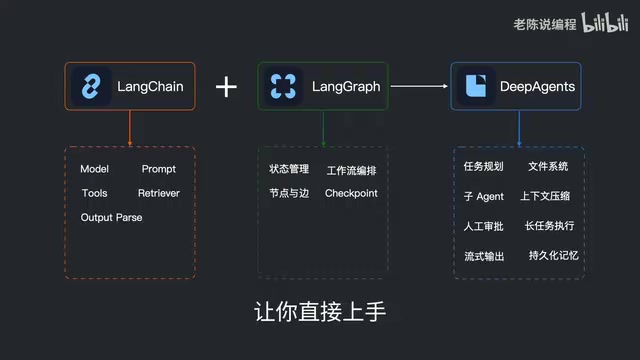
If you're not yet familiar with LangChain, it's recommended to build that foundation first before diving into DeepAgents — the learning curve will be much smoother. Many of DeepAgents' underlying mechanisms are essentially higher-level abstractions over LangChain/LangGraph capabilities.
How to Choose Between LangChain and DeepAgents
When facing different task scenarios, how do you decide between LangChain and DeepAgents? A simple, practical rule of thumb is to choose based on chain length.
Short-Chain Scenarios: Prefer LangChain
LangChain is better suited for short-chain scenarios with clear, well-defined paths — such as one-shot Q&A, simple Retrieval-Augmented Generation (RAG), or fixed-flow information processing. These tasks have explicit steps and linear logic, which LangChain's foundational components handle efficiently without needing a heavier framework.
Technical Background on RAG Retrieval-Augmented Generation (RAG) is one of the most prevalent short-chain LLM application patterns today. The core idea is: before prompting the model, retrieve relevant document chunks from an external knowledge base (such as a vector database) and inject them into the prompt, enabling the model to generate grounded responses. A typical RAG pipeline has just two steps — "retrieve → generate" — making it a linear, stateless short-chain task that's well-suited to LangChain's foundational components. In contrast, multi-step Agent tasks require dynamically deciding the next action based on the previous step's output at every turn, with state propagating continuously throughout the entire chain. The complexity grows exponentially — and this is precisely the blind spot that short-chain frameworks struggle to cover.
Long-Chain Scenarios: Prefer DeepAgents
Once a task becomes a multi-step closed loop requiring reliable end-to-end delivery, DeepAgents is the better fit. Its built-in planning capabilities, tool call management, and context management mechanisms are designed specifically for these scenarios.

The real-world case chosen for this article — a HarmonyOS automated testing Agent — is a classic long-chain task: starting from reading requirements, progressing through test case design and script execution, and ultimately producing a test report. The chain is long and the steps are granular, making it an ideal way to evaluate DeepAgents' actual ability to handle long tasks.
Why HarmonyOS Automated Testing Is the Perfect Long-Chain Validation Scenario The complexity of HarmonyOS automated testing spans multiple dimensions. First, it requires cross-domain knowledge integration — simultaneously understanding business requirement documents, test design methodologies (such as equivalence partitioning and boundary value analysis), and the APIs of the HarmonyOS ArkTS/ArkUI testing framework. Second, tasks have strong dependencies — test script generation depends on test case design, and report generation depends on script execution results; a failure at any step cascades downstream. Third, the entire process involves feedback loops — when a script fails, the Agent must analyze error logs, fix the script, and re-execute it. This kind of cyclic reasoning is exactly where LangGraph's state machine and DeepAgents' planning capabilities shine. Using such a real-world engineering scenario as a validation case provides a comprehensive stress test of DeepAgents' planning stability, tool call reliability, and context management in practice.
The Core of DeepAgents: create_deep_agent
The barrier to entry for DeepAgents is quite low — its core is a single main entry-point function.
Importing the Main Entry-Point Function
First, import create_deep_agent from DeepAgents. This is the main entry point of DeepAgents, and it's the one function you need to create an agent. Its purpose is to create a Deep Agent with planning, tool invocation, and context management capabilities — everything else revolves around it.
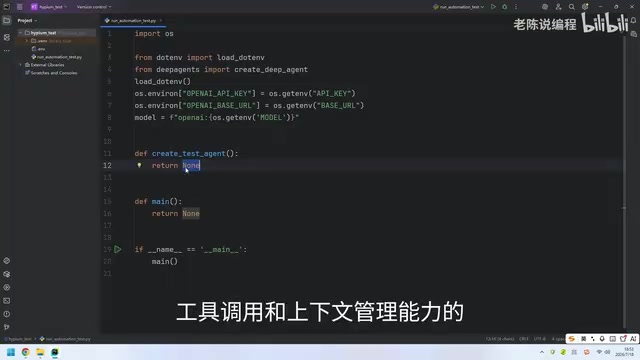
Key Parameter Descriptions
When calling create_deep_agent, there are three key parameters to understand:
- Model: Specifies the large language model the agent will use. The model configuration follows the same convention as in LangChain and won't be repeated here.
- System Prompt: The system prompt that defines the agent's role and behavioral boundaries. This is the key lever for controlling Agent behavior and requires careful design.
- Debug: A toggle for debug mode. When enabled, it surfaces detailed runtime logs for troubleshooting — especially important for long-chain tasks.
Engineering-Grade System Prompt Design In Agent development, a System Prompt carries far more weight than in an ordinary conversation — it is essentially the agent's "constitution," defining its role boundaries, behavioral norms, output format requirements, and error-handling strategies. An engineering-grade System Prompt typically covers several dimensions: role definition (who you are, what you can do, what you cannot do), task decomposition strategy (how to break down complex tasks into executable sub-steps), tool usage specifications (when to call which tool, how to handle tool call failures), and output format constraints (structured output vs. natural language, JSON Schema constraints, etc.). In long-chain Agents, the quality of the System Prompt directly determines planning stability — a poorly designed prompt can cause the Agent to "lose its way" at intermediate steps and fail to complete the full task loop.
With these three parameters properly configured, you can create an agent instance tailored to specific business needs.
Running Your First DeepAgent
Once the agent is created, the next step is to actually run it.
Creating an Instance and Starting a Conversation
In the main function, first call the creation function (e.g., create_test_agent) to create an agent instance, then use the invoke method to initiate a conversation.

What's passed to invoke is a dictionary with a messages field containing a list of messages. Each message has two fields:
- Role: The message role. When Role is
user, it indicates this is the user's query. - Content: The actual content — the task description the user wants the agent to complete.
Technical Details of the
invokeMethod and Message Structure Theinvokemethod is the standard synchronous call interface in the LangChain ecosystem. Its counterparts includeainvoke(asynchronous),stream(streaming output), andastream(asynchronous streaming). This interface convention follows LangChain's Runnable protocol, which allows chains, agents, tools, and other components to be called and composed in a unified way. The message structure passed in follows the OpenAI Chat Completions API message format standard: each message consists of aroleandcontent, where validrolevalues includesystem(system instructions),user(user input),assistant(model response), andtool(tool call result). This format has become the de facto industry standard, and nearly all mainstream LLM APIs are compatible with it — understanding it is important for migrating code across different models and frameworks.
Parsing the Return Value
After the agent finishes running, the messages field in the returned result contains the complete record of the entire conversation. Typically you take the last message — the agent's final reply — and extract the text from content to print.
At this point, a complete DeepAgent invocation loop is up and running: create instance → start conversation → parse result.
Summary
The core value of DeepAgents lies in pre-packaging the hardest problems in production-grade Agent development — planning, tool invocation, and context management — so developers can focus on business logic itself. For complex, long-chain, multi-step tasks like HarmonyOS automated testing, DeepAgents provides a more reliable foundation for real-world deployment.
If you already have a LangChain foundation, migrating to DeepAgents will be quite smooth. If you haven't built that foundation yet, it's worth systematically learning LangChain first, then coming back to experience the developer productivity gains this out-of-the-box framework delivers.
Key Takeaways
Related articles

Disaster and Glory of the Apollo Program: The History We Must Revisit Before Returning to the Moon
From the fatal Apollo 1 fire to Apollo 8's daring lunar orbit to Apollo 11's successful landing—revisiting the disasters, fears, and compromises of the Apollo program and their lessons for today's return to the Moon.
Netflix Trust Exercise Turns Into Firing Trap: Where Are the Boundaries of Corporate Trust?
A Netflix employee was fired after sharing private info in a trust exercise. We analyze the risks of corporate trust exercises and how employees can protect themselves.

AMD CDNA5 Architecture Deep Dive: Technical Evolution and the AI Computing Competition Landscape
Deep analysis of AMD's CDNA5 architecture covering Chiplet packaging upgrades, HBM memory evolution, and low-precision compute optimization, examining how AMD challenges NVIDIA's AI chip dominance.