DeepSeek-OCR Deployment and Fine-Tuning: A Complete Hands-On Guide

A complete hands-on guide to deploying and fine-tuning DeepSeek-OCR with vLLM, Unsloth, and LoRA.
This guide walks through the full DeepSeek-OCR workflow: deploying the model with the vLLM inference engine, efficient fine-tuning via Unsloth, dataset preprocessing, LoRA training, result validation, and extending into RAG, Agents, and the Milvus vector database for enterprise-grade intelligent document systems.
Why Choose DeepSeek-OCR as a Learning Entry Point
OCR (Optical Character Recognition) has long been a core technology for document intelligence, data extraction, and similar scenarios. DeepSeek's OCR model, with its strong recognition capabilities in Chinese-language scenarios, is gradually becoming a focal point of developer attention. Based on a systematic technical tutorial, this article organizes a complete technical path—from environment setup to result validation—around two main threads of the DeepSeek-OCR model: deployment and fine-tuning.
DeepSeek-OCR was released by DeepSeek at the end of 2024, and its most groundbreaking design concept is "Contexts Optical Compression." When traditional large language models process long text, the number of tokens grows linearly with text length, incurring huge computational and memory overhead. The approach proposed by DeepSeek-OCR is: render text as images, then use a visual encoder (DeepEncoder) to perform high-ratio compression on the images. A single image token can carry ten or even twenty times the information of a text token. This paradigm of "compressing text with vision" not only makes OCR recognition more efficient but also provides a brand-new technical route for long-context processing. Understanding this is key to grasping why this model has unique advantages in document-dense scenarios, and it also explains why it has become a hot topic among researchers.
What makes this DeepSeek-OCR hands-on workflow worth attention is that it does not stop at the surface level of "calling an API," but delves into the full chain of inference engine deployment, dataset preparation, LoRA fine-tuning, and result validation. For developers who genuinely want to master the ability to deploy large models in practice, this kind of hands-on path offers more reference value than scattered tutorials.
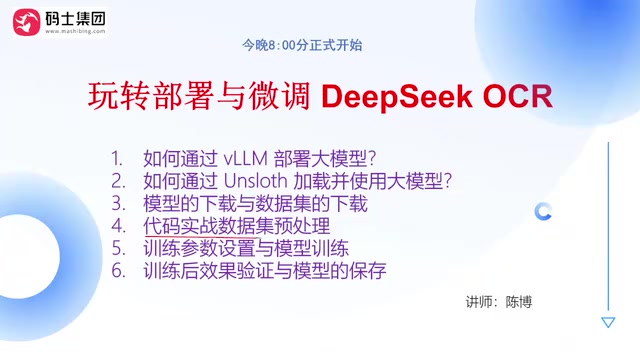
DeepSeek-OCR Deployment: Choosing an Inference Engine and Fine-Tuning Framework
Deploying DeepSeek-OCR with vLLM
When deploying large models, inference performance is often the key factor determining real-world usability. The tutorial uses vLLM as the inference engine to deploy the DeepSeek-OCR model. The core advantage of vLLM lies in its PagedAttention mechanism, which can significantly improve memory utilization and throughput—especially suitable for OCR scenarios requiring high concurrency or long-text processing.
vLLM was open-sourced by a team at UC Berkeley in 2023, and its core innovation, PagedAttention, borrows the idea of virtual memory paging from operating systems. Traditional inference frameworks pre-allocate contiguous memory for each request to store the KV Cache (key-value cache); once the sequence length is uncertain, this causes significant memory fragmentation and waste. PagedAttention splits the KV Cache into fixed-size "blocks" that are allocated on demand and stored non-contiguously—just like how an operating system manages memory pages—bringing memory utilization close to the theoretical limit and boosting throughput several to dozens of times compared to native Hugging Face Transformers inference. In addition, vLLM supports Continuous Batching, dynamically inserting new requests to fill idle compute, which is especially critical in multi-user concurrent OCR service scenarios.
For beginners, the value of understanding vLLM deployment lies in this: it encapsulates the complex aspects that once required manual optimization—such as inference scheduling and memory management—into out-of-the-box capabilities, allowing developers to focus on business logic rather than low-level performance tuning.
Efficient Fine-Tuning with Unsloth
For the choice of fine-tuning framework, the tutorial adopts Unsloth. Unsloth is a fine-tuning acceleration framework that has received wide acclaim in the open-source community in recent years. Through deep optimization of the compute graph and memory, it enables faster training speed and lower memory usage on consumer-grade GPUs.
Unsloth's acceleration does not rely on stacking hardware, but is achieved through low-level techniques such as hand-written Triton kernels, optimized backpropagation compute paths, and reduced unnecessary data copies. Official data shows that Unsloth can boost LoRA fine-tuning speed by about 2x while reducing memory usage by around 70%, all without loss of training accuracy. This means that fine-tuning tasks that originally required A100-class GPUs can now be completed on consumer-grade or entry-level GPUs like the RTX 3090, 4090, or even the T4.
This is particularly important for individual developers and small-to-medium teams—it means you can complete a full LoRA fine-tuning experiment without an expensive multi-GPU cluster, dramatically lowering the barrier to model customization.
Preparation Before Fine-Tuning: Models and Datasets
Where to Download Models and Datasets
The first step of fine-tuning work is preparing the base model and training data. The tutorial emphasizes the issue of download channels for models and datasets—you can typically obtain open-source model weights and public datasets from platforms such as Hugging Face and ModelScope. For users in China, ModelScope often provides more stable download speeds.
Hugging Face is the world's largest open-source model hosting platform, where nearly all mainstream open-source large models make their debut; ModelScope, operated by Alibaba's DAMO Academy, has mirror servers deployed within China, avoiding the instability and speed limits of cross-border networks. Beyond download speed, the two also differ subtly in user experience: Hugging Face's transformers ecosystem is more complete, while ModelScope has done more adaptation for Chinese models and domestic compliance. In actual development, a common trick is to set a mirror endpoint (such as pointing the HF_ENDPOINT environment variable to hf-mirror) to accelerate the retrieval of Hugging Face resources, balancing ecosystem completeness with download efficiency.
Dataset Preprocessing
Data preprocessing is a critical stage that determines the success or failure of fine-tuning, and it's also the part most easily overlooked by beginners. Data for OCR tasks usually contains images and corresponding text annotations. Preprocessing needs to accomplish:
- Format unification: aligning images and annotations into an input format the model can accept
- Data cleaning: removing low-quality or incorrectly annotated samples
- Training set construction: organizing data into the standard structure required by the fine-tuning framework
Data quality directly determines the ceiling of the fine-tuned model. A small, carefully cleaned and annotated dataset often yields better results than a large volume of noisy data.
Hands-On LoRA Fine-Tuning
Why Use LoRA Fine-Tuning
LoRA (Low-Rank Adaptation) is currently the most mainstream parameter-efficient fine-tuning method. It freezes the vast majority of the original model's parameters and trains only a small number of low-rank matrices, thereby achieving domain adaptation at extremely low cost while preserving the model's original capabilities.
LoRA was proposed by Microsoft Research in 2021. Its mathematical core is the low-rank decomposition hypothesis: when a model adapts to a downstream task, the weight update matrix ΔW actually has a very low "intrinsic rank," so it can be approximated by the product of two small matrices A and B (ΔW ≈ BA), where the dimensions of A and B are far smaller than the original weights. During training, the original weights W are frozen, and only A and B are updated, with the parameter count often being just 0.1%–1% of the original model. LoRA is a member of the parameter-efficient fine-tuning (PEFT) family, which also includes methods like Prefix-Tuning, Adapter, P-Tuning, and QLoRA. Among them, QLoRA further combines 4-bit quantization, making it possible to fine-tune tens-of-billions-parameter models on a single 24GB GPU. Understanding the commonality of these methods—freezing the main body and fine-tuning locally—helps developers flexibly choose based on resources and tasks.
Compared to full-parameter fine-tuning, LoRA's advantages are very clear:
- Low memory usage: training can be completed on a single consumer-grade GPU
- Fast training speed: the number of parameters to update is greatly reduced
- Easy deployment: the fine-tuning output is a lightweight adapter that can be flexibly swapped
Training Code and Workflow
Combined with the Unsloth framework, the code implementation for LoRA fine-tuning is relatively concise: load the base model, inject the LoRA adapter, configure training hyperparameters, and start the training loop. The tutorial particularly emphasizes the reproducibility of the training code—from data loading to training monitoring, every step should be clear and traceable.
Result Validation and Model Saving
How to Validate Fine-Tuning Results
After fine-tuning is complete, the most important step is to validate whether the results have genuinely improved. The validation approach proposed in the tutorial is: use the models before and after fine-tuning to perform inference on the same test samples, and compare metrics such as recognition accuracy and error rate. Only when the fine-tuned model shows a measurable improvement on the target scenario can the training be considered truly successful.
This step may seem simple, but it is the only objective standard for judging the value of fine-tuning. Avoiding "feeling good about yourself" and letting the data speak is a basic quality of professional developers.
Saving the Model
After training is complete, saving the model also involves careful consideration. The LoRA adapter can be saved separately for flexible loading, or it can be merged with the base model into complete weights for direct deployment. Which approach to choose depends on the subsequent application scenario and deployment environment.
Extended Vision: RAG + Agent + Vector Database
Beyond the OCR model itself, this technology stack also extends to the integrated application of RAG (Retrieval-Augmented Generation), Agents, and the Milvus vector database. This means OCR is no longer an isolated recognition tool, but can serve as the entry point for an entire intelligent document processing system:
- OCR is responsible for converting image documents into structured text
- The text is vectorized and stored in the Milvus vector database
- The RAG mechanism retrieves relevant document fragments when a user makes a query
- The Agent orchestrates the entire workflow, enabling intelligent Q&A and decision-making
RAG (Retrieval-Augmented Generation) was proposed by Meta in 2020 to address large models' problems of "hallucination" and knowledge timeliness. Its basic workflow is: split external documents and convert them into high-dimensional vectors via an embedding model, storing them in a vector database; when a user asks a question, the question is likewise vectorized, and the most relevant document fragments are retrieved via similarity search to be fed as context to the large model for answer generation. Milvus is a distributed vector database open-sourced by Zilliz, purpose-built for efficient similarity retrieval of massive vectors. It supports multiple indexing algorithms such as HNSW and IVF, and can recall results from billions of vectors within milliseconds. When OCR digitizes paper or image documents and feeds them into the RAG workflow, and an Agent then orchestrates retrieval, reasoning, and tool invocation, it forms the complete closed loop of an enterprise-grade intelligent document system.
This combination of "OCR + RAG + Agent + vector database" represents a typical architecture for current enterprise-grade AI applications. Only by mastering the complete chain—from model deployment and fine-tuning to system integration—can developers truly acquire the ability to turn large models into productivity tools.
Summary
Using DeepSeek-OCR as the vehicle, this tutorial connects the core skills of deploying large models in practice: vLLM deployment, the Unsloth fine-tuning framework, dataset processing, LoRA training, result validation, and model saving, and further extends to the system-level application of RAG and vector databases.
For developers looking to get started with large model fine-tuning, this path provides a complete and actionable reference framework. The real value lies not in memorizing a specific command, but in understanding the technical logic behind each stage—why deploy this way, why fine-tune this way, and how to validate the results. Once you master this methodology, you'll be able to transfer it to the customization of any open-source large model.
Key Takeaways
Related articles

Disaster and Glory of the Apollo Program: The History We Must Revisit Before Returning to the Moon
From the fatal Apollo 1 fire to Apollo 8's daring lunar orbit to Apollo 11's successful landing—revisiting the disasters, fears, and compromises of the Apollo program and their lessons for today's return to the Moon.

Netflix Trust Exercise Turns Into Firing Trap: Where Are the Boundaries of Corporate Trust?
A Netflix employee was fired after sharing private info in a trust exercise. We analyze the risks of corporate trust exercises and how employees can protect themselves.

AMD CDNA5 Architecture Deep Dive: Technical Evolution and the AI Computing Competition Landscape
Deep analysis of AMD's CDNA5 architecture covering Chiplet packaging upgrades, HBM memory evolution, and low-precision compute optimization, examining how AMD challenges NVIDIA's AI chip dominance.