DeepSeek V4 Official Release Imminent: What 1.6 Trillion Parameters Really Means

DeepSeek V4 Pro brings 1.6 trillion parameters, million-char context, and 60-80% faster inference at disruptive pricing.
DeepSeek V4's official release is imminent, with V4 Pro featuring 1.6 trillion parameters and million-character context windows via MoE architecture. The D-SPARK inference framework delivers 60-80% speed gains, while aggressive pricing at 6 RMB per million tokens positions DeepSeek to disrupt the global AI API market with utility-like pay-as-you-go access to top-tier model capabilities.
A Moment the Entire Internet Is Watching
Mid-July — that was DeepSeek's promised release window for V4's official version. As the calendar creeps toward the end of July, many developers still have that "V4 launch" reminder sitting quietly in their phone notes, waiting to be checked off.
The anticipation feels oddly specific — like watching the class valedictorian who declared "I've got this one in the bag" before the exam, only to still be inside the testing room seconds before time runs out. A joke circulating online captures the mood perfectly: users have split into two camps over whether V4 drops today or tomorrow, while in the middle stands "J-pang" (梁文锋's nickname), calmly insisting "mid-July is correct" — it's just that on their calendar, "July has 180 days."
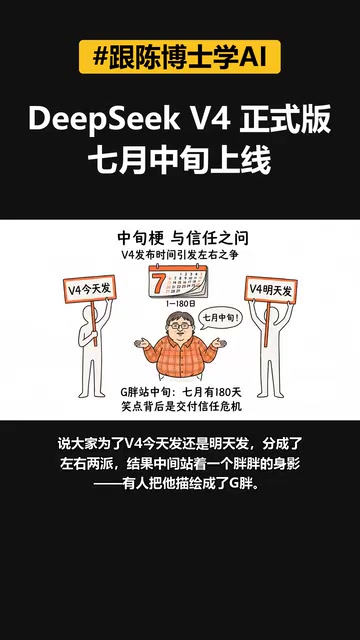
Jokes aside, there's a serious question worth asking: why did the DeepSeek team dare to set such a tight release window? The answer lies in the flurry of technical moves they've made over the past few weeks.
DeepSeek V4 Sprint: Technical Foundations Fully in Place
Looking back at the timeline, DeepSeek has been sprinting at full speed.
- June 27: The team, in collaboration with Peking University, released the DeepSpark (D-SPARK) inference acceleration framework — a technical solution that significantly boosts model response speed. The founder personally co-authored the paper, signaling its importance.
- June 29: V4's official version was announced, with a direct commitment to launch "by mid-July." Simultaneously, they unveiled a distinctive "Fenggu Pricing" (骨气定价, roughly "backbone pricing") mechanism — API prices double during peak hours.
- June 30: More details continued to emerge, fully igniting market excitement.

This cadence reveals that DeepSeek didn't make an impulsive announcement. They began the public countdown only after all core technical reserves were in place. In other words, their confidence stems from engineering certainty, not marketing hype.
1.6 Trillion Parameters: From Chatbot Toy to Production-Grade Tool
The real highlight of DeepSeek V4 lies in its technical leap. According to disclosures, the V4 Pro version features a total parameter count of 1.6 trillion, capable of processing over a million characters of context in a single pass.
What does this number actually mean? To understand the significance of 1.6 trillion parameters, some background is helpful: parameter count is the core metric for measuring neural network complexity. Each parameter is essentially a numerical weight the model learned during training. More parameters theoretically allow the model to capture richer knowledge patterns and linguistic regularities. 1.6 trillion parameters places V4 Pro in the same ultra-large-scale model tier as GPT-4. But here's the key: DeepSeek's MoE (Mixture of Experts) architecture means that while total parameter count is massive, only a subset of expert networks are activated during each inference pass — for example, out of 1.6 trillion total parameters, perhaps only tens of billions are activated per query. This maintains the capability ceiling while keeping actual GPU compute requirements within commercially viable bounds.
This architectural choice marks a fundamental shift in DeepSeek's product positioning — it's no longer just a conversational toy, but aims to enter production workflows, handling complex tasks that require long logical chains.
Ultra-long context capability is particularly critical. Early large language models typically had context windows of only 4K or 8K tokens (roughly 3,000–6,000 Chinese characters), meaning the model couldn't process more than a few pages of content. A million-character context window, however, allows the model to ingest an entire technical manual, tens of thousands of lines of code, or a complete legal contract in one pass. The technical challenge here is that the computational complexity of the Attention mechanism grows quadratically with sequence length. The industry typically needs sparse attention, linear attention, or hierarchical compression techniques to break through this bottleneck. DeepSeek's ability to extend context to the million-character level indicates they've achieved an engineering breakthrough in long-sequence modeling. This enables the model to digest entire codebases, complete technical documentation, or lengthy business processes — precisely the capability enterprise applications value most.
D-SPARK Inference Acceleration Framework: 60–80% Speed Improvement
Equally important as parameter scale is inference efficiency. Inference acceleration is one of the key bottlenecks for deploying large models — after training is complete, the process of generating a response each time a user sends a request is called "inference." Traditional autoregressive generation outputs text token by token, with speed limited by GPU memory bandwidth and computational throughput. For a model of 1.6 trillion parameters, without a dedicated acceleration framework, a single inference could take tens of seconds or longer, completely failing to meet real-time interaction requirements.
The D-SPARK framework employs multiple cutting-edge acceleration techniques, potentially including Speculative Decoding (using a small model to predict the large model's output to reduce computation steps), KV Cache optimization (key-value caching strategies to reduce redundant computation), operator fusion (merging multiple computation steps into single executions), and quantized inference (representing weights with lower-precision numbers to speed up computation). Real-world testing shows that end-user generation speed has improved by 60 to 80 percent.
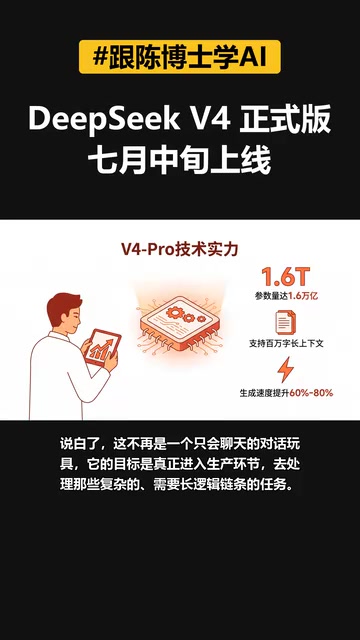
This data sends an important signal: the underlying technical foundation was already proven long ago. A 60–80% speed improvement means user wait times could shrink from several seconds to the 1–2 second range, which is critical for both interactive experience and enterprise-grade batch processing. So what's the team working on in the final stretch before official launch? Most likely the last mile of engineering delivery — polishing API stability (including load balancing, failover, and rate limiting), or clearing the final hurdle of compliance review (domestic AI models in China must pass algorithm registration and other regulatory processes). For a model intended to handle production-grade workloads, these finishing touches are every bit as important as the model itself.
DeepSeek V4 Pricing Strategy: Pay-as-You-Go Like Utilities
For eagerly waiting users, API pricing is perhaps the most practical concern.
DeepSeek recently closed a substantial funding round, then turned around and rolled out its "Fenggu Pricing" strategy: baseline costs are kept extremely low, with inference output at just 6 RMB per million tokens; but during peak hours on weekday mornings and afternoons, prices double to 12 RMB.
To appreciate this pricing's competitiveness, some industry context helps: Tokens are the basic units large language models use to process text, with roughly 1.5–2 Chinese characters per token. For comparison, OpenAI's GPT-4o output pricing is approximately $15 per million tokens (about 109 RMB), and even their cheapest GPT-4o-mini is around $0.6 per million tokens (about 4.4 RMB). DeepSeek offering a 1.6-trillion-parameter top-tier model at 6 RMB per million tokens is globally disruptive.

The signal behind this pricing logic is crystal clear — DeepSeek wants to roll out powerful model capabilities at massive scale using a "pay-as-you-go like utilities" approach. Peak-hour premiums and off-peak discounts are essentially price levers to guide users toward off-peak usage, balancing compute resources and optimizing overall commercialization efficiency. This dynamic pricing model has long precedent in cloud computing (such as AWS spot instances), but remains innovative in the large model API space. The core logic: attract massive developer adoption through ultra-low unit prices, amortize compute costs through scale effects, and achieve dynamic revenue balance through peak-hour premium mechanisms.
From this perspective, delaying a day or two in exchange for a more stable commercial interface is actually a smart trade-off.
DeepSeek V4 Is Worth the Wait
So stop fixating on "is it today or tomorrow." Using the joke's logic, their definition of "mid-month" might not quite match the standard calendar, but we shouldn't doubt DeepSeek's ability to deliver — the goods are already on the way.
For developers waiting on V4, this update carries enough weight to warrant a day or two of flexibility. Perhaps the next time you put down your phone and pick it up again, that blue new-version entry point will have quietly appeared. Fellow coders, let the servers catch one last breath — the show is about to begin.
Related articles

Deep Dive into the EYG Programming Language: A New Portable Programming Paradigm Designed for Humans
Deep analysis of the EYG programming language's core design, including algebraic effects, program state persistence, and cross-platform portability, exploring how it addresses modern software fragmentation.

What Happens After You Click a Link? A Complete Technical Breakdown
From DNS resolution, TCP handshake, and TLS encryption to the Blink rendering engine — a detailed breakdown of what happens after you click a link.

Deep Dive into AI Short Drama "Nido de Villanas": How AIGC Mass-Produces Binge-Worthy Content
Using AI-generated Spanish short drama Nido de Villanas as a case study to analyze AIGC script generation, character consistency, multilingual dubbing, and the commercial logic of scaled AI drama production.